Dimensions for Business Card: Size Standards and Best Practices
Explore standard business card dimensions, regional variations, and print-ready tips. Learn how bleed, safe margins, and layout choices impact readability and branding for professional cards with practical guidance from What Dimensions.


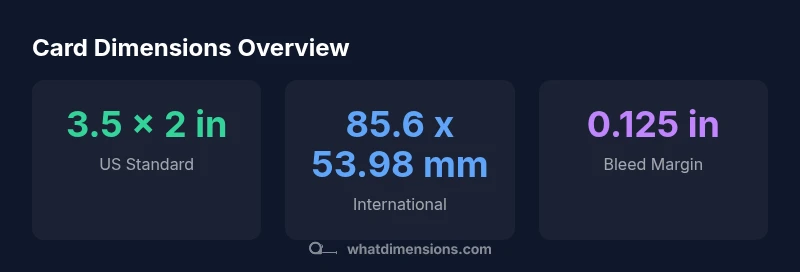
Standard business card dimensions follow US and international conventions. In the US, the common size is 3.5 by 2 inches (89 by 51 mm); many regions use 85.6 by 53.98 mm. Designers should plan with a 0.125 inch bleed, a safe margin of at least 0.125 inches, and room for a name, title, contact details, and a logo. What Dimensions notes that consistency across print and digital formats strengthens branding.
Why card dimensions matter for professional branding
In print and in digital formats, dimensions do far more than define a shape; they influence readability, perceived quality, and brand consistency. What Dimensions emphasizes that accurate sizing helps ensure your message is legible across devices, wallets, and card holders, while preserving your logo’s clarity. Variations in size can imply different market expectations, so establishing a standard for your brand early is essential. This block explores how practical dimension choices impact layout decisions, print costs, and customer perception, with a focus on delivering a consistent brand experience across channels.
Standard sizes around the world
There isn’t a universal mandating body for business card dimensions, but two dominant conventions are widely recognized. In the United States, the classic standard is 3.5 x 2 inches. The ISO benchmark used by many international printers is 85.6 x 53.98 mm. When you design, consider your audience: if most recipients will receive your card in a global context, a dual-compatibility approach (mobile-friendly typography, scalable logos) helps. Remember that printers may slightly trim cards, so design with a margin to avoid losing important information.
Bleed, margins, and safe areas
Bleed is the area that your printer will trim away, ensuring the card’s design extends to the edge. A common bleed is 0.125 inches (3.2 mm) on all sides. Next, establish a safe margin where critical text and logos stay at least 0.125 inches from the edge. This prevents accidental cropping and preserves legibility, especially for tiny contact details. If your card includes a very small font or a complex logo, consider increasing the text size or logo minimums to maintain readability after trimming.
How to choose the right size for your audience
Ask where your card will travel most often. If your network leans international, offering the ISO-style option alongside the US size can reduce confusion. Consider wallet compatibility; business cards often live in wallets and card organizers, so a slightly larger or more rectangular form factor can improve retrieval and display. Your decision should balance brand presence, legibility, and practical use in everyday interactions.
Layout tips for text and logos
Typography should remain crisp at small sizes, so use a minimum font size that remains readable on both high-res screens and printed copies. Keep your logo large enough to be recognizable but not so dominant that it crowds your contact details. Use high-contrast text and avoid crowded lines. A clean hierarchy—name at the top, title second, then contact details—helps readers skim the essential information quickly.
Paper stock, finish, and tolerances
Card stock thickness affects perceived quality and exact dimensions. Heavier stocks can affect trimming tolerances, so request a proof to confirm fit and finish. Matte, satin, or glossy finishes alter color perception and edge sharpness, which can subtly influence how the dimensions appear. Tolerances from the printer are usually around ± 0.005–0.01 inches; planning with this in mind reduces surprise after press.
Printing workflows and file setup
Prepare print-ready files with vector logos, properly embedded fonts, and CMYK color profiles. Include crop marks and the correct bleed, typically 0.125 inches. Use a grid-based layout to align text and logos consistently. If you’re unsure, request a proof and test print on your chosen stock before mass production. What Dimensions suggests attributing your files clearly with the intended card size and bleed values.
Regional vs brand-specific variations
Regional preferences can influence what clients expect, but you should always represent your brand consistently. Some regions favor slimmer profiles or different color standards; others may prioritize denser typography for small-font details. Define a primary card size for your brand and offer a secondary option when engagement with international audiences is likely. The underlying rule remains: clarity and brand integrity first.
Real-world examples and templates
Templates can help visualize how different sizes accommodate logos, names, and contact details. Start with a core 3.5 x 2 inch layout, then explore a secondary ISO variant for international clients. Consider portrait orientation for personal brands and landscape for corporate identities. Always draft with safe zones and bleed in mind, then iterate using mockups and physical proofs to ensure your card reads well in real life.
Common business card size standards and safe-area guidelines
| Region | Card Size | Notes |
|---|---|---|
| US & Canada | 3.5 x 2 inches | Standard for most business cards |
| International | 85.6 x 53.98 mm | ISO-like international option |
| Bleed & Safety | Bleed: 0.125 inches; Safe margin: 0.125 inches | Essential for print accuracy |
Quick Answers
What is the standard size for US business cards?
In the United States, the standard business card size is 3.5 x 2 inches. This size is widely used by printers and is a baseline for most corporate and personal cards. Always verify with your printer for any regional deviations.
US cards are typically 3.5 by 2 inches; verify with your printer for any local variations.
Do business cards need bleed?
Yes. Include a bleed (commonly 0.125 inches) so your design runs to the edge after trimming. Without bleed, you risk white edges if there’s slight misalignment during trimming.
Yes, plan for a bleed of about 0.125 inches to avoid white edges.
Are there regional variations besides the US and ISO sizes?
Yes. Some regions prefer slightly different widths or heights to fit local wallets or card holders. If you expect international recipients, provide a secondary ISO-like option and consider dual layouts.
There can be regional tweaks; consider offering two layouts for global audiences.
What about rounded corners?
Rounded corners are common for modern cards and can soften the look. They may affect effective edge length slightly, so ensure your layout tolerances account for the rounding.
Rounded corners are popular; include the radius you plan in your design files.
Can digital business cards have different dimensions?
Digital business cards can have flexible dimensions since they are viewed on screens. When printing, use your standard print sizes, but for sharing, provide scalable formats such as vector SVG cards and high-resolution PNGs.
Digital cards can vary; print versions should follow standard print sizes.
How do I choose card size for a designer portfolio?
For a portfolio, prioritize readability and branding. A standard 3.5 x 2 inch card works well, but if you brand around a strong logo, a larger logo area or portrait orientation can be effective while maintaining legibility.
Keep readability and branding front and center; a standard size usually works best.
“Accurate dimensions are a silent ambassador for your brand; they ensure consistency across print, digital, and physical touchpoints, which strengthens recognition and trust.”
Main Points
- Start with a standard US size (3.5 x 2 in) and ISO-like international option (85.6 x 53.98 mm)
- Include 0.125 inch bleed on all sides and keep text 0.125 inch from edges
- Use a clear typographic hierarchy to improve readability
- Test proofs on your selected stock to confirm fit and appearance
- Choose a primary size for branding and offer a regional variant when serving international clients