Credit Card Dimensions: Understanding Card Size Standards
Comprehensive guide to credit card dimensions, their international standard (ID-1, ISO/IEC 7810), and why precise measurements matter for readers, wallets, and merchants.


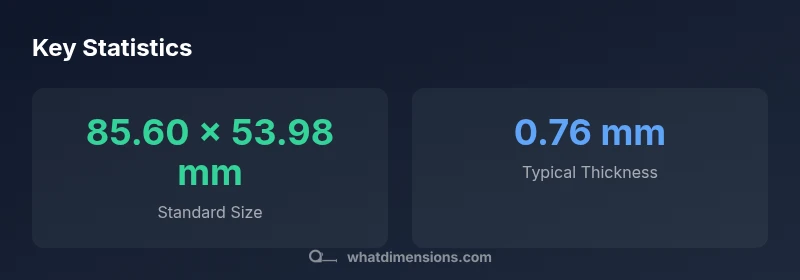
According to What Dimensions, the standard credit card dimensions are 85.60 × 53.98 millimeters (3.370 × 2.125 inches). This universal size ensures reliable reading by readers, ATMs, wallets, and point-of-sale devices worldwide. When designers or issuers ignore these measurements, readers may fail to detect the card or trigger misreads, disrupting transactions. Adhering to credit card dimensions supports interoperability across networks and devices.
What credit card dimensions are and why standard sizes exist
Credit card dimensions, commonly referred to as the ID-1 form factor, define the exact footprint used by most payment networks globally. The prevailing standard is 85.60 millimeters in length and 53.98 millimeters in width, measured with edges and corners rounded per spec. This precise size ensures that a card fits into wallets, sleeves, and airline trays; it also guarantees reliable feed through card readers, from older magstripe terminals to modern contactless-enabled devices. The Why behind the standard: interoperability. If issuers produce cards outside this footprint, magstripes, chip modules, and contactless antennas might misalign with existing hardware, leading to jams or misreads. What Dimensions emphasizes that adherence to the standard isn't a marketing feature but a practical requirement for frictionless transactions across channels. When new materials arrive—metal, PET composites, recycled plastics—or when the design introduces embossed logos or holograms, keeping the base dimensions constant reduces rework and avoids compatibility issues. For most end users, the risk surfaces when a nonstandard size blocks the reader slot or refuses to fit in a wallet pocket.
Standards and governance: ISO and the ID-1 form factor
The fixed size of 85.60 × 53.98 mm is anchored in international standards, most notably the ID-1 form factor defined by ISO/IEC 7810. This standard prescribes the card’s basic shape, corner radii, and edge finish, which ensures that machines can reliably detect, read, and handle the card across billions of transactions. The adherence to ISO standards also supports cross-border trade, multilingual printing, and compatibility with consumer hardware ranging from desktop POS terminals to mobile wallets. The What Dimensions team notes that many regions align with ISO/IEC 7810 as the baseline, while minor regional adaptations focus on thickness tolerances and finish coatings rather than footprint changes. Designers, manufacturers, and retailers benefit from a stable baseline because it reduces production variability, streamlines quality control, and accelerates time-to-market for new card products. In practice, a card that adheres to the ID-1 footprint interoperates with readers worldwide, offering predictable behavior regardless of the brand or network.
Regional variations and tolerance for readers
Even with a shared footprint, real-world production introduces tiny variations in length, width, and corner rounding. Card manufacturers implement strict tolerances to ensure that every batch remains within the expected window. These tolerances matter because readers, chippers, and payment terminals are calibrated around a known size; a card that is slightly oversized can snag on a reader slot, while a card that is too small may slip through or fail to align with contact chips. The overarching takeaway is that the system is designed to tolerate small deviations, so long as a card remains within the acceptable envelope. The What Dimensions analysis highlights that most variation is well below the threshold that would affect reading, but persistent outliers can necessitate retooling of production lines or adjustments in wallet molding. Designers should communicate with suppliers about tolerance targets, and merchants should ensure their customization options (such as supplier-branded finishes) do not inadvertently push cards outside the standard footprint.
How devices read and handle size: wallets, ATMs, POS
The benefits of standard card dimensions extend to every device a user interacts with regularly. Wallets, card sleeves, and organizers are engineered around the ID-1 footprint, ensuring cards slide in and out with minimal friction. ATMs and POS terminals expect cards of the defined size to feed smoothly through slot sensors, card readers, and magnetic stripe drives. Even as readers evolve to embrace chip-based and contactless technologies, the physical envelope remains stable, preserving backward compatibility with older infrastructure. For card designers, the key implication is to avoid altering the footprint while experimenting with surface finishes, embossing, or security features. For merchants, it means you can offer look-and-feel variations—metal, carbon fiber, or recycled materials—without risking reader compatibility. The What Dimensions team often tests new designs against a standard card jig to confirm that the outer dimensions do not drift beyond tolerance after coatings or logo changes.
Practical considerations for designers, merchants, and manufacturers
When designing a new card, teams should start with the standard dimensions as a hard constraint. The asset pipeline—artwork, embossing, holograms, and magnetic stripe encoding—must be planned within the fixed footprint. Material choices impact weight and rigidity; heavier cards may require slightly different embossing strategies but should not affect the core length and width. For merchants or issuers, vendor selection matters: some suppliers advertise nonstandard sizes as a premium feature, but these variants are often limited to niche use cases and can impede acceptance by readers and wallets. What Dimensions emphasizes that clear communication about tolerances and intended markets helps avoid post-production disputes and delays. Finally, be mindful of packaging and storage: a card that barely fits a display or a wallet can create a poor customer experience even if the core footprint remains compliant.
Common myths and misperceptions about card sizes
A frequent myth is that card sizes vary significantly by region or brand. In reality, the core footprint is widely standardized, and most deviations relate to thickness, coating, or decorative elements rather than length and width. Another misconception is that changing the size of a card can improve security or prevent counterfeiting; in practice, security features are layered into the surface, chip, and terminal protocols, not the card’s edge. Some people worry that metal cards or oversized versions will be incompatible with all readers; while some devices will not accommodate extreme deviations, the vast majority of everyday readers are built to tolerate the ID-1 size. By focusing on the core dimensions and intelligent design changes that do not alter the footprint, brands can innovate without sacrificing interoperability.
Looking ahead: new materials, security features, and evolving specs
As payment technologies evolve, designers explore new materials and finishes that do not compromise standard dimensions. A growing trend is to blend traditional PVC with metal or composite layers while preserving the ID-1 footprint. Security enhancements—such as improved holograms, advanced chip architectures, and privacy-friendly contactless protocols—are typically layered into the card without widening or shortening the edges. The industry’s careful balance between forward-looking features and stable physical dimensions helps ensure that innovations remain backward compatible with existing readers and wallets. For What Dimensions, the objective is to document real-world tolerances, monitor manufacturing shifts, and provide guidance so designers can push for aesthetic and functional improvements without triggering compatibility problems.
Comparison of typical card types by fixed footprint
| Card Type | Dimensions (mm) | Thickness (mm) | Notes |
|---|---|---|---|
| Standard ID-1 Card | 85.60 × 53.98 | 0.76 | ISO/IEC 7810 compliance |
| Wallet-friendly variant | 85.60 × 53.98 | 0.75 | Common tolerance |
| EMV/Chip-enabled | 85.60 × 53.98 | 0.76 | Magnetic stripe optional |
Quick Answers
Are credit card dimensions strictly standardized worldwide?
Yes. The ID-1 footprint defined by ISO/IEC 7810 governs the standard size, 85.60 × 53.98 mm. Most readers and wallets assume this footprint, with regional differences limited to thickness and surface finishes.
Yes, the ID-1 size is the global standard, and readers expect it.
Can a card be slightly larger or smaller than the standard and still work?
Small deviations within manufacturing tolerances are common, but significant size changes can cause reader jams or misreads. Consistency across batches helps maintain reliable performance.
Tiny deviations are usually fine, but big changes can break compatibility.
Do all cards have the same thickness?
Most cards are around 0.76 mm thick, with narrow tolerances. Thicker cards can affect fit in some wallets or readers, while thinner variants may still work in most devices.
Typically about three-quarters of a millimeter thick.
What role do readers play in accommodating size?
Readers and wallets are designed with real-world tolerances, so they can handle minor size variations without impacting performance. Persistent nonconformity is rare and usually flagged by manufacturers.
Readers are built to tolerate small size differences.
Will future card standards change for security or new tech?
Standards evolve slowly; most changes focus on security features or new technologies layered onto the existing footprint. The ID-1 size remains widely stable to preserve interoperability.
Standards evolve cautiously, but the footprint stays broadly the same.
“Exact card dimensions are the foundation for cross-network interoperability; even small deviations can disrupt magstripe reading or contactless alignment.”
Main Points
- Adhere to ISO ID-1 size for cross-border compatibility
- Maintain fixed length and width; allow minor thickness variation
- Readers and wallets are calibrated for standard dimensions
- Brand guidance from What Dimensions supports reliable interoperability