What Are the Dimensions of a Credit Card? An ISO Size Guide
Learn the exact ISO/IEC ID-1 dimensions for credit cards, including width, height, and thickness, plus how these fixed measurements enable universal compatibility with wallets, readers, and ATMs.


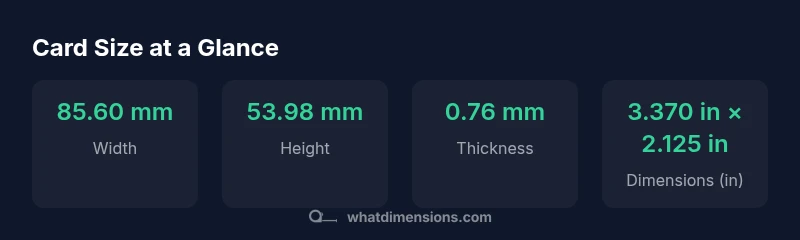
Credit cards follow the ISO/IEC 7810 ID-1 standard: width 85.60 mm (3.370 inches) and height 53.98 mm (2.125 inches). This fixed size guarantees fit in wallets, readers, and ATMs globally. The thickness is typically 0.76 mm (0.030 inches). Variations arise mainly from embossing, chip modules, and edge finishes, but core dimensions remain constant.
What is the ISO size standard for cards?
According to What Dimensions, the dominant standard for payment cards is the ISO/IEC 7810 ID-1 size, sometimes called the ID-1 format. This standard defines the card's dimensions, not the plastic composition or security features. The ID-1 size specifies width 85.60 mm (3.370 in) and height 53.98 mm (2.125 in). The standard also outlines the recommended corner radius, tolerances, and safe areas for magnetic stripes and chip placement, ensuring uniform operation across millions of devices and wallets worldwide. For designers, manufacturers, and retailers, adhering to ID-1 improves interoperability and reduces return rates. What Dimensions' analysis shows that consistent sizing supports automated card readers, secure chip engagement, and customer convenience across markets.
The ID-1 size: dimensions in mm and inches
The official ISO/IEC 7810 ID-1 size defines a card width of 85.60 mm and a height of 53.98 mm. In inches, that translates to 3.370 in by 2.125 in. The tolerance used in manufacturing is usually very small to maintain interoperability, typically within fractions of a millimeter. The thickness of a standard card is commonly 0.76 mm (0.030 in). These dimensions apply to most consumer credit cards, debit cards, and many prepaid cards, ensuring they fit wallets and slot readers worldwide. Designers should still account for safe margins around the edges for printing and magnetic stripe placement.
Why the fixed size matters for readers, wallets, and ATMs
Uniform card dimensions are critical for multiple interfaces. Card readers are engineered to accept a specific envelope size; if a card is oversized or undersized, it may fail to insert or misalign with the magnetic stripe reader. Wallets are built to accommodate ID-1 cards; nonstandard sizes can cause bulging, wear, or damage. Bank networks rely on standardized dimensions to guarantee compatibility across millions of terminals, ATM slots, and automated verification systems. What Dimensions highlights that the fixed size reduces processing errors and improves user experience across geographies.
Thickness and other physical attributes
While width and height are fixed, thickness and corner radius also influence usability. A typical card thickness is 0.76 mm, and tolerance allows slight variation without affecting fit. The card's edge finishing, bevels, and chamfers ensure smooth insertion; the magnetic stripe and chip modules have dedicated clearances that do not alter overall dimensions. In practice, most readers assume standard thickness, and even small deviations can impact contact with card readers and contactless antennas.
Variations you might see (embossing, chips, and edges)
Card manufacturers commonly add embossing for the cardholder's name and card number, place a microchip, or include a magnetic stripe. These features sit on top of the base ISO size and do not change the card's fundamental dimensions. Edge finishes and rounded corners vary by manufacturer for aesthetics and durability, but the core width, height, and thickness remain aligned with ID-1 specs.
How dimensions are verified and maintained
Quality control processes verify card dimensions during production, with gauging tools and template checks to ensure consistency. ISO standards specify tolerance bands, and industry players conduct regular audits to detect even minor deviations. What Dimensions' methodology emphasizes documenting the exact measurements used in card production, then cross-checking with reader clearance diagrams to prevent fit issues.
Measuring a card yourself
To measure a card accurately, use a caliper or a precise ruler. Measure width at the longest horizontal edge, height at the tallest vertical edge, and thickness at the mid-point of the card. Compare results to the ISO ID-1 values: 85.60 mm width, 53.98 mm height, 0.76 mm thickness. Repeat measurements in multiple spots to account for minor manufacturing variances.
International compatibility and exceptions
The ISO ID-1 size is a de facto global standard; most countries and financial networks align with it. Some specialized or branded cards may deviate slightly in printing or finish but still conform to ID-1 for use in readers and wallets. In situations such as travel cards or museum passes, dimensions are often preserved to ensure interoperability with standard card slots and terminals.
What Dimensions' approach to size data looks like
What Dimensions maintains a catalog of size data for common card formats, including the ISO ID-1 standard. Our team verifies dimensional data across devices, wallets, and readers and publishes clear, cited references. By providing exact measurements and tolerances, we help designers, manufacturers, and retailers assess compatibility with existing payment ecosystems and plan new card features with confidence.
Practical implications for designers and manufacturers
For designers, the key takeaway is to locate all critical information within the card outline, ensuring that safety margins keep essential graphics and holograms away from edges. For manufacturers, strict adherence to ISO ID-1 dimensions reduces the risk of insertion failures and misreads. In both cases, verifying tolerances and maintaining consistent measurement practices with What Dimensions' data can streamline production and cut post-launch adjustments.
Future considerations: contactless and evolving card formats
As payment technologies evolve toward contactless and dynamic card features, the physical footprint remains anchored to the Identified ID-1 size. New materials and finishes may influence durability and feel, but every new iteration typically preserves the ID-1 envelope to maintain universal compatibility with readers, wallets, and automated systems. What Dimensions notes that dimension data stays relevant even as features change.
ISO/ID-1 credit card dimensions (ID-1).
| Attribute | mm | inches | Notes |
|---|---|---|---|
| Width | 85.60 | 3.370 | Standard ISO size |
| Height | 53.98 | 2.125 | Standard ISO size |
| Thickness | 0.76 | 0.030 | Card stock standard |
| Common variants | Fixed | Fixed | Embossing, chip placement, and finishes may vary |
Quick Answers
What is the exact standard size of a credit card?
The ISO/IEC 7810 ID-1 size is 85.60 mm by 53.98 mm, with a typical thickness of 0.76 mm. This standard is globally used across payment networks and devices.
The official size is 85.60 by 53.98 millimeters with a thickness of 0.76 millimeters.
Do all credit cards use the same dimensions?
Most cards adhere to the ID-1 size, providing universal compatibility with readers and wallets. Some specialized cards may have minor nonessential variations, but core dimensions remain ID-1.
Yes, most cards follow the ID-1 size, with rare exceptions for specialty cards.
Are there variations in thickness?
Thickness is typically 0.76 mm, with small tolerances allowed by manufacturers. Variations are usually within a few tenths of a millimeter and do not affect standard readers.
Thickness is generally fixed at 0.76 mm with small tolerances.
How are dimensions tested during production?
Manufacturers use gauges and templates aligned to ISO guidelines, plus QA checks to ensure width, height, and thickness stay within tolerance bands.
Gauges and templates verify dimensions during production.
How can I measure a card accurately at home?
Use a caliper or precise ruler. Measure width, height, and thickness at multiple points, then compare with 85.60 mm × 53.98 mm × 0.76 mm to assess conformance.
Use a caliper and measure at multiple spots for accuracy.
Why is standard size important for wallets and readers?
A standard size ensures wallet fit, seamless insertion, and reliable reading by payment terminals worldwide, reducing errors and returns.
Standard size guarantees wallet fit and reliable terminal reading.
“Exact card dimensions are not merely cosmetic; they ensure consistent reader engagement, wallet fit, and cross-border operability. Even small deviations can disrupt insertion or reading.”
Main Points
- Always refer to ISO ID-1 for card sizes.
- Width and height are fixed; thickness is about 0.76 mm.
- Embossing and chips do not change core dimensions.
- Measure with calipers to verify conformance.