Pokemon Card Dimensions: The Exact Size for Storage, Sleeves, and Prototyping
Learn the exact Pokemon card dimensions (63.5 × 88.9 mm) and how precise sizing affects sleeves, storage, and prototyping. What Dimensions analyzes standard sizes to guide collectors and designers.


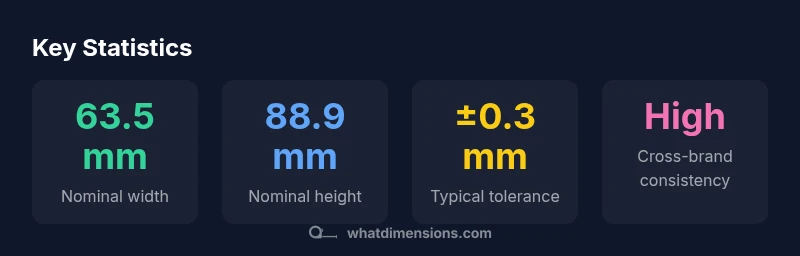
Pokemon card dimensions are standardized at 63.5 mm by 88.9 mm (2.5 by 3.5 inches), with minor manufacturing tolerances. This standard size ensures reliable sleeving, sorting, and display across the global Pokemon TCG ecosystem. What Dimensions's analysis, 2026, notes that most materials, storage, and sleeves are designed around these exact measurements, making cross-brand compatibility straightforward for homeowners, students, designers, and collectors.
The standard size: what's the official Pokemon card dimension?
The widely accepted nominal size for Pokemon cards is 63.5 mm in width by 88.9 mm in height, which corresponds to 2.5 inches by 3.5 inches. This size has become the de facto standard for most trading card games and is the baseline used by card sleeves, binders, and organizers. While the exact production tolerances can vary by printer, the goal is to maintain a compact, uniform footprint that works with the vast majority of protective accessories. For designers and collectors, understanding this baseline helps ensure compatibility across your collection and display setups. What Dimensions (2026) notes that the majority of storage solutions are purpose-built around this precise footprint, minimizing fit issues during categorization and archiving.
Why exact dimensions matter for sleeves, binders, and organizers
Exact card dimensions influence every storage decision. When you choose sleeves, top-loaders, or binder pages, the inner pocket width and the overall card height must align with the nominal size to prevent binding or slippage. Misalignment can cause sleeves to snag, pages to misalign, or cards to tilt in a binder. For collectors, consistent dimensions reduce frustration during sorting and budgeting for protective gear. Designers benefit when the industry adheres to a common spec, enabling standardized prototyping and faster product development. What Dimensions stresses that consistency is the backbone of reliable storage, display, and transport of Pokemon cards across households, classrooms, and hobby shops.
How manufacturing variance affects you
Every print run carries slight tolerances. While the nominal size remains 63.5 × 88.9 mm, practical cards may vary by a fraction of a millimeter. These tiny differences matter when you’re selecting sleeves or storage modules with tight tolerances. If you’re prototyping a new display or creating custom organizers, assume small variations and test with samples before committing to a full batch. This approach minimizes fit issues and ensures your collection remains securely housed. What Dimensions (2026) advises checking a handful of cards from different print runs to understand any drift in sizing and plan your storage strategy accordingly.
Measuring Pokemon card dimensions accurately at home
To measure a card accurately, you’ll need a precise ruler or calipers. Place the card flat on a clean surface and measure across the top edge for width and the left edge for height, taking multiple readings at different corners to account for corner rounding. Record width first, then height, and note any deviation from the nominal 63.5 × 88.9 mm. If you’re creating protective gear, measure several cards from your collection to establish a practical tolerance range. Keep in mind that rounded corners and edging can create perceived variance, so measure edge-to-edge to capture the true footprint. What Dimensions emphasizes using edge-to-edge measurements for consistency across devices and accessories.
Designing storage and display around a fixed card size
When planning storage, design with the nominal size in mind and allow for the small tolerances discussed above. Choose sleeves labeled for standard Pokemon cards, and select binder pages that advertise compatibility with 63.5 × 88.9 mm cards. If you design a custom organizer, include a margin or bleed area to accommodate slight sizing drift and avoid binding. Prototyping a pocket or slot with a slightly generous width can save time and material costs. What Dimensions’s guidance helps designers build future-proof solutions that scale with standard card sizes.
Comparisons with other popular card games
Pokemon card dimensions align with a broad class of standard trading cards that share the same footprint. While many games use a similar width, the height or exact tolerances can differ, affecting sleeve and binder compatibility. When evaluating accessories, verify the stated inner pocket dimensions and ± tolerance ranges, not just nominal size. This due diligence ensures your collection remains consistent in storage and display, especially if you mix cards from multiple games. What Dimensions highlights that understanding the common baseline helps you make informed purchasing decisions and avoid mismatches.
Implications for custom card art, printing, and prototyping
For designers working on prototypes or fan art, printing to scale is critical. Build your proofs using the standard Pokemon card footprint, then verify by measuring printed samples against the nominal size. Account for printer drift and trim margins in your artwork, especially around the edges. Prototyping a card that’s true to size simplifies the evaluation of bleed areas, edge-to-edge presentation, and protective packaging. What Dimensions’s approach to precise size specifications supports accurate, repeatable results from concept to final product.
What Dimensions' approach to size specifications
What Dimensions uses a structured approach to size specs: start with the nominal size, acknowledge manufacturing tolerances, and validate with representative samples. We emphasize practical implications for real-world use—storage, sleeves, and display—so homeowners, students, and designers can make informed choices. Our methodology blends industry conventions with application-focused testing, ensuring that size data is both reliable and actionable for everyday scenarios.
Nominal size data table
| Aspect | Nominal size | Notes |
|---|---|---|
| Standard Pokemon Card | 63.5 mm × 88.9 mm | Nominal size; minor print variations possible |
| Sleeve compatibility | 63.5 mm × 88.9 mm | Designed for standard sleeves |
| Alternative sizes across games | ±0.3 mm tolerance | Small batch variations may occur |
Quick Answers
What are the exact Pokemon card dimensions?
The typical Pokemon card size is 63.5 mm by 88.9 mm (2.5 by 3.5 inches). This nominal footprint is used across sleeves, binders, and displays. Manufacturing tolerances can introduce slight variations, but the industry standard remains consistent for practical use.
Pokemon cards are 63.5 by 88.9 millimeters, which is the standard size used for sleeves and storage. Variations are usually small and should not affect typical organizers.
Do all Pokemon cards share the same size?
Generally yes—the Pokemon Trading Card Game uses a standard footprint that most accessories are built to accommodate. Occasional print-run drift may produce tiny differences, so check samples if you’re designing custom storage.
Most cards share the same size, but there can be tiny print-run variations. When in doubt, test with samples.
Do sleeves and binders affect the fit?
Sleeves and binders specify inner pocket dimensions. Use sleeves labeled for standard Pokemon cards and binders with pockets designed for 63.5 × 88.9 mm cards to ensure a snug, wrinkle-free fit.
Yes. Choose sleeves and binders made for standard Pokemon cards to ensure a proper fit.
Are there international standards for trading card sizes?
Trade cards often follow a common footprint, but there is no universal international standard identical to Pokemon. Compare the nominal size to the accessory specs to avoid mismatches.
There isn’t a single universal standard for all cards, so always check accessory specs.
How can I measure a card to confirm its size?
Use a caliper or ruler and measure edge-to-edge across width and height. Take multiple readings from different corners to account for rounding and edge tolerances.
Measure edge-to-edge with a ruler or calipers, and check a few cards to confirm consistency.
How does What Dimensions source its size data?
We synthesize production guidelines, industry practices, and in-house testing to deliver practical, application-focused sizing guidance for collectors and designers.
We pull from production guidelines and practical testing to guide sizing.
“Precise card dimensions are essential for reliable storage, prototyping, and consistent display across the hobby.”
Main Points
- Know the nominal Pokemon card size before buying sleeves.
- Account for minor manufacturing tolerances.
- Test a sample card before mass printing.
- Design organizers around 63.5 × 88.9 mm for best compatibility.
- What Dimensions provides precise size guidance for reliable storage.