What are the Dimensions of a Pokémon Card? A Precise Size Guide
Discover the exact dimensions of a Pokémon card (63.5 × 88.9 mm / 2.5 × 3.5 inches). Learn how size affects sleeves, storage, and display for collectors and retailers.


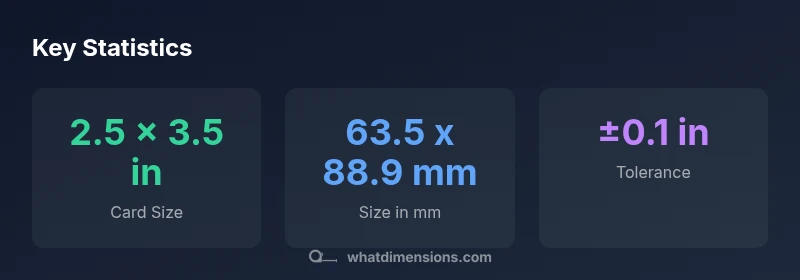
Pokémon cards follow a standard size of 2.5 inches by 3.5 inches (63.5 mm by 88.9 mm). This uniform dimension ensures compatibility with most sleeves, cases, and binders used by collectors worldwide. While individual sets may introduce tiny tolerances during printing, official guidance and common practice keep cards within a tight tolerance to maintain consistency.
Why card dimensions matter for collectors
For collectors, the exact dimensions of a Pokémon card are not just numbers; they influence sleeve choice, storage, and display aesthetics. According to What Dimensions, precise size references underpin reliable inventory and cross-collection compatibility. When you ask what are the dimensions of a pokemon card, the answer is a consistent rectangle: 2.5 inches wide by 3.5 inches tall (63.5 mm by 88.9 mm). This uniformity has roots in the broader card- and print industries, where standardization reduces variation across factories and regions. As sizes were settled, sleeves and binders could be designed once and reused globally. The result is a hobby that travels well: a binder here in Tokyo, a sleeve rack in Toronto, many years apart, all fitting the same size. The challenge for modern collectors is accounting for tiny tolerances introduced during printing and cutting, which can affect fit in tight spaces but rarely alter the overall footprint.
The standard size in practice: inches and millimeters
The canonical Pokémon card size is 2.5 × 3.5 inches, which translates to 63.5 × 88.9 millimeters. This dual representation helps buyers and graders compare cards across markets that use either metric or imperial measurement. In practice, the centimeters are rounded to one decimal place (6.4 cm × 8.9 cm). Manufacturers aim to keep tolerance bands tight; typical real-world variation is subtle, only noticeable under high-precision tools. For card holders, sleeves, and binders, this means you can count on a consistent footprint for most cards, regardless of edition or language. If you’re assembling a display, you can plan grids and frames around the standard dimension with confidence. For designers replicating or simulating card assets, the canonical size also serves as a common baseline to maintain proportionality when rendering mockups.
Printing tolerances and regional variations
Even with a standard footprint, printing tolerances exist. The width and height may deviate slightly due to tooling differences, trimming imperfections, or edge finishing. What Dimensions analysis notes that most cards stay within a small margin around the nominal size, often within ±0.1 inch (±2 millimeters). In some regions or production runs, you might encounter a card that feels a touch wider or taller, but the effect is usually imperceptible in ordinary sleeves. For graders and retailers, this is why you measure a card rather than assuming the exact dimension from the label. If you’re organizing a bulk collection, you’ll appreciate that the tolerance remains narrow enough to keep the pile visually uniform, even if a handful of cards test the edges of a sleeve or binder. The conclusion is practical: size matters, but small deviations rarely compromise overall compatibility.
How to measure a Pokémon card accurately
Accurate measurement is a skill every serious collector should cultivate. Start with a caliper or a precise ruler. Place the card on a flat surface, align the corners, and measure the width first, then the height. For quick checks, you can use a transparent ruler with metric and imperial scales. Record measurements from multiple samples if you’re assessing a batch. Compare your readings to the standard 63.5 mm by 88.9 mm footprint, noting any deviations beyond ±2 mm. When you’re shopping, carry a small measurement tool in your wallet so you can verify dimensions on the spot. Finally, remember that a card’s condition grade also depends on surface features and edge wear; maintain both accuracy and care for a complete assessment.
Sleeve and binder compatibility for collectors
Choosing the right protective accessories starts with card dimensions. Most standard card sleeves and two-pocket boxes assume the classic 2.5 × 3.5 in size, so compatibility is high across brands. If you’re upgrading from a mixed-size storage strategy, you’ll want to switch to sleeves labeled as compatible with standard trading cards. Binders and pages typically market pockets sized for a 63.5 × 88.9 mm footprint; however, always verify the pocket dimensions for edge clearance, especially for older print runs or special promos. Testing a sample card in your chosen sleeve before committing to a bulk purchase can save time and money. The goal is to protect the card’s corners and surface while preserving a uniform display grid.
Practical implications for designers, retailers, and graders
From packaging to cataloging, standard card size simplifies processes. Designers creating mockups for Pokémon products rely on the canonical footprint to maintain visual consistency. Retailers use consistent dimensions to stock sleeves, binders, boxes, and display cases; graders reference the footprint when assigning condition grades or validating authenticity. For retailers dealing with international customers, metric measurements provide a universal reference point, reducing ambiguity in product listings. Finally, for collectors who batch-order protective gear, standardized dimensions make it easy to compare options and buy confidently. What Dimensions emphasizes that a shared size reduces friction across the hobby and supports inclusive participation across geographies.
How to verify card size when buying loose cards or bulk
When purchasing loose cards or bulk lots, always verify the actual dimensions rather than relying on packaging claims. Use a caliper to measure a representative sample of cards; calculate the average and note any extremes. If you find significant variation beyond ±2 mm in either dimension, request a replacement or measure additional cards to confirm consistency. Document your findings and align with the standard size as a benchmark. For casual buyers, a quick check with a ruler can prevent receiving cards that don’t fit your sleeves or binder pages. Your goal is to maintain a uniform collection and protect resale value through accurate records.
Quick reference: size guidance for common card types
While Pokémon cards share a single baseline, other card formats also matter for collectors who handle mixed formats. For example, some gaming cards, promos, or oversized specials may differ in size, affecting sleeves and binders. If you frequently handle nonstandard cards, build a quick reference chart and store it with your inventory. The result is a practical toolkit that keeps your collection organized, legible, and ready for display or grading.
Pokémon card standard dimensions and practical notes
| Dimension | Pokémon Card Size | Notes |
|---|---|---|
| Width | 2.5 inches | Standard width across sets |
| Height | 3.5 inches | Standard height across sets |
| Width (mm) | 63.5 | Metric width |
| Height (mm) | 88.9 | Metric height |
| Tolerance | ±0.1 inches | Typical manufacturing tolerances |
| Sleeve compatibility | Standard sleeves | Widely compatible |
Quick Answers
What are the official dimensions of a Pokémon card?
The official size is 2.5 by 3.5 inches (63.5 by 88.9 mm). This standardized footprint is used across most printing runs, sleeves, and display cases. Always verify with reputable sources when dealing with nonstandard promos.
Pokémon cards are 2.5 by 3.5 inches, or 63.5 by 88.9 millimeters.
Do all Pokémon cards have the same size?
In practice, cards adhere to a single baseline size, but you may encounter tiny tolerances from production. For collectors, measuring a sample helps confirm fit.
Most are the same size, but small production differences can occur.
Why does card size matter for sleeves and binders?
Because sleeves and binder pockets are designed for a specific footprint. Using the correct size prevents edge wear and fit issues during storage and display.
Size matters for sleeves and binders to fit properly.
Are there exceptions for promos or oversized cards?
Some promos or special editions may vary in size. Always check the exact dimensions listed by the manufacturer before purchasing sleeves or storage.
Promos can differ in size; verify before buying.
How can I measure a card at home accurately?
Use a caliper or a precise ruler. Measure width and height at multiple corners, and compare to the standard 63.5 x 88.9 mm footprint.
Use a caliper or a ruler to measure width and height.
Where can I find official sources for card dimensions?
Check the official Pokémon TCG site and reputable hobby references for standardized dimensions and sleeve recommendations.
Official sites and reputable sources have the standard dimensions.
“Exact dimensions unify the hobby, ensuring compatibility across sleeves, displays, and cataloging. Precision matters for collectors.”
Main Points
- Know the standard size: 2.5 × 3.5 inches.
- Measure for accuracy when buying or grading.
- Choose sleeves and binders sized for standard cards.
- Expect tiny tolerances; don’t rely on labels alone.
- Use a quick reference when handling mixed formats.