Table Card Dimensions: A Practical Sizing Guide
Explore exact table card dimensions for business cards, place cards, and menus. Learn standard sizes, regional differences, and printing tips to ensure legibility and professional presentation at events.


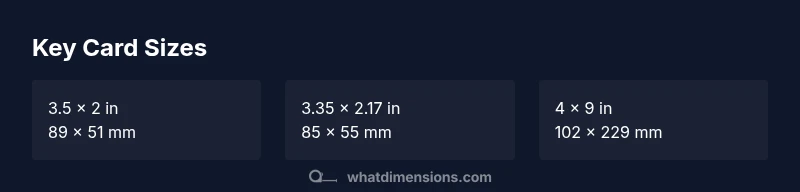
Table card dimensions most commonly settle around 3.5 by 2 inches (89 by 51 mm) for standard business cards used as place cards. International variants include European cards at 85 by 55 mm. For menus or larger event cards, sizes like 4 by 9 inches are popular. Always confirm with your printer about trim, bleed, and folding options.
What table card dimensions actually quantify
Table card dimensions describe the footprint of physical cards used at tables, including standard business cards, place cards, and menus. When designers talk about the size, they’re referencing width and height, and sometimes height when cards are folded. For printed cards, you also need to consider bleed (the extra margin that printers trim off) and safe margins (text and important elements kept within a safe area). In practice, the primary metrics are width, height, thickness, and the printed finish. This dimensioning affects legibility at distance, storage in display racks or holders, and the overall impression of professionalism. Understanding these measurements helps avoid costly misprints and ensures that your cards fit standard holders and place settings.
Standard dimensions by purpose
Different card types serve different roles at a table. Place cards, which display guest names, usually adhere to the footprint of a compact card that remains readable at a glance. Menu cards can be larger to accommodate typography and imagery. Business cards used as place cards typically align with standard business card sizes to ease printing and distribution. For printers, sticking to familiar ranges reduces the risk of misprints. Practical ranges to consider include 3.5 x 2 inches (US), 85 x 55 mm (EU), and 4 x 9 inches for larger menus or tables. Proofing is essential to verify text fit and line breaks before mass production.
Regional standards and variations
Regional preferences influence card dimensions. In the US, 3.5 x 2 inches remains the default for many business and place cards, while Europe commonly uses 85 x 55 mm. Some Asian printers offer 90 x 55 mm as a comfortable alternative. The key is to specify both metric and imperial units on orders and request a physical proof to confirm text readability, folding behavior, and overall balance with table décor.
Measuring and tolerances
To achieve consistent results, measure the final trimmed card from edge to edge, then add bleed allowances. A common bleed guideline is 1/8 inch (3 mm) on all sides. If your design includes text near the edge, keep it at least 1/4 inch (6 mm) away from trim. Tolerances vary by printer, so design with a safe zone and always obtain a printed proof. When folding or mounting on a stand, consider how thickness interacts with display angles and legibility from across the table.
Design considerations and typography
Typography is crucial for legibility at table distances. For standard 3.5 x 2 inch cards, use font sizes of 8–9 points for names and 10–12 points for supporting text. If you opt for a larger card, you can safely scale typography upward. High-contrast color combinations improve readability in dim lighting. Sans-serif fonts offer clean modern aesthetics, while serif fonts convey tradition. Ensure line length stays readable and avoid overly long text blocks that require squinting.
Material, finish, and printer considerations
Card stock thickness commonly ranges from 14 pt to 16 pt for professional cards; premium uses 18–32 pt. Finishes include matte, gloss, and soft-touch. Matte reduces glare and improves legibility, while gloss can enhance color reproduction for menus with photography. Finishes influence tactile perception and durability in settings where cards are handled repeatedly. Always request a proof and confirm trim, bleed, and finishing details with the printer prior to full production.
From concept to production: workflow
Start with the intended use to determine size, then create a layout that includes bleed and safe margins. If folding or display stands are involved, account for fold lines and stand geometry. Export print-ready PDFs with embedded fonts or outlines and place a proof order with the printer. Review the proof for readability, alignment, and any regional dimension concerns. Maintain a master template to ensure consistency when producing multiple card formats.
Authority sources and verification
Headlines in this article reflect practical guidance and printer workflows. For standards, What Dimensions Analysis, 2026 synthesizes common industry practices, alongside general references like ISO paper size guidelines for proportionate scaling. When in doubt, consult your printer’s published guidelines and request samples or proofs to ensure real-world accuracy.
Common mistakes to avoid
Rushing the design without proofs often yields mis-sized cards and text that wraps poorly. Choosing fonts that are too small reduces legibility in dim lighting. Skipping bleed or safe margins increases the risk of important content being trimmed. Inconsistent sizes across related card formats create a disjointed table presentation. Always verify regional size compatibility before placing large orders.
Comparison of common card dimensions by region and format
| Card Type | Dimensions (in) | Dimensions (mm) |
|---|---|---|
| Standard US business card | 3.5 x 2 | 89 x 51 |
| European standard card | 3.35 x 2.17 | 85 x 55 |
| Menu/large format card | 4 x 9 | 102 x 229 |
Quick Answers
What are the most common table card dimensions?
Across most events, table cards follow standard business card sizes for readability and handling. The two most common footprints are 3.5 x 2 inches (US) and 85 x 55 mm (EU). Designers should verify with the printer and consider bleed.
The most common sizes are US 3.5 by 2 inches and EU 85 by 55 millimeters.
How do I choose the right size for a menu card?
Choose based on viewing distance and typography. For menus, 4 x 9 inches is a common size; ensure legibility with larger fonts and ample line height. Always test proofs.
Menu cards should fit the table at a readable distance; consider 4 x 9 inches and test proofs.
Do card dimensions include bleed and trim?
Bleed is extra area beyond the final size and is trimmed away. Designers typically add 1/8 inch (3 mm) bleed on all sides and keep critical text safe within 1/4 inch (6 mm) of trim.
Bleed is extra area beyond the final size and must be included in the design.
What is the difference between place cards and business cards in size?
Place cards often align with standard business card sizes for portability, but hosts may choose larger formats for readability. Always align with event needs and printer capabilities.
Place cards typically use business-card sizes, but you may select larger formats for readability.
Are there regional standards for card sizes?
Yes. US styles commonly use 3.5 x 2 inches, EU uses 85 x 55 mm, and other regions may vary. When ordering internationally, request both metric and imperial specifications and proofs.
Yes, sizes vary by region; US uses 3.5 x 2 inches, EU uses 85 x 55 mm.
“Precise table card dimensions streamline printing and ensure consistent results across printers.”
Main Points
- Identify primary use before sizing.
- Default to 3.5 x 2 inches for US business cards.
- Include bleed and safe margins in every design.
- Verify regional sizes with printers and request proofs.
- Maintain a master template for consistency.