Place Card Dimensions: A Practical Guide to Size and Printing
Discover the essential place card dimensions for flat and folded cards, how to choose sizes, stock weights, and printing tips to ensure legible, elegant seating labels at events.


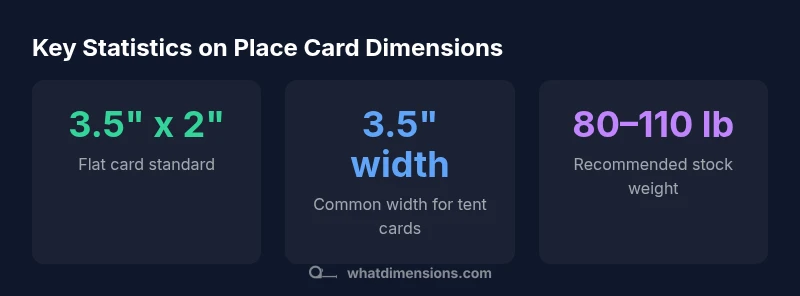
Place card dimensions typically refer to the flat card: about 3.5 inches wide by 2 inches tall (roughly 9 x 5 cm). For folded or tent-style place cards, designers often keep the width at 3.5 inches while the height ranges from 2.5 to 3 inches when standing. Always confirm with your printer for precise specs.
Why Place Card Dimensions Matter
According to What Dimensions, place card dimensions influence readability, seating flow, and overall table aesthetics. The chosen size affects how clearly guests can read names from across the table and whether the label leaves enough space for short notes or table numbers. Consistency across all stationery promotes a cohesive look, while too-small cards can appear crowded. Consider your event style, guest list, and venue when selecting a size. Font legibility is a core driver: shorter lines require larger type or tighter tracking, but excessive card height can crowd place settings. When dimensions are well chosen, guests glide to their seats, and the host project feels polished. For designers, this is as much about spacing as it is about wording—the same typographic rules you apply to menus and invitations apply to place cards.
What Dimensions also notes that printer tolerance, trim accuracy, and paper stock all influence the final result. Always request a dummy print from your printer before mass production to confirm margins, bleed, and alignment with your seating chart.
How to Choose the Right Size for Your Event
Selecting place card dimensions starts with the venue and seating layout. A long rectangular banquet table with close seating benefits from a standard flat card size so names stay legible from across the table. For smaller round tables, a slightly shorter width can help ensure the card doesn’t obstruct guests’ view. Consider the distance between guests and the seating label; if guests sit farther away, increase font size or card height modestly. Font choice, line-length, and line-height all interact with card size. Practical rule of thumb: pick a width around 3.5 inches for visual balance with standard dinnerware, then adjust height to accommodate the number of characters in each name while maintaining readability at arm’s length. Always create mockups against your actual table layout to validate visibility from all seats.
Standard vs Custom Sizes: Pros and Cons
Standard sizes offer cost efficiency, broad compatibility with envelopes and signage, and predictable printing results. Custom dimensions give you creative freedom to showcase your event’s style or brand, but they can increase production costs and complicate seating charts. If you opt for a nonstandard width, ensure your seating plan software and printer can accommodate the variation, and allow extra time for proofs. Consistency across your invitation suite and place cards creates a cohesive look, but mismatched dimensions can disrupt the visual rhythm of your tables. When in doubt, start with a standard, mark any required deviations, and test print a few samples before committing to a large run.
Stock, Ink, and Print Methods for Accurate Dimensions
Paper stock affects not just feel but how well print sits on the surface. Heavier stock (80–110 lb cover) provides crisp ink and robust edges, reducing bleed and ghosting. Matte finishes improve legibility and reduce glare on bright lighting, while satin or linen textures can influence perceived size since texture can slightly obscure fine letterforms. Printing method also matters: digital printing is convenient for short runs and proofs, while offset printing delivers sharper results for large orders. Bleed, margins, and crop marks must be accounted for in the design file to ensure the final card lands at the intended size after trimming. If your printer uses a specific stock, request a prepress guide to align file setup with your chosen dimensions.
Practical Printing Tips and Mockups
Creating a realistic mockup helps you verify size in context. Print a 100% scale proof on your chosen stock, then cut and fold or trim to confirm fit with the seating chart. Check that the font size remains legible at the typical viewing distance (often a few feet for a wedding reception). When ordering, request 5–10 extra cards as backups for misprints or last-minute guest changes. If you plan to print on both sides, ensure the design aligns correctly after folding or mounting; alignment drift can make names hard to read. Finally, confirm with your vendor about any edge-cuts or trimming variances that could affect your exact final dimensions, and adjust margins accordingly.
Variations by Style: Formal, Casual, and Themed Events
Formality often dictates density and spacing on place cards. Formal events typically favor tighter line spacing and well-proportioned margins to maximize readability within a compact footprint. Casual affairs might leverage more generous margins and larger type for a carefree, approachable look. Themed events can introduce design elements that affect perceived size, such as decorative corners or bold typography, which may make the card read larger or smaller depending on contrast and line length. Regardless of style, consistency across the place cards, invitations, and menus remains a hallmark of professional presentation. Consider your overall branding and ensure your sizes align with your other printed pieces.
Accessible Design: Readability and Font Sizing for All Guests
Accessibility should guide your typography decisions. For most place cards around 3.5 inches wide, using a font size of 12–14 pt for names strikes a balance between readability and space. If guests include older readers or anyone with visual impairment, increase the font size or use bold for essential lines like host names. Maintain high contrast between text and background, especially on glossy or textured stock, and avoid overly decorative fonts that may distort letter shapes at small sizes. When possible, test the final look under room lighting similar to your event venue to ensure legibility is maintained from all seating angles.
Comparison of place card sizes
| Card Style | Typical Width | Typical Height (flat) | Notes |
|---|---|---|---|
| Flat card | 3.5 inches | 2 inches | Common standard for seating cards |
| Tent/Folded card | 3.5 inches | 2.5–3 inches | Same width, taller when standing; requires crease |
| Large format (custom) | 4 inches or more | 2.5–4 inches | Reserved for special seating labels |
Quick Answers
What is the most common place card size?
The most common size for flat place cards is about 3.5 x 2 inches. Printers vary, so always confirm exact specs with your vendor.
Most common size is about 3.5 by 2 inches.
Should place cards be printed on both sides?
Printing on both sides is optional. It can add space for extra details, but single-sided usually reads more cleanly at range.
Double-sided can add space; otherwise, single-sided is clearer.
What stock weight is best for place cards?
Choose 80–110 lb cover stock for durability and crisp printing. Lighter stock may curl or bleed more easily.
Use sturdy card stock, around 80 to 110 pounds.
How should font size be chosen for readability?
Aim for at least 12 pt for names on a 3.5 x 2 inch card; test print to confirm legibility from typical seating distances.
Use larger fonts if needed; test prints help.
Do size recommendations vary by event type?
Yes. Formal events often use tighter margins and balanced typography; casual events may opt for more generous spacing and bolder fonts.
Depends on formality; adjust spacing and fonts accordingly.
“Precise place card dimensions ensure legibility and a polished table presentation; consistency across invitations, place cards, and menus is the hallmark of professional stationery.”
Main Points
- Define event style to choose a size
- Balance readability with space for names
- Choose printer-compatible stock for accuracy
- Prefer standard sizes for cost and compatibility
- Test print on chosen stock before bulk run