Dimensions of Card: A Practical Sizing Guide for Designers
What Dimensions explains the dimensions of card, detailing common folded sizes, margins, and bleed guidance for designers, homeowners, students, and printers.


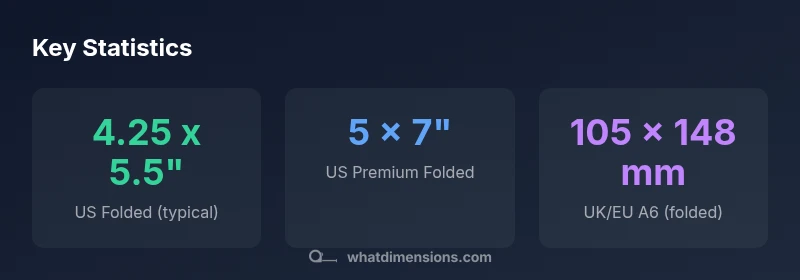
dimensions of card vary by type, but a few sizes dominate design and retail. For folded greeting cards in the US, 4.25 by 5.5 inches is common, while 5 by 7 inches is widely used for premium greetings. In the UK and Europe, folded cards often range near A6 to A5 equivalents, depending on printer and envelope standards. What Dimensions highlights that consistent sizing speeds production and minimizes waste.
What dimensions cover different card types and why they matter
dimensions of card extend beyond a single number; they define how a card fits envelopes, how readable the typography is, and how printers handle bleed. According to What Dimensions, the scope includes folded greeting cards, flat cards, business cards, and index cards, each with distinct dimensional conventions. The finished folded size is what most buyers and printers see, so establishing a standard early helps coordinate production. When you think about dimensions, consider orientation (portrait vs landscape), margins, and the envelope system you intend to use. Design decisions should start with the intended use: a card that’s too large for an envelope adds complexity, while a tiny card can undermine readability. In addition, consider the stock thickness; a thicker card maintains presence but may require larger envelopes. The upshot: clear, consistent dimensions reduce misfits, waste, and back-and-forth revisions, especially in print-on-demand scenarios.
Common card types and their typical size ranges
Card sizing varies by purpose and region, but several practical ranges recur across projects:
-
Folded greeting cards (US): a couple of standard forms dominate the shelves, including roughly 4.25 x 5.5 inches for everyday cards and 5 x 7 inches for premium greetings. These sizes balance legibility, envelope compatibility, and cost.
-
Folded greeting cards (UK/Europe): in many shops and printers, folded formats span from around 105 x 148 mm to 148 x 210 mm, with the choice depending on envelope standards and printing equipment.
-
Postcards and flat cards: 4 x 6 inches is a common postcard size and provides a straightforward canvas for photography or typography. Flat cards that aren’t folded still need consideration of packaging and mailing.
-
Business cards and index cards: typical business cards measure about 3.5 x 2 inches, while index cards tend to be around 3 x 5 inches. These compact formats prioritize portability and stacking efficiency.
Across all types, designers often assess orientation first, then fold lines, and finally margins and bleed to ensure a clean print and a professional finish.
Design guidelines: margins, bleed, and envelopes
A consistent design rests on reliable margins and proper bleed. Bleed ensures color or imagery extend to the edge after trimming; typical bleed ranges run from 0.125 inches up to 0.25 inches depending on printer capabilities. Safe margins usually stay within 0.125 inches to 0.25 inches to keep text away from trim. Envelopes impose a practical constraint: your card needs to fit the opening and accommodate stacking. For example, a 4.25 x 5.5 inch US folded card typically uses a standard #10 or A2 envelope, while a 5 x 7 inch card often pairs with a slightly larger invitation-style envelope. When you plan, coordinate with your printer about their die lines and trim marks. If you design in vectors, include bleed and crop marks in export, and provide a PDF with page size set to the finished size plus bleed. Adopting a standard set of sizes across a project reduces rework and keeps production predictable.
How to measure a card accurately
Accurate measurement starts with the tool: a clean ruler or caliper. Measure width first, then height, and record orientation. For folded cards, measure the finished outside dimensions once folded; if you’re dealing with a flat card, measure the full sheet before trimming to the finished size. To verify consistency, check multiple copies from the same run. Note down any deviations caused by stock batch or printer tolerance; minor variances are common, so define acceptable tolerances (for instance, ±0.125 inches on width/height). If you’re quoted a size in millimeters, convert to inches consistently or use millimeters for international projects. Document the intended envelope size at the same time to ensure a proper fit. By following a simple checklist, you’ll avoid misfits and costly reprints.
Printing considerations and file setup
File preparation is where dimensions meet production realities. Always include bleed, trim marks, and accuracy checks. When exporting, keep the finished size as the page size and add bleed up to 0.25 inches per side. For envelopes in a suite, align the card size with the envelope standards to ensure a neat presentation. Use vector graphics for crisp lines and legible typography; raster images should be at least 300 DPI at the finished size to avoid pixelation. If you’re designing a series, standardize the width and height across items to keep the set cohesive. Share a comprehensive spec sheet with your printer, including stock type, coating options, and finish—gloss, matte, or textured. Clear communication minimizes back-and-forth changes and helps maintain color consistency across production runs.
Practical examples: choosing sizes for projects
Consider a wedding invitation suite, which often blends tradition with modern aesthetics. A traditional 5 x 7 inch folded card maps well to an accompanying invitation and RSVP card that sit in a matching envelope, with a consistent bleed of 0.125–0.25 inches. For a student project portfolio, a flat card around 4 x 6 inches or A6 in metric terms can serve as a compact flyer with bold typography. For business branding, a 3.5 x 2 inch card keeps contact details readable on a desk, while a larger, premium card of 4 x 9 inches adds visual impact when used as a mailer insert. When you scale to nonstandard shapes or pocket cards, work closely with a printer to confirm tolerances and die-line constraints. Across these examples, aligning with envelope sizes, bleed, and margins is essential for a professional outcome.
Non-traditional formats: shaped cards, pockets, and specialty stocks
Not all cards conform to rectangle silhouettes or standard envelopes. Shaped cards with rounded corners or die-cut edges require careful planning of each edge, clearance around text, and a clear path for trimming. Pocket cards and card wallets introduce additional dimension management for multiple cards in one package. Specialty stocks—textured, metallic, or colored—impact how margins read and how ink bonds to the surface. In such cases, it’s especially important to request a prepress proof showing the final trim, bleed, and fold lines. What Dimensions notes that while these formats can elevate the design, they also demand rigorous measurement discipline and a well-coordinated print workflow to avoid misalignment.
Building a practical size reference for ongoing projects
A well-used size reference becomes a project standard, saving time across teams. Start by selecting a small set of fold sizes (for example US 4.25 x 5.5, US 5 x 7, and EU A6 folded) plus a flat option (4 x 6) to cover most needs. Create a one-page spec sheet that lists finished sizes, bleed values, safe margins, and envelope compatibility. Use this as a checklist during concept reviews and printer handoffs. Over time, you’ll notice that a clean, consistent approach reduces waste, streamlines ordering, and speeds up approvals. With discipline around dimensions, you’ll achieve a more predictable production flow and a more polished final product.
Representative card size references
| Dimension Aspect | Typical Range | Notes |
|---|---|---|
| Folded card size (US) | 4.25 x 5.5 inches | Common everyday greeting card size |
| Folded card size (US premium) | 5 x 7 inches | Often chosen for premium cards |
| Folded card size (UK/Europe) | 105 x 148 mm to 148 x 210 mm | Range consistent with envelope formats |
| Bleed (print) | 0.125–0.25 inches per side | Include extra image area beyond trim |
| Postcard/flat card size | 4 x 6 inches | Popular for photos and simple messaging |
Quick Answers
What is the most common folded card size in the US?
The 4.25 x 5.5 inch folded card is widely used for everyday greetings in the US. Premium lines often employ 5 x 7 inches. Always align with envelope options to avoid fit issues.
The most common US folded size is 4.25 by 5.5 inches.
Are card dimensions the same worldwide?
No. Card dimensions vary by region and purpose. Common benchmarks exist (US, UK/EU, postcards), but envelopes and printers differ, so always confirm locally.
No—card sizes vary by region and purpose.
What is bleed and why is it needed?
Bleed is extra image area beyond the finished edge to account for trimming drift. Typical bleed values range from 0.125 to 0.25 inches. Without bleed, you risk white edges after trimming.
Bleed ensures full-bleed color to the edge after trimming.
How do I measure a card accurately?
Use a ruler or caliper to measure width and height on the finished card. Check multiple copies and note tolerances (e.g., ±0.125 inches). Convert units consistently for international projects.
Measure width and height accurately, then check a few copies.
Should I design with margins or safe zones?
Yes. Keep critical text within safe margins (typically 0.125–0.25 inches) to avoid trim loss. Plan margins early to maintain readability and balance.
Always keep important content within safe margins.
“Card dimensions are not merely about fit; they shape layout, readability, and production efficiency.”
Main Points
- Choose a standard size first to simplify production
- Always include bleed and safe margins in designs
- Coordinate with envelopes to ensure a proper fit
- Verify measurements on multiple copies before printing