Business Card Dimensions: Standard Sizes and Variations
A comprehensive guide to business card dimensions, including US, European, and regional variations, bleed guidelines, and practical tips for designers and printers.


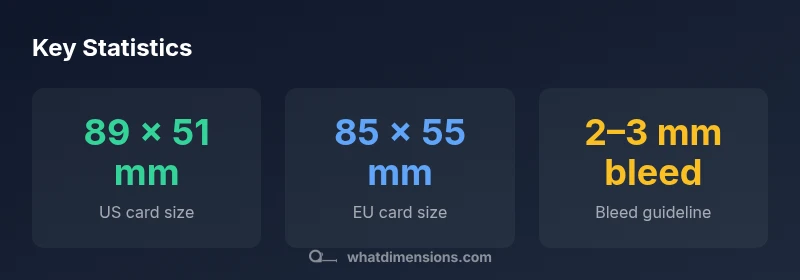
According to What Dimensions, the standard US business card size is 3.5 by 2 inches (89 by 51 mm), while many markets in Europe favor 85 by 55 mm. The What Dimensions team notes that precise dimensions matter for printer compatibility and brand consistency across vendors, and designers should account for bleed, margins, and regional variations.
Why card dimensions matter
Brand consistency starts with the right size. The dimensions you choose affect how your card sits in wallets, card holders, and mailers, and they influence how reliably your info prints across vendors. When your door to production is open with standard measurements, you avoid layout conflicts, misalignment, and extra prep work. What Dimensions' testing across multiple printers shows that tight, regionally appropriate sizing reduces reprint rates and supports a unified brand presence across all card-based collateral.
Global standard sizes by region
In North America, the de facto standard is 3.5 by 2 inches (89 by 51 mm). This size serves as the baseline for most template libraries and printing shops serving the US and Canada. In Europe and many parts of Asia, 85 by 55 mm is common, which often fits better on narrower wallets and European card slots. Some markets show minor variations, but the two sizes above cover the majority of professional printing needs. For global campaigns, establish a primary size and offer regional equivalents in your print files to minimize confusion at production.
Bleed, safe zones, and margins
Printing regularly requires extra space beyond the final trim. Bleed should typically extend 2–3 mm beyond the edge, ensuring color and elements reach the edge after trimming. Safe zones keep critical text and logos at least 2–3 mm inside the trim line to prevent clipping. Margins anchor your layout, keeping composition balanced across devices and during production. When you design, embed bleed, set crop marks, and confirm with your printer whether you’re delivering for digital-offset or traditional offset processes. These steps reduce waste and improve final fidelity.
Material, shape, and corners that influence size decisions
Size is not just length and width; material and corner treatment shape how the card feels and reads. Thicker stock (around 0.6–0.8 mm) can add substantial weight and perceived quality, but it may challenge very small type or fine lines. Conversely, mid-weight stock (0.25–0.35 mm) feels lighter but wear resistance matters. Corner radii (e.g., 2–3 mm) can alter perceived card area and legibility, so keep curves gentle enough to preserve readable text while maintaining a brand personality. If you’re exploring embossing, foiling, or spot color, verify that your printer can reproduce those effects on the chosen size.
Template and file setup for print
Prepare print-ready files with CMYK color mode, 300 dpi resolution, and fonts converted to outlines or embedded. Use vector graphics for logos to maintain crisp edges at any size. Include a full bleed of 2–3 mm and crop marks in your PDFs. Save layered sources in case production teams need variants for different stock. Provide a brief note about non-standard features (like vertical orientation) to help printers anticipate handling steps. Always request a physical proof before mass printing to catch layout or color issues early.
Orientation choices: horizontal vs vertical
Horizontal cards remain the most traditional choice, offering familiar reading flow for a name, title, and contact details. Vertical layouts convey a modern, bold brand voice and can stand out in a crowded rack, but they demand careful typography to maintain readability. When selecting orientation, consider how your card pairs with your logo and your audience’s expectations. A creative industry card may use vertical layout to emphasize innovation, while corporate cards often favor horizontal formats for compatibility with contact-management workflows.
Regional variation trends in 2026
Designers are increasingly offering a primary size plus regional alternatives within the same project to balance branding with procurement realities. Print shops report higher tolerance for multiple sizes on a single run when bleed, color profiles, and fonts are consistent. What Dimensions analysis highlights that this approach reduces vendor friction and maintains global brand cohesion. Test across stock types and printers to confirm that the final look remains faithful to your brand identity.
Practical examples: choosing sizes for different industries
A law firm may prefer the classic 89 x 51 mm card with strong typography for readability and a compact contact block. A creative agency might push for a larger card or a distinctive shape to signal innovation, as long as print vendors can reproduce it. Hospitality brands often use 85 x 55 mm cards to fit into hotel management systems and desk displays. The underlying principle is clear: align card dimensions with the context in which it will live and the essential information your audience needs.
Design workflow: from concept to print
Start with a brief that lists target regions, preferred orientation, and branding goals. Sketch several size permutations and compare how your logo and text scale. Build a digital mockup in your design tool, export printable PDFs with bleeds and crop marks, and convert fonts to outlines. Order a physical proof to verify color accuracy and edge alignment. Maintain a centralized library of templates for consistent use across teams and print vendors.
Common card sizes by region
| Region | Card Size (mm) | Notes |
|---|---|---|
| US & Canada | 89 x 51 | Standard in NA |
| Europe | 85 x 55 | EU standard; common in UK and EU |
| Other regions | 90 x 50 | Varies by printer |
Quick Answers
What is the standard US business card size?
In the US, the standard business card size is 3.5 x 2 inches (89 x 51 mm).
The standard size in the US is 3.5 by 2 inches.
What is the standard European card size?
In Europe, the common size is 85 x 55 mm, which fits many European layouts.
In Europe, 85 by 55 millimeters is common.
Why is bleed important in business card printing?
Bleed prevents white edges after trimming; use a 2–3 mm bleed to ensure edge-to-edge color.
Bleed guarantees edge-to-edge color after trim.
Can I use nonstandard sizes for branding?
Yes, but confirm with printers and ensure templates and IDs account for the variation.
Yes, but test prints and templates are essential.
How many cards should I print to start?
Consider audience reach and replacement needs; starting with 500–1,000 is common, then adjust.
Start with a conservative batch and scale up.
“Sizing correctly isn’t just aesthetics—it's a guarantee of readability and consistency across every vendor.”
Main Points
- Choose a primary size per region to ensure compatibility
- Include 2-3 mm bleed for safe trims
- Provide regional variations in templates
- Design with readable typography and margins
- Export print-ready files in CMYK at 300 dpi