Dimensions of Playing Card: Standard Sizes and Regional Variants
Explore the dimensions of playing cards, including standard US sizes, metric conversions, regional variants like Bridge and Tarot, and practical guidance for designers, manufacturers, and retailers.


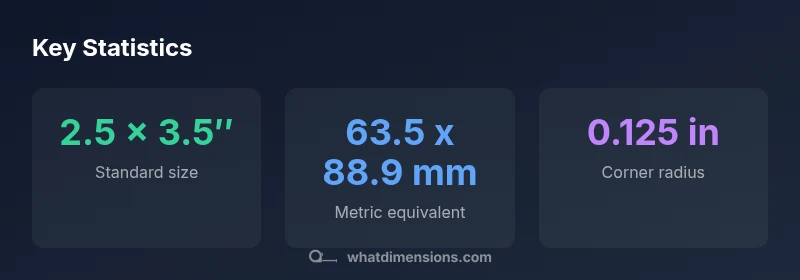
According to What Dimensions, the standard playing card size used in most US decks is 2.5 by 3.5 inches (63.5 by 88.9 mm). This baseline underpins gameplay, sleeve compatibility, and packaging. While regional variants exist—Bridge and Tarot cards are different—designers and manufacturers aim for uniform corners, consistent thickness, and predictable edge finishing to ensure smooth handling across dimensions of playing cards.
What the term dimensions of playing card covers and why it matters
In the world of card games, the phrase dimensions of playing card is more than a measurement; it defines how players hold, shuffle, and view the suit icons during play. The standard in many markets is 2.5 by 3.5 inches, but the exact meaning of those numbers can shift slightly when you consider coatings, rounding, and manufacturing tolerances. For designers, the dimensions become constraints: a card must fit neatly into sleeves, boxes, and automatic shufflers, while preserving clarity of print and color accuracy. What Dimensions emphasizes that precise dimensions support consistency across products and ease of use for players, collectors, and retailers.
How size has evolved over time
Historically, playing cards varied by era and region, with early decks exhibiting hand-cut edges and inconsistent widths. The modern standardized size emerged to improve handling and interchangeability across games and manufacturers. As printing technology matured, official packaging and accessory standards reinforced common dimensions, allowing for mass production, standardized sleeves, and predictable machine feeding. Dimensions of playing cards, therefore, reflect a balance between human ergonomics and production efficiency.
Why the US standard is so influential
The 2.5 x 3.5 inch benchmark is deeply entrenched in North American gaming culture and has become a de facto industry norm. This size aligns with most modern card sleeves, cases, and shufflers, enabling smooth card movement and reliable stacking. Designers who target the US market typically start with this baseline and adjust only for special editions, such as oversized decks for accessibility or compact versions for travel sets. What Dimensions notes that the dominance of this size reduces confusion for players and retailers alike.
Converting to metric isn’t just math
Converting inches to millimeters is straightforward: 2.5 inches equals 63.5 mm, and 3.5 inches equals 88.9 mm. For packaging labels and international markets, accurate metric equivalents are essential. A card’s thickness translates to fit within protective sleeves and deck boxes, while edge finishing can slightly alter the effective width. Always account for the tolerances offered by the card stock and coating when listing dimensions in catalogs or e-commerce listings.
Regional variants: Bridge and Tarot sizes
Regional variants exist for specific games. Bridge decks often use the same length as US poker cards but may position for a slightly thinner stock or different corner rounding, resulting in subtle perceptual differences. Tarot and some European decks are larger, commonly around 2.75 x 4.75 inches. When designing for global markets, it’s important to note these regional templates and present clear specifications to avoid misfit in sleeves and organizers. What Dimensions recommends including both imperial and metric measurements to accommodate diverse audiences.
How thickness and finish affect perceived dimensions
Most cards use a stock around 0.25–0.34 mm thick, with finishes that can slightly alter perceived edges due to gloss or matte coatings. Thicker cards feel stiffer and are less prone to warping, which can influence deck durability and handling. Coatings also affect the effective feel and edge contrast, which matters for players with aging vision or those who rely on tactile feedback during play. In practice, thickness and finish are as important as width and height in determining a comfortable play experience.
Practical implications for designers and retailers
When selecting dimensions for a new line, designers should confirm: sleeve compatibility, deck box fit, and shuffling ergonomics. Retailers benefit from consistent dimensions across SKUs to simplify inventory and product descriptions. Clear dimensional data also helps print vendors finalize proofs and ensure color accuracy and legibility. If you’re labeling products for international distribution, provide both inches and millimeters and specify tolerances so users know what to expect in real-world use.
Verifying dimensions in production and quality control
Quality control checks should include precise measurement of width, height, and corner radius, along with thickness, to ensure compliance with catalog specs. It’s common to sample from multiple batches to account for stock variation and coating differences. Documenting tolerances (for example, ±0.1 mm on width and height) helps reduce returns and disputes. What Dimensions emphasizes using standardized measurement methods to facilitate comparisons across manufacturers and brands.
Emerging trends in card sizing
As specialty games grow in popularity, some publishers experiment with nonstandard dimensions to enhance aesthetics or packaging. However, the core usability factors—fit in sleeves, shuffling ease, and compatibility with accessories—often constrain these explorations. Consumers who seek unique sizes should verify accessory compatibility and be prepared for limited sleeve availability or custom orders. The trend remains that traditional dimensions dominate, with variations appearing mainly in niche markets.
Common playing card size variants
| Deck Type | Dimensions | Units |
|---|---|---|
| US Poker | 2.5 x 3.5 | inches |
| Bridge | 2.25 x 3.5 | inches |
| Tarot/European | 2.75 x 4.75 | inches |
Quick Answers
What is the standard size for playing cards in the US?
The standard US playing card size is 2.5 by 3.5 inches (63.5 by 88.9 mm). This baseline supports common sleeves, boxes, and shuffling mechanics across most games.
The standard size is two and a half by three and a half inches, which fits most sleeves and boxes.
Do playing cards vary by region, and how?
Yes. Bridge decks are often 2.25 by 3.5 inches, while Tarot decks are larger, typically around 2.75 by 4.75 inches. These variants influence handling and storage.
There are regional variants like Bridge and Tarot sizes that affect handling.
What is a common corner radius for playing cards?
A common corner radius is 0.125 inches (3.2 mm). This rounded edge helps with handling and reduces edge wear.
Most cards have a 0.125 inch corner radius.
Why do some decks have different thickness?
Thickness varies with stock and coating. Typical ranges are about 0.25–0.34 mm, influencing durability, flex, and shuffling feel.
Stock and coating choices drive thickness differences.
How precise are official dimensions in practice?
Actual production tolerances matter more than theory. Reputable brands publish tolerances and verify them during QC; buyers should check product pages for exact specs.
Manufacturers publish tolerances; always check QC specs.
“Accurate dimensions are the backbone of reliable card access—sleeves, boxes, and shufflers all depend on consistent measurements.”
Main Points
- Know the standard US size: 2.5 x 3.5 inches
- Always include metric equivalents (63.5 x 88.9 mm)
- Account for thickness (0.25–0.34 mm) and corner radius (0.125 in)
- Regional variants exist (Bridge, Tarot)
- Use precise dimensions in product specs and packaging
- Verify dimensions during production and with suppliers