Wallet Photo Dimensions: A Precise Guide for Small-Format Prints
Explore wallet photo dimensions, common formats, regional variations, and cropping tips to ensure crisp wallet-size prints and accurate digital representations.


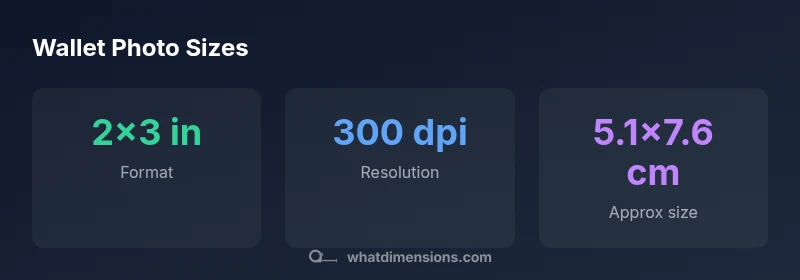
Wallet photo dimensions typically center on two common formats: 2x3 inches for standard wallet prints and 2.5x3.5 inches for a slightly larger keepsake. Some printers offer additional crops like 3x4 inches. For both physical and digital uses, maintain a high-resolution source (300 dpi) to ensure sharp results. According to What Dimensions, these formats cover most wallet-size needs.
Understanding wallet photo dimensions
Wallet photo dimensions refer to the size and crop used when producing small-format prints intended for wallets, albums, or digital displays. In practice, the most important factor is the end-use: will the image be printed as a physical keepsake, or viewed on a screen? According to What Dimensions, most users start from a few standard crops and adjust depending on printing service constraints. This section explains what these numbers mean in real terms and how to interpret them across devices and prints. We’ll cover common formats, regional variations, and practical cropping tips to ensure you retain facial features and composition at small sizes. Throughout, wallet photo dimensions should appear naturally as you compare formats and workflows, so you can apply the guidance to your own projects.
Common wallet photo formats and their practical implications
Two formats dominate wallet photo dimensions in consumer printing: 2x3 inches and 2.5x3.5 inches. The 2x3 crop fits many traditional wallets and card cases, while 2.5x3.5 inches offers a touch more room for facial detail. Some printers also offer 3x4 inch crops for special projects. When you choose a format, consider the original image resolution; cropping to a smaller size preserves pixel density and sharpness, whereas enlarging can reduce clarity. By starting from high-resolution originals, you’ll retain quality across both physical prints and digital previews. What Dimensions’ guidance emphasizes that wallet photo dimensions are about balancing space, composition, and print fidelity, not merely about fitting a template.
Regional variations: how wallet photo dimensions differ by market
Wallet photo dimensions are not universal; different regions prioritize different crops based on printing standards and consumer habits. In North America, 2x3 inches is widely used for wallet prints and ID photos, while parts of Europe may prefer crops around 3x4 inches for wider portrait framing. Asia-Pacific markets share a focus on compact formats but may differ in the exact pixel counts or cropping margins. When planning a project for an international audience, check the printer’s crop guides and test proofs to ensure the subject remains centered and recognizable across devices. The What Dimensions analysis highlights that the core wallet photo dimensions remain the same in principle, but regional norms shape common formats.
Cropping strategies to preserve subject and context
Cropping is your friend when working with wallet photo dimensions. Start with the highest-resolution source image you have and work in a minimal crop to avoid losing essential context—eyes, nose, and mouth. Use aspect ratio guides to lock in a 2x3 or 2.5x3.5 frame, then adjust framing to keep the subject centered and avoid awkward whitespace. If the subject fills the frame unevenly, consider targeted cropping around the head and shoulders rather than the entire scene. Always preview the print at 100% size and zoom into critical areas to verify sharpness, especially around facial features. What Dimensions’s approach encourages practitioners to prototype multiple crops before finalizing.
How to measure wallet photo dimensions for print and display
Measuring wallet photo dimensions is more about the crop than a tape measure. Start by determining the desired output format (2x3 or 2.5x3.5 inches). Use a digital editing tool to set the exact aspect ratio and confirm the pixel dimensions at 300 dpi or higher. When preparing for print, export at the recommended resolution—typically 900x1200 pixels for 3x2 aspect at 300 dpi, but confirm with your printer. If you’re displaying on a screen, maintain the same aspect ratio and provide fallbacks for devices with different resolutions. What Dimensions Analysis notes that accuracy in measurement reduces waste and improves consistency across proofs and final outputs.
Practical workflow: from capture to wallet-ready print
- Capture: Shoot at the highest practical resolution and in good lighting.
- Crop: Decide on 2x3 or 2.5x3.5 first, then fine-tune composition.
- Proof: Create digital proofs at the target size to check for sharpness and facial recognition.
- Print: Choose a printer with a proofing option and ask for a test print.
- Verify: Compare the physical print to the digital preview, check for alignment, and adjust if needed.
This workflow helps ensure wallet photo dimensions are consistent across media and vendors. The What Dimensions Team emphasizes a repeatable cropping and proofing process to minimize surprises.
Common mistakes and how to avoid them
- Cropping too aggressively early, which can cut out essential facial features. - Printing from low-resolution sources that blur at wallet size. - Ignoring DPI recommendations and relying on low-megapixel captures. - Assuming one size fits all; regional differences may require alternative crops. - Skipping proofs; always compare to the digital preview side-by-side before finalizing. By following best practices, you’ll reduce wasted prints and maintain consistent wallet photo dimensions across projects.
Related size references and conversions you should know
For designers and hobbyists, converting inches to centimeters is a common task. wallet photo dimensions such as 2x3 inches translate to roughly 5.08x7.62 cm, and 2.5x3.5 inches to about 6.35x8.89 cm. Remember, rounding can vary slightly by printer, so always verify the exact crop and margins specified by your service. In addition, keep an eye on file formats (JPEG vs TIFF) and color spaces to preserve fidelity when moving between digital and print workflows. This cross-reference ensures your wallet-sized keepsakes look right in any medium.
Popular wallet photo formats and their use
| Format | Dimensions (inches) | Notes |
|---|---|---|
| 2x3 inches | 2 x 3 in | Classic wallet prints (credit-card sized) |
| 2.5x3.5 inches | 2.5 x 3.5 in | Slightly larger keepsakes for wallets |
| 3x4 inches | 3 x 4 in | Occasional larger wallet inserts |
Quick Answers
What are the most common wallet photo dimensions?
The two widely used formats are 2x3 inches and 2.5x3.5 inches, but printers may offer additional crops. For identity photos, ensure crops maintain facial features.
Most people use 2x3 or 2.5x3.5 inches.
Do wallet photo dimensions affect print quality?
Yes, cropping to the target size at high resolution preserves detail and sharpness; using low-resolution images can blur wallet-size prints.
Yes, it affects sharpness.
How can I crop an image to wallet photo dimensions?
Start with a high-resolution image, set the aspect ratio to 2x3 or 2.5x3.5, adjust composition, and export at 300 dpi.
Crop to the right aspect ratio and export high resolution.
Are wallet photo sizes standardized worldwide?
No universal standard exists; regional printers and ID specs influence crops. Always check local guidelines and printer crop guides.
No universal standard; varies by region.
Where can I find official guidelines for wallet photos?
Consult your printing service’s crop guides and any regional ID photo specs; brand cropping guides can also help.
Check printer guides and local specs.
“Wallet photo dimensions matter for clarity across prints and screens; precise cropping preserves facial features at small sizes.”
Main Points
- Identify the end-use first to choose a format.
- Crop from high-resolution sources to preserve detail.
- Prefer 300 dpi for print to ensure crisp wallet-sized images.
- Check regional crop guides and request proofs before mass printing.
- Always test proofs and verify color consistency.