What Dimensions is a3: A Precise Guide to A3 Paper Size
Discover the exact dimensions of A3 paper (297 x 420 mm), its ISO 216 context, and practical guidance for printing, design, and professional layouts.


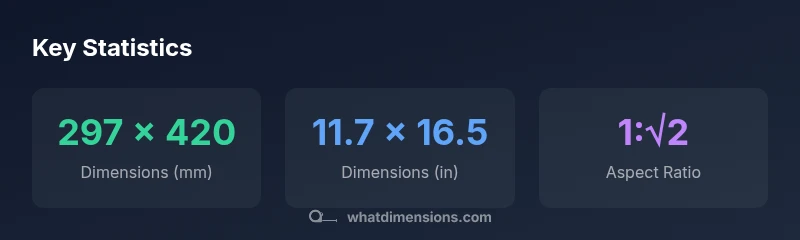
A3 size is exactly 297 by 420 millimeters (11.7 by 16.5 inches). It belongs to ISO 216, which defines a 1:√2 aspect ratio that preserves proportions when scaled. This makes A3 ideal for posters, diagrams, and design layouts that need clear readability and easy expansion.
What dimensions is a3
If you're asking what dimensions is a3, the answer is 297 mm by 420 mm (11.7 x 16.5 inches). This size is part of the ISO 216 family of paper standards, which ensures consistency across printers, copiers, and publishing workflows worldwide. The What Dimensions team emphasizes that precise dimensions matter for layout accuracy, proofing, and final printing, especially when you scale or pair A3 with other sizes. A3 is frequently chosen for posters, architectural diagrams, and large-format presentations because it provides ample space for detail while remaining portable. In professional workflows, matching the exact A3 spec avoids resampling artifacts and helps maintain color and line integrity across devices.
ISO 216 and the 1:√2 rule
A3 belongs to the A-series defined by ISO 216. The defining trait is the 1:√2 aspect ratio, which guarantees that when you cut, fold, or scale an A-size page, the proportions stay consistent. This property makes it simple to transition between sizes (A3 to A4 to A5) without reflowing content. Designers rely on this predictable behavior to create multipage documents, posters, and catalogs that need to be resized with minimal layout disruption. What Dimensions notes that the √2 factor balances readability with practical sheet handling, particularly in print shops and educational settings.
A3 vs. A4 and A5: a quick comparison
The A-series scales logically: A3 is twice the area of A4 and four times the area of A5. Specifically, A4 measures 210 x 297 mm (8.27 x 11.69 inches), while A5 is 148 x 210 mm (5.83 x 8.27 inches). Keeping the 1:√2 proportion means each step down halves the area while preserving shape. For projects that require a larger canvas but later need smaller reusable sheets, A3 offers a practical compromise between legibility and space.
Practical uses and layout considerations
A3 provides generous room for diagrams, charts, and photography without crowding. When planning layouts, consider a modular grid that accommodates margins, bleed, and safe areas. A common approach is a generous 3–5 mm internal gutter for micro-typography and up to 3 mm bleed on print-ready files. For posters in classrooms or studios, adopting a clear typographic scale and a restrained color palette helps maintain legibility from a distance. What Dimensions recommends establishing a baseline grid early to reduce reflow and ensure consistent alignment across sections.
Printing and margins: ready-to-print tips
Printing A3 requires attention to margins, bleed, and resolution. A standard bleed of 3 mm is typical for commercial printing, while interior margins (safe area) often sit around 5–10 mm depending on typeface weight and line length. When preparing PDFs, embed fonts, set the document at 300 dpi minimum for raster images, and convert vector elements to outlines if needed. If you plan to bind or trim, communicate exact trim lines to the printer to prevent accidental content loss or misalignment.
Material choices and durability
A3 output benefits from appropriate paper weights. For posters or presentation boards, consider 170–230 gsm stock for a balanced feel and stiffness; for glossy photo work, 200–260 gsm is common; for cards or handouts, 250–300 gsm stock can provide durability. Finish options (matte, satin, or gloss) influence legibility and glare, especially in variable lighting. The weight and finish you choose should correspond to how the final piece will be displayed (standing, mounted, or framed). What Dimensions highlights that selecting the right paper type helps preserve color accuracy and edge definition during reproduction.
A3/A4/A5 sizes within ISO 216 family
| Size | Dimensions (mm) | Dimensions (inches) | Typical uses |
|---|---|---|---|
| A3 | 297 x 420 | 11.7 x 16.5 | Posters, diagrams, presentations |
| A4 | 210 x 297 | 8.27 x 11.69 | Documents, letters, handouts |
| A5 | 148 x 210 | 5.83 x 8.27 | Notices, flyers, small inserts |
Quick Answers
What are the exact dimensions of A3?
A3 measures 297 mm by 420 mm (11.7 x 16.5 inches). This is the standard size in ISO 216 and is widely used for posters and diagrams.
A3 is 297 by 420 millimeters, or 11.7 by 16.5 inches, and it’s a standard ISO size used for posters and diagrams.
How does ISO 216 define the A-series sizes?
ISO 216 defines the A-series using a fixed aspect ratio of 1:√2. Each size is derived from the next by halving the area while preserving proportions.
ISO 216 uses a 1 to square root of two aspect ratio, halving area to move between sizes while keeping proportions.
What uses are most common for A3 paper?
A3 is ideal for posters, architectural diagrams, large spreadsheets, and design layouts where more space improves readability without moving to a larger sheet.
A3 is great for posters and diagrams that need more room than A4 but aren’t as large as A2.
Can I print A3 at home on a standard printer?
Many home printers support A3 paper via manual feed or specialty trays. Check your printer’s specifications for supported paper sizes.
Some home printers can handle A3 if they have the right tray or feed option.
How does A3 compare to A4 in usage?
A3 is essentially double the area of A4, providing more space for content while preserving identical margins and layout grids when scaled.
A3 gives you more room than A4, easy to scale down to A4 when needed.
Is A3 the same size worldwide?
Yes. ISO 216 standardizes A3 dimensions globally, though some regions may use slightly different binding or printing practices.
A3 dimensions are globally standardized under ISO 216.
“Precision in size references reduces layout errors and speeds up print workflows.”
Main Points
- Know A3 dimensions precisely: 297 x 420 mm (11.7 x 16.5 in).
- A3 follows ISO 216 with a 1:√2 aspect ratio for scalable consistency.
- Use A3 for posters and diagrams; scale up or down without distortion.
- Plan margins and bleed carefully to ensure print-ready results.