What Dimensions Are Half a Page: A Practical Guide
Learn the exact measurements for half-page formats on common paper sizes, including US Letter and A4, with practical layout, bleed, and orientation tips for print design.


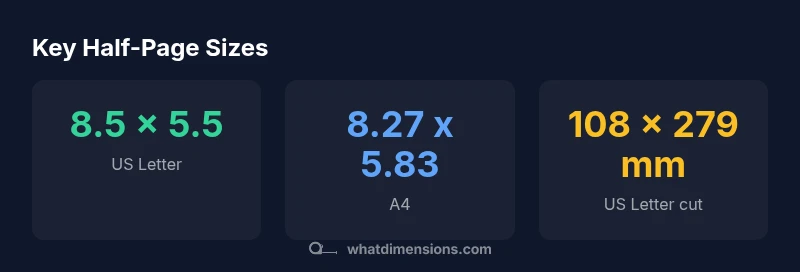
According to What Dimensions, half-page dimensions depend on the base sheet. On US Letter (8.5 by 11 inches), a common half-page size is 8.5 by 5.5 inches when cut or folded. For international formats like A4 (210 by 297 mm), half-page is typically 210 by 148.5 mm. Designers also consider orientation and bleed when defining a half-page layout.
What 'Half-Page' Means
In print and design, 'half-page' describes a layout that occupies roughly half the area of a standard sheet. The exact dimensions depend on the base paper size you start from. What Dimensions emphasizes that the most common reference points are US Letter and A4, because these sizes cover a large portion of home and office printing. For US Letter, dividing the 8.5 by 11-inch sheet in half typically yields a landscape-ready 8.5-by-5.5-inch rectangle, which is a standard flyer or mini-poster size. When you’re working with A4 paper, halving the sheet along the longer edge produces about 210 by 148.5 mm, or 8.27 by 5.83 inches. Because printers trim and bind differently, you should always confirm the exact trim area with your print vendor.
Common Base Sizes and Their Halves
US Letter and A4 are the two most common starting points. US Letter size is 8.5 inches wide and 11 inches tall. Halving along the height (the 11-inch side) creates two 8.5 x 5.5 inch panels; along the width creates two 4.25 x 11 inch panels. For A4, which is 210 x 297 mm, halving along the height yields 210 x 148.5 mm, while halving along the width yields 105 x 297 mm. That means you have four potential half-page formats depending on how you cut. In practice, most designers choose 8.5 x 5.5 inches for a conventional half-page flyer and 8.27 x 5.83 inches for a European/A4 layout.
How to Calculate Your Half-Page Dimensions
Start with the base sheet’s dimensions, then pick the cut direction. If you split along the longer edge (the one that measures 11 inches on Letter, 297 mm on A4), half-page measures width x half-height. If you split along the shorter edge (8.5 inches or 210 mm), you’ll have half-width x full height. Convert units as needed: 1 inch equals 25.4 mm. Use exact bleed and margin considerations: add at least 0.125 inch (3 mm) bleed beyond the final trim. Example: for a US Letter sheet cut to two pages, the final flyer size is 8.5 x 5.5 inches; with 0.125 inch bleed on all sides, the layout file should extend to 8.75 x 5.75 inches.
Bleed, Margins, and Printing Considerations
Bleed ensures color or images extend to the edge after trimming. A typical bleed is 3 mm (0.125 inch) on all sides, though some printers request 5 mm for large-format jobs. Margins, or safety lines, keep critical text away from cuts. A safe margin for half-page pieces is often 0.25 inches (6.5 mm), but always check your printer’s specs. When you design for both screen and print, maintain a consistent grid to prevent misalignment during trimming. If you’re designing a double-sided half-page flyer, consider how the back side aligns with the front and allow for facing-page margins.
Orientation and Layout: Portrait vs Landscape
Choosing portrait or landscape depends on your content flow. Horizontal (landscape) half-pages are common for posters, banners, and photo-heavy layouts; portrait half-pages suit text-heavy leaflets and minimal design. Consider typography: 11- or 12-point fonts on a 8.5 x 5.5 inch panel can become cramped; scale carefully. Use a single focal image and bold headlines to maximize readability within the smaller canvas. When in doubt, print a low-cost proof to verify legibility and balance.
Practical Design Rules for Text, Images, and Grids
Use a 2- or 3-column grid to structure content. Keep headlines clear; limit body copy to 60–100 words per panel if you’re doing two-per-page. Reserve space for branding and a call-to-action. Ensure image resolution remains high (at least 300 DPI for print). If you’re using photos, crop to the half-page shape early in the design process to prevent awkward white space.
International Variations and Quick Conversions
Besides US Letter and A4, other common half-page sizes exist in different markets. For example, halving an international 'A-series' sheet yields sizes roughly 210 x 148.5 mm or 105 x 297 mm, depending on cut. Some regions standardize on metric dimensions; converters should remember to check printer specs and local cutting tolerance. If you’re shipping digital PDFs, set the page dimension to the final trimmed size and include bleed.
Choosing the Right Half-Page Size for Your Project
Ask: Will readers view the piece at arm’s length? Will you fold it? Where will it be distributed? For classroom handouts, a compact 4.25 x 11 panel may be easier; for a hand-out flyer, 8.5 x 5.5 or 8.27 x 5.83 are common. Consider color, imagery, and typography balance on the smaller surface; you might need larger margins and bolder type.
How to Verify Dimensions with Your Print Shop
Always provide exact dimensions in inches and millimeters to your printer. Ask for a proof that includes bleed marks and trim lines. Confirm whether the printer uses US Letter or A4; request a sample cut to verify alignment. If the project is time-sensitive, request a digital proof before committing to production.
Half-page sizes for common print formats
| Paper Size | Half-Page (inches) | Half-Page (mm) | Notes |
|---|---|---|---|
| US Letter (cut along long edge) | 8.5 x 5.5 | 215.9 x 139.7 | Common flyer size |
| US Letter (cut along short edge) | 4.25 x 11 | 108 x 279.4 | Alternate orientation |
| A4 (cut along long edge) | 8.27 x 5.83 | 210 x 148.5 | Standard half-page |
| A4 (cut along short edge) | 4.13 x 11.69 | 105 x 297 | Alternate orientation |
Quick Answers
What does half a page mean in printing?
In printing, half-page refers to a layout that occupies half the base sheet’s area. The exact size depends on the base paper (US Letter, A4, etc.). Orientation and bleed influence the final trim.
Half-page is half the sheet’s area; orientation and bleed affect the final trim.
How do I compute half-page dimensions for US Letter?
Start with 8.5 by 11 inches and cut along the 11-inch side to get 8.5 by 5.5 inches, or along the 8.5-inch side to get 4.25 by 11 inches.
Cut an 8.5 by 11 sheet in half either along the long edge or the short edge.
Should I design for bleed when making half-page flyers?
Absolutely. Include bleed beyond the final trim to avoid white edges after cutting. Typical bleed is 3 mm, but confirm with your printer.
Yes—add bleed beyond trim to ensure color goes to the edge.
Are half-page sizes the same in metric and imperial systems?
The concept is the same across systems, but exact dimensions differ by paper size. US Letter halves differ from A4 halves, so choose the base size first.
Yes, but the numbers depend on the paper standard you use.
Can I use half-page dimensions for digital screens?
You can, but screen publishing uses pixels and aspect ratios. For print PDFs, stick to the final trimmed size with bleed.
Yes, but translate to pixels/DPI for screens and keep print-ready for PDFs.
What is the best half-page size for a flyer?
Depends on content. For imagery-heavy flyers, 8.5 x 5.5 inches is a strong standard on US Letter; for Europe, 8.27 x 5.83 inches on A4 is common.
There isn’t a one-size-fits-all; choose based on content and distribution.
“Understanding half-page dimensions starts with the base sheet, then accounting for orientation and bleed yields a print-ready layout.”
Main Points
- Choose base size first: US Letter or A4.
- Always plan for bleed (3 mm typical).
- Half-page orientation affects readability and layout.
- Verify with printer for exact bleed and trim.
- Keep critical content within safe margins.