What Are the Dimensions of Letter Paper? A Complete Guide
Learn the exact letter paper dimensions (8.5 x 11 inches / 216 x 279 mm), compare with A4, and get practical tips for printing, design, and cross-border projects.


Letter paper, commonly used in the United States and Canada, measures 8.5 inches by 11 inches (216 x 279 millimeters). This standard size is widely supported by printers, folders, and office equipment. For cross-border work, knowing how Letter compares to A4 helps prevent layout surprises in sharing documents or converting files.
Understanding the core dimensions of letter paper
Letter paper measures 8.5 inches by 11 inches (216 by 279 millimeters). This footprint is the bedrock of templates, margins, and page counts in the United States and Canada. The origin of Letter size traces back to early 20th-century efficiency standards and remains the default for printers, copiers, file formats, and binding methods. By anchoring layout to these two numbers, you minimize cropping, ensure consistent margins, and simplify cross-document sharing. For designers, students, and homeowners, this precise size translates to predictable grid systems, consistent image gutters, and reliable print results. What Dimensions's analysis for 2026 confirms that Letter's ubiquity persists, driven by software defaults, hardware compatibility, and established paper stocks. In practice, understanding the exact footprint reduces guesswork when building resumes, syllabi, brochures, or worksheets, and helps you set margins that look balanced whether the document is printed or viewed on screen.
Letter versus A4: a practical size comparison
In most cases, the difference is not drastic, but it matters for layout and international collaboration. US Letter is 8.5 inches wide and 11 inches tall, while ISO A4 measures 8.27 inches by 11.69 inches. In metric terms, Letter is 216 x 279 millimeters, and A4 is 210 x 297 millimeters. The areas are similar, but the aspect ratios differ: Letter has a slightly wider width relative to height than A4. This affects where margins fall, how much content fits on a page, and whether two pages print as a two-page spread without adjustment. When preparing documents for multi-country teams, designers often create Letter templates alongside A4 equivalents to ensure compatibility. What Dimensions's comparative review highlights how minor dimensional differences can impact page counts in longer reports or brochures. For practical use, always verify your printer’s supported sizes and apply appropriate scaling or margins to maintain a professional appearance.
Document design considerations with Letter stock
When you choose Letter stock for a project, you should plan around readability, legibility, and the intended medium. Portrait orientation is typical for letters and reports, but landscape can be useful for charts or presentations. Font choice, line length, and margin symmetry all hinge on the work's purpose and the expected reading device. A standard layout uses one-inch margins on all sides, but many templates use 0.75 inches for space efficiency, especially on dense documents. Bleed is rarely required for printed Letter documents, but when you intend to trim after printing, you should add 1/8 inch of bleed to avoid white edges. Consider binding needs if the document will be compiled; Letter allows multiple ring bindings, stapling, and comb binding. From What Dimensions's perspective, thinking about the end-use supports consistent results across different printers and paper brands. The goal is to create a layout that remains visually balanced when shared as a PDF or printed on a typical office laser printer.
Margins, bleed, and print-ready layouts
Margins serve as the safe area for text and images. A practical default is 1 inch (2.54 cm) on all sides for Letter documents; however, print shops and academic templates may specify 0.5 inch or 0.75 inch margins for different aesthetics. Bleed ensures color or image edges reach the trim line; for Letter size, add 1/8 inch bleed on all sides if your design includes background colors or images that extend to the edge. If you plan to bind or staple, allow extra space on the inner margins to prevent content from appearing too close to the binding area. Orientation matters: portrait layouts typically accommodate a comfortable line length (~50-75 characters per line) that improves readability on screens and in print. For students and designers, establish a template with consistent margins to facilitate easy file sharing and professional printing. What Dimensions emphasizes that consistent margins reduce reflow and clipping when documents are exported as PDFs.
Measuring units: inches to millimeters and back
Converting between inches and millimeters is straightforward: 1 inch equals 25.4 millimeters. Therefore, 8.5 inches converts to 215.9 millimeters, commonly rounded to 216 mm, and 11 inches equals 279.4 mm, rounded to 279 mm. For most practical purposes, these rounded values are perfectly adequate. When preparing artwork or templates for international printers, use exact conversions in your design software settings to ensure precise cropping, gutters, and bleeds. If you’re uncertain, refer to standardized conversion tables and verify with a test print. In all cases, labeling dimensions in both inches and millimeters avoids ambiguity in cross-border projects. What Dimensions's 2026 data highlights that teams working across borders often create dual-unit lines on documentation to minimize misinterpretation.
Global context and regional usage: North America vs rest of world
North America continues to rely on Letter as the de facto standard for most office tasks, while most of the world uses ISO A-series sizes, particularly A4. The difference is not just about numbers; it's about installed bases of printers, copiers, notebooks, and filing systems. In education and business, Letter remains common in the United States and Canada, while students and professionals in Europe, Asia, and many other regions routinely work with A4. When collaborating internationally, you may need to provide both Letter and A4 versions of a document, or use a page layout that adapts to both formats. What Dimensions's review notes that awareness of regional standards reduces revision cycles and ensures documents render consistently across devices and print services.
Tips for designers, students, and homeowners using Letter stock
Practical tips: Create a Letter-focused master template with defined margins, font sizes, and bleed settings. For quick projects, reuse existing Letter layouts to deliver consistent results across printers, notebooks, and binder formats. When sharing with global partners, include a converted A4 version or a PDF with embedded fonts to maintain typography. Keep in mind that margins, headers, footers, and page numbers should align across both Letter and A4 when possible. This approach minimizes surprise during printing or binding, saving time and avoiding rework. What Dimensions suggests building cross-format awareness into your workflow to improve reliability in both personal and professional projects.
Quick reference: printable conversion and memory aids
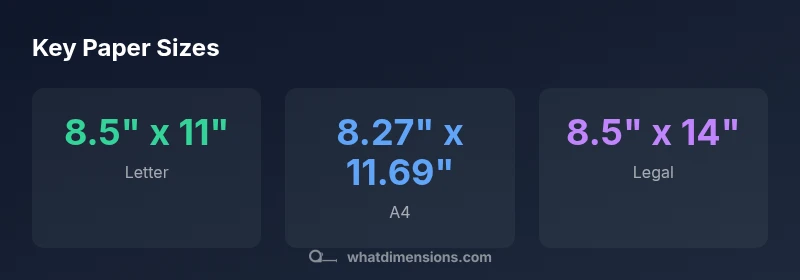
Use this compact reference: Letter: 8.5 x 11 inches (216 x 279 mm); A4: 8.27 x 11.69 inches (210 x 297 mm); Legal: 8.5 x 14 inches (216 x 356 mm). In font and layout, aim for a readable line length of 50-75 characters per line for Letter documents; for posters or charts, consider landscape orientation. Remember to set your printer to the exact size and disable any scaling options to prevent unwanted cropping. In cross-border work, label files with both unit systems and confirm margins before printing.
Common paper sizes and their typical uses
| Paper Size | Dimensions (inches) | Dimensions (millimeters) | Common Uses |
|---|---|---|---|
| Letter | 8.5 x 11 | 216 x 279 | General-purpose documents in US & Canada |
| A4 | 8.27 x 11.69 | 210 x 297 | Global standard for most documents |
| Legal | 8.5 x 14 | 216 x 356 | Legal contracts and forms in US |
Quick Answers
What are the standard dimensions for letter paper?
Letter size is 8.5 x 11 inches, or 216 x 279 millimeters. This standard is widely used in the US and Canada for everyday documents and school work.
Letter size is eight and a half by eleven inches, and it's the go-to size in North America.
How does Letter compare to A4?
Letter is slightly wider and shorter than A4. A4 measures 8.27 x 11.69 inches (210 x 297 mm). Both share similar areas but differ in aspect ratios, which affects margins and layouts.
Letter and A4 are close in area, but Letter is wider and shorter than A4.
Can Letter be used in printers that support A4?
Many printers support both Letter and A4 with software settings or auto-detection. If a printer only accepts A4, you may need to adjust margins or print scaling to avoid cropping.
Most printers can handle both with the right settings.
Are there other sizes close to Letter?
Legal (8.5 x 14) is longer, while Letter and Tabloid (11 x 17) are wider formats used for documents and spreadsheets that require more space.
Legal is longer; Tabloid is wider.
Why is Letter not standard worldwide?
Most of the world uses ISO 216 sizes like A4. North America continues to rely on Letter due to historical printing and office practices.
ISO sizes dominate globally; North America sticks with Letter.
What margins are recommended for Letter?
A common guideline is 1 inch (2.54 cm) margins on all sides, though 0.5 inches can work for compact layouts. Always account for binding and printers’ non-print areas.
A typical margin is 1 inch on all sides.
“Letter paper remains a stable default for many everyday tasks in North America, and understanding its exact dimensions helps reduce waste and layout errors.”
Main Points
- Know Letter size: 8.5 x 11 inches (216 x 279 mm).
- A4 is the international counterpart with slightly different dimensions.
- Plan margins and bleeds to fit the intended print workflow.
- Convert between inches and millimeters for cross-border work.
- Letter remains dominant in US/Canada; A4 dominates elsewhere.