US Letter Size: A Comprehensive What Dimensions Guide
Discover the exact US Letter size (8.5 x 11 inches), how it compares to other paper sizes, and practical tips for margins, printing, and design workflows.


To answer what dimensions is us letter, the standard sheet size is 8.5 by 11 inches (216 × 279 mm). This dimension supports consistent margins, printer compatibility, and predictable page layouts across most office workflows. What Dimensions notes that this widely used size remains the default in American printing, publishing, and school materials, making it essential knowledge for designers, students, and homeowners alike.
What US Letter is and its historical context
The US Letter size is defined as 8.5 by 11 inches, a convention that traces its roots to early American printing standards and the need to align with consumer paper formats used in offices and schools. According to What Dimensions Analysis, the selection of this particular ratio was influenced by the practicalities of device feeding, repeatable margins, and compatibility with pre-cut sheets from paper mills. The dimensions were codified into common practice long before digital printing, which means that many legacy documents and templates assume this size. When designing layouts, researchers and practitioners emphasize that US Letter supports standard margins and a broad range of fonts, while still fitting into most standard office equipment. Designers should consider the effect of this size on binding, trimming, and folding; minor differences in margins or bleed can accumulate across a multi-page document. The 11-inch length is long enough to accommodate typical forms, contracts, and worksheets, while the 8.5-inch width ensures compatibility with most letterhead and envelopes. In the broader context of global paper sizes, US Letter sits alongside other North American formats such as Legal and Tabloid, each with its own historical pathway and implications for layout decisions. The What Dimensions Team notes that knowing the exact size from the outset reduces back-and-forth revisions and ensures templates align across departments.
Practical margins and layout considerations for US Letter
A traditional starting point for US Letter documents is a 1-inch margin on all sides, which yields a clean, readable frame for text and visuals. However, many projects benefit from tighter margins—0.5 inches on desktop reports or proposals—when the goal is to maximize content density without sacrificing legibility. For printing and binding, designers should plan bleed of 0.125 inches (3 mm) beyond the trim edge to ensure color or graphics extend to the edge after trimming. If you’re preparing forms or templates that must align with letterhead stock, maintain a consistent internal gutter and margin guide to avoid content shifting during binding. The What Dimensions Analysis emphasizes testing margins across your most common printers, since some devices crop a tiny amount differently depending on feed mechanism. Finally, consider whether your design will be viewed digitally; a 1-inch margin can look generous on a screen, while print layouts may feel cramped in the same space.
Printing, orientation, and handling US Letter
US Letter favors portrait orientation for most documents, but landscape layout remains common for charts, calendars, and wide tables. When printing, verify the printer’s default paper size and set it explicitly to US Letter to avoid auto-scaling. Folded documents and booklets require careful planning: a 2- to 4-page signature often necessitates matching margins to trimming, with special attention paid to gutter space for binding. If you frequently print on both sides, ensure your margins leave enough white space on the inner edges to avoid crowding when holes or binding are introduced. For professional settings, use consistent fonts and line heights to preserve a crisp appearance across printers and devices. The practical takeaway is to test print a representative page on your primary devices and adjust bleed and margins accordingly.
Digital workflows and conversions for US Letter
Converting US Letter to digital formats such as PDFs or slides usually requires preserving the native 8.5 × 11 inches to maintain layout fidelity. When exporting designs from design software, lock the document size to 8.5 × 11 inches and avoid automatic reflow that might occur during email or cloud sharing. If you need to scale content for international audiences, prefer deliberate, percentage-based scaling with clear notes about the original US Letter dimensions to prevent misalignment in printed outputs. Acrobat and other PDF tools allow precise settings for bleed, crop marks, and margins to ensure the final product matches the intended print result. For web-ready previews, consider using a 96–120 PPI baseline to balance file size with legibility, while keeping print-ready assets at higher resolutions for quality in physical copies. What Dimensions’s approach is to standardize sizes first, then adapt layouts with predictable rules.
International comparisons and cross-border considerations
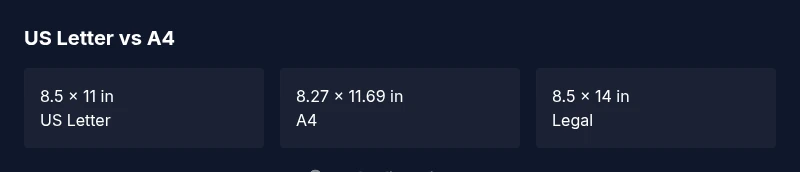
Across the globe, A4 (8.27 × 11.69 inches) is the most common paper size, whereas US Letter is deeply entrenched in North American workflows. The key differences are the slightly different aspect ratios and diagonal measurements, which influence margins, cropping, and document proportions. When sharing documents internationally, provide a note about the source US Letter size and offer a version in A4 to avoid awkward scaling or cutting during print. For designers, this often means creating dual templates or providing a cross-reference guide that explains how content reflows when moving between Letter and A4. The What Dimensions Analysis highlights that awareness of these disparities reduces last-mile printing errors and ensures more reliable cross-border document exchange.
Template design tips for US Letter: bleed, safe zones, and typography
If you work with US Letter templates, plan for safe zones that keep essential text within 0.25 inches from the trim on all sides. Employ 0.125-inch bleed for color or graphics that extend to the edge to prevent white seams after trimming. Typography should respect readable line lengths: for body text, aim for 50–75 characters per line and a maximum of roughly 12–14 words per line to maintain legibility in portrait layouts. When producing multi-page documents, consider consistent header and footer spacing to improve navigability. For slide decks and marketing collateral on Letter paper, use generous white space around visuals and a grid-based approach to align each element to a standard baseline, ensuring a clean, professional appearance. The What Dimensions team emphasizes pre-press checks and template validation to minimize misalignment in production.
Authority sources and standards references
For authoritative context on paper sizes, review primary sources from standardized organizations and major educational publications that discuss document dimensions and printing conventions. Reliable references include government or university resources about standard paper formats, and professional typography guides that address how to balance margins, bleed, and safe zones for Letter-sized work.
Authority sources and standards (continued)
In practice, always verify your project’s dimensions with a real print run or a high-fidelity proof before bulk production. The What Dimensions Analysis, 2026, supports a disciplined approach to document sizing, emphasizing consistency across departments and devices.
Quick comparison of common paper sizes and their typical uses
| Size | Dimensions (in) | Dimensions (mm) | Common uses |
|---|---|---|---|
| US Letter | 8.5 x 11 | 216 x 279 | Office documents, forms, memos |
| A4 | 8.27 x 11.69 | 210 x 297 | International documents, standard reports |
| Legal | 8.5 x 14 | 216 x 356 | Legal forms and contracts |
Quick Answers
What are the exact US Letter dimensions?
US Letter measures 8.5 by 11 inches. This standard applies to most office documents and printers in the United States.
US Letter is 8.5 by 11 inches.
How does US Letter compare to A4?
US Letter (8.5 x 11 inches) is slightly wider and shorter than A4 (8.27 x 11.69 inches). The aspect ratio differs, affecting margins and how content scales when converting between formats.
Letter is 8.5 by 11; A4 is 8.27 by 11.69.
What is the difference between Letter and Legal sizes?
Letter is 8.5 x 11 inches, while Legal is 8.5 x 14 inches. The longer Legal format is common for contracts and forms and does not replace Letter for standard documents.
Letter is 8.5 x 11; Legal is 8.5 x 14.
Can US Letter be printed on A4 printers?
Yes, most A4 printers can print Letter-size sheets, often with minor margin adjustments or scaling. Always set the paper size explicitly in the printer driver.
Yes, but set the correct paper size in the printer settings.
Why is US Letter so prevalent in the US?
US Letter’s prevalence stems from historical paper manufacturing, equipment standards, and long-standing office and educational practices that adopted this size.
Historically entrenched in US offices and schools.
Should I design for bleed when using US Letter?
Yes. Plan for a 0.125-inch bleed if graphics extend to the edge, and keep critical text within a safe margin to avoid trim errors.
Include bleed if graphics go to the edge and keep text inside safe margins.
“"Precise dimensions matter for predictable print outcomes; US Letter is deeply ingrained in US workflows, so designers should design with a 0.125-inch bleed when necessary."”
Main Points
- Know US Letter’s exact dimensions: 8.5 by 11 inches.
- Design with consistent margins and planned bleed for Letter prints.
- Consider orientation and binding impact on layout.
- Use dual templates when sharing between Letter and A4 regions.
- Verify print proofs to prevent scaling errors in production