What Are the Dimensions of Legal Paper? A Practical Guide
Explore the exact dimensions of legal paper (8.5 x 14 inches / 216 x 356 mm), how it compares to Letter and A4, and tips for accurate printing and filing.


What is Legal Paper?
Legal paper is a US-oriented sheet size used primarily for contracts, filings, and formal documents. The name reflects its historic role in legal proceedings, where longer sheets facilitated longer text without excessive folding. In everyday office tasks, legal size is often preferred when documents may exceed the vertical space of a standard letter page. Designers and printers should adjust margins and binding to accommodate the taller sheet, and understanding this size helps avoid misfeeds in printers and scanners. While the US commonly uses legal, many organizations that collaborate internationally encounter ISO sizes such as A4. What Dimensions emphasizes using the precise size to prevent misalignment or wasted paper when distributing documents across devices and folders.
Exact Dimensions: Legal Paper
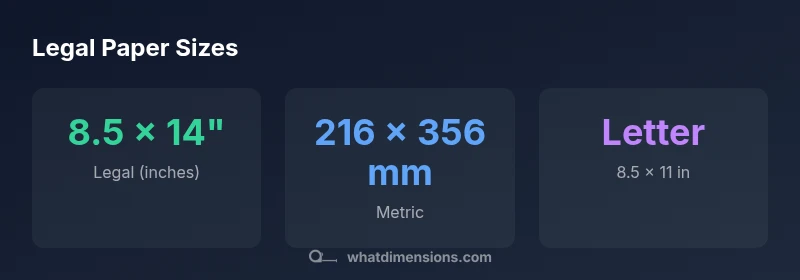
The legal paper size in the United States is exactly 8.5 inches wide by 14 inches tall. In metric terms, that corresponds to 216 millimeters by 356 millimeters. There is no ambiguity about these numbers: 8.5" x 14" is the standard specification for legal documents, making this sheet long enough to fit more lines of text than a typical Letter page. Orientation matters: portrait is common for legal filings, but landscape is used for certain forms, spreadsheets, or diagrams. When you set up a document, configure the page size in your word processor or PDF creator to match 8.5 x 14 to avoid unexpected cropping or misalignment. If you are preparing forms for international collaboration, including the metric equivalents helps ensure compatibility across devices and printers.
How Legal Paper Compares to Letter and A4
Legal (8.5 x 14 in) is significantly longer than Letter (8.5 x 11 in), giving about 3 extra inches of vertical space. In metric terms, Legal is 216 x 356 mm, while Letter is 216 x 279 mm. A4, which is the common ISO size, measures 210 x 297 mm (roughly 8.27 x 11.69 in). These differences may affect margins, binding, and document flow when moving between regions. For example, a contract drafted on Legal paper may not print correctly on a standard Letter tray without adjustments. When sharing documents with international partners, consider providing both sizes or a clearly labeled size to prevent confusion or misalignment.
Practical Uses for Legal Paper
Legal paper is favored in law offices, government filings, and certain business workflows that require longer lines per page or a distinct filing format. It supports longer contracts, affidavits, and court exhibits where a taller page helps keep content legible without cramming. Some printers offer a dedicated legal tray, while others can feed legal sheets from the same tray as Letter with the right settings. In classrooms and training environments, instructors might use legal sheets for handouts that need more information per page. Understanding your main use case—filings, contracts, or forms—helps determine whether legal size is the best choice for a given project.
Printing and Handling: Margins, Cropping, and Orientation
Exact page size matters to avoid clipping at the printer margins. For legal pages, set margins wide enough to prevent content from touching the edge, especially for double-sided prints. If you plan to bind documents, leave extra margin on the left side for binding. When scanning or archiving, ensure your scanning software uses a legal page profile to maintain the document’s proportions. Cropping can occur if a printer assumes Letter size; in such cases, you may end up with truncated text. Consistent settings across devices—drivers, firmware, and software—minimize surprises during print runs.
Measuring and Verifying Sizes: A Quick Guide
To verify a sheet is legal size, you can use a ruler or calipers to confirm the width equals 8.5 inches and height equals 14 inches. If you must convert to metric, remember 1 inch equals 25.4 millimeters, so 8.5 inches is exactly 215.9 millimeters and 14 inches is 355.6 millimeters. Many printers display page size options; select Legal or enter custom dimensions if needed. Keeping a small reference card with the dimensions nearby helps staff select the correct size quickly. For archival quality, always confirm that your document’s page size is locked in the file settings before distributing it.
International Context: ISO Sizes and Cross-border Printing
Outside the United States, the ISO A-series sizes dominate, with A4 being the most common. Legal size does not have a direct ISO equivalent, so when sharing with international colleagues, providing both United States legal and ISO sizes helps avoid confusion. Architects and print shops often adjust layouts to accommodate different standards, ensuring that line breaks, margins, and fold lines align correctly. If you work with suppliers in Europe or Asia, including the metric dimensions and a note about the US legal size can accelerate production and avoid back-and-forth corrections. What Dimensions recommends preparing a size guide for teams that operate across borders.
What Dimensions Means for Design and Documentation
Precise dimensions streamline project workflows: you can plan margins, typography, and binding with confidence when the page size is fixed. For layout-heavy documents—rental agreements, briefs, or case files—legal size offers extra vertical space that can be exploited for notes and annotations. In the era of digital PDFs and print-on-demand, ensuring the file uses the correct page size reduces reflow and formatting issues on different devices. The What Dimensions approach emphasizes clear specifications, consistent terminology, and a shared reference for all stakeholders to minimize friction and improve speed of production.
Summary tips and common pitfalls
When working with legal paper, keep a running checklist to avoid common mistakes. First, always verify page size in the source document, printer settings, and any export profile before printing a batch. If you share files internationally, include both the legal size in inches and the metric equivalent to prevent misinterpretation. If a printer reports misfeeds or cropping, re-check the page size and adjust the printer tray or feed method to ensure the sheet feeds correctly. Understand that Legal is not ISO-standard; for cross-border collaboration, provide both sizes and consider converting margins to global standards to maintain readability. If you are coordinating multiple departments or offices, maintain consistent margin guidelines and a standardized file naming convention to reduce reprints and errors.