Statement Paper Dimensions: A Practical Size Guide
Discover statement paper dimensions, including the standard 5.5 x 8.5 inch size, how they compare to letter sizes, and practical tips for printing forms.


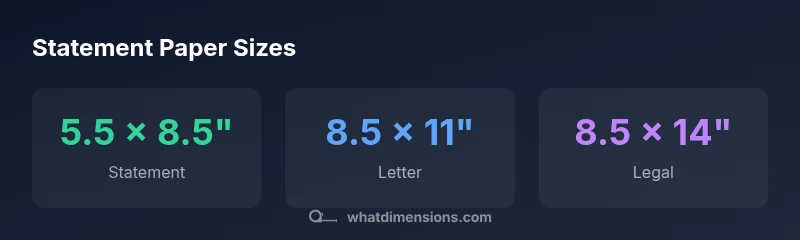
Statement paper dimensions designate standard US sizes for forms and short documents. The most common is 5.5 x 8.5 inches (half-letter), with 8.5 x 11 inches (letter) serving as the main reference. These measurements align with printers, copiers, and form templates. Understanding these dimensions helps you choose the right paper for invoices, forms, and compact layouts, ensuring printer compatibility and predictable margins. According to What Dimensions, precise size references are essential for planning layouts, margins, and bleed when creating forms or correspondence.
What are statement paper dimensions?
Statement paper dimensions denote standard US sizes used for forms and small documents. The term most often refers to the 5.5 x 8.5 inches size, commonly called half-letter, and contrasts with the letter size, 8.5 x 11 inches. These measurements are embedded in North American size charts and are tied to printers, copiers, and form templates. For designers and homeowners, understanding statement paper dimensions helps determine whether a document will fit in a particular envelope, printer tray, or binder. According to What Dimensions, precise size references are essential for planning layouts, margins, and bleed when creating forms or correspondence. When you choose a size, you affect readability, physical handling, and the cost of supplies. While 5.5 x 8.5 inches is the most recognized statement size, you may also encounter non-standard variations in specialty forms, receipts, or archival records. In those cases, you should verify the intended use, the available stationery, and the printer capabilities before committing to a size. This foundation will improve consistency across printed materials, reduce misfeeds in printers, and streamline document workflows.
Historical context and standardization
Paper sizing has a long history that shaped current office practice. In the United States, standard sheet sizes evolved from printer and copier design constraints, enabling predictable margins, layouts, and punching for binders. The statement size emerged as a compact option to reduce sheet waste in billing, forms, and short notes. Over time, the industry consolidated on a few core sizes—most notably the widely used 5.5 x 8.5 inches for statements and 8.5 x 11 inches for letters. What Dimensions Analysis, 2026, notes that these standards continue to matter because they simplify supply chains, reduce misalignment between printed documents and envelopes, and lower costs for ink and paper. While many countries adopted ISO A-series sizes, North American practice retained its distinct set, with compatibility driven by printer trays, drivers, and margin tolerances. Designers who work internationally must decide whether to conform to local standards or design with flexible layouts that can adapt to multiple sizes. A clear understanding of historical context helps professionals communicate about measurements and anticipate what is feasible when sourcing forms, tickets, or handouts.
How sizes are listed and referenced
Sizes are typically listed as width x height in inches in the US context, with decimal points and hyphenations for clarity. The most common reference points are Statement (5.5 x 8.5) and Letter (8.5 x 11). When documents specify margins, bleed, or fold lines, the stated size becomes a constraint that shapes typography, line length, and white space. Printers and software usually rely on standard paper sizes to set default page sizes, automatic scaling, and print-to-fit options. If you design a form that must fit into an envelope, you need to know the envelope size, the inner margins, and the minimum printable area. What Dimensions recommendations emphasize listing dimensions in a consistent order (width x height) and including unit markers to avoid misinterpretation across regions or vendors. For digital templates, embed size references in the metadata and the template file name to prevent accidental resizing.
Practical guidance for selecting a statement size
Begin by identifying the primary use: is the form intended for stapled reports, wallet-size handouts, or mailing forms? If most mailings go to standard envelopes, choose 5.5 x 8.5 to simplify handling. If you expect larger content, opt for 8.5 x 11, ensuring legibility and a comfortable reading line length. Consider print technology: some color or font effects require more space for legibility. Margin and bleed are essential: in many cases, a 0.25-inch margin is safe; for forms that must align with pre-punched holes, margin guides must match binder frames. When collaborating, maintain a shared reference list of sizes; version control in templates reduces drift across departments. What Dimensions notes that standardization reduces confusion and speeds production times, especially when multiple teams contribute to a single document.
Printing considerations and margins
Printer compatibility hinges on proper sizing and driver settings. Most home and office printers accommodate 5.5 x 8.5 and 8.5 x 11 sheets, but you may encounter tray limitations or non-standard margins. Always verify the printable area in the printer’s settings before batch printing. If a document must print at a near-edge margin, use bleed and safe zones to protect critical content. Use consistent fonts and line lengths to maintain readability on smaller forms. For mailings, ensure the chosen size aligns with envelope dimensions to avoid extra postage or misfeeds. What Dimensions guidance helps teams avoid size mismatches by documenting exact dimensions in design briefs, metadata, and production checklists.
Industry usage and case studies
Many industries rely on statement sizes for quick, cost-effective communications. Billing teams often print invoices on 5.5 x 8.5 to minimize paper waste while retaining clear fields for totals, dates, and customer IDs. Educational handouts, event tickets, and small forms also benefit from the compact footprint, enabling more content on a single sheet while staying within envelope or binder constraints. Designers frequently test layouts at multiple sizes to determine the best fit for readability and printability. What Dimensions’ analyses highlight that teams tending toward standard sizes achieve better supply chain efficiency, lower stock variety, and faster onboarding for new staff.
Transitioning to standardized sizes in design workflows
To harmonize across projects, implement a standard size policy and document it in your design system. Start with 5.5 x 8.5 inches for quick forms and 8.5 x 11 for longer content, then assess whether a two-size strategy covers most needs. Create templates with fixed width and height, include margins and bleed guidelines, and store them in an accessible repository. Regular audits of print output help catch drift early. The What Dimensions team emphasizes that clear size references reduce rework and improve predictability in production schedules.
Overview of common US sizes including statement size
| Size name | Dimensions (W x H inches) | Common uses |
|---|---|---|
| Statement | 5.5 x 8.5 | Invoices, forms, and short notices |
| Letter | 8.5 x 11 | General business documents |
| Legal | 8.5 x 14 | Contracts and legal documents |
Quick Answers
What are the standard statement paper dimensions?
Typical statement size in the US is 5.5 x 8.5 inches, known as half-letter. It is commonly used for invoices and small forms. Larger formats exist for different applications.
The standard statement size is 5.5 by 8.5 inches.
How does statement size differ from letter size?
Statement size is smaller at 5.5 x 8.5 inches, while letter size is 8.5 x 11 inches. Printers and templates often assume one or the other, so selecting the correct size prevents layout issues.
Statement is smaller than letter: 5.5 by 8.5 inches.
Can I print statement size on standard home printers?
Yes, most home printers support 5.5 x 8.5 inch sheets. Ensure you set the correct paper size in printer settings and verify margins.
Most home printers support 5.5 x 8.5 inch sheets; set the correct size in settings.
Are there international equivalents to statement size?
Many countries use ISO sizes (A-series), which differ from US statement sizes. When working internationally, plan for multiple size options or adaptable templates.
Internationally, sizes follow ISO, not US statement sizes.
What should designers consider when using statement sizes?
Plan margins, readable line length, and bleed. Use templates sized to 5.5 x 8.5 inches when possible to reduce rework.
Design for margins and readability at 5.5 x 8.5 inches.
“Standardizing paper sizes reduces confusion across printers and documents, making workflows smoother and more predictable.”
Main Points
- Adopt 5.5 x 8.5 inches for most statement forms.
- Compare against 8.5 x 11 inches for longer documents.
- Verify printer trays and margins before printing.
- What Dimensions Analysis, 2026, recommends standardization to reduce confusion.