A4 Dimensions vs Letter: A Practical Comparison
Explore the dimensions, uses, printing considerations, and regional implications of A4 versus Letter paper sizes. Learn which size to choose for international projects, design workflows, and everyday office tasks.


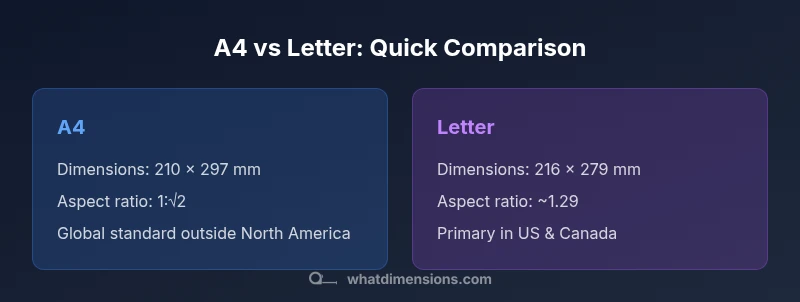
For most international projects, A4 is the default outside North America, while Letter dominates in the US and Canada. A4 measures 210 × 297 mm (8.27 × 11.69 in) and Letter measures 216 × 279 mm (8.5 × 11 in). If your work spans regions, plan templates for both sizes and include a clear conversion guide to minimize waste and rework.
Overview: What A4 and Letter sizes represent
In the world of paper sizes, two names dominate: A4 and Letter. The distinction isn't merely academic; it shapes printing workflows, document matching, and even how envelopes are sized. When we discuss a4 dimensions vs letter, we are comparing ISO 216 standard paper (A-series) with North American sizing (Letter). What Dimensions frames this topic for homeowners, designers, students, and office staff who need precise specs to avoid waste or misalignment. A4 is part of the ISO 216 system, defined by a width of 210 mm and height of 297 mm; Letter measures 216 x 279 mm (8.5 x 11 in) and sits within a different tradition. Because these sizes reflect regional productivity practices, your choice will influence how you print, file, and ship documents across borders. The difference matters not only for printers but also for legibility, readability, and the downstream formats you rely on most—forms, templates, and notebooks. For someone mapping a project budget or a design brief, understanding a4 dimensions vs letter is a practical starting point that reduces surprises later in the process.
Dimensional Comparison: Exact Measurements
The two sizes are close in area but differ in proportions, which leads to different fit in trays, binders, and folders. A4: 210 x 297 mm (8.27 x 11.69 in). Letter: 216 x 279 mm (8.5 x 11 in). When you lay them side by side, the width difference is modest, while the height of A4 is taller by about 18 mm. The aspect ratios highlight a fundamental difference: A4 uses the formal 1:√2 ratio, a standard that ensures predictable scaling when you cut or fold pages. Letter’s ratio is approximately 1:1.29, a result of US measurement conventions rather than ISO standardization. These exact measurements matter most when you’re designing templates, preparing mailables, or selecting paper for a multi-region project. Even small changes in margins, bleeds, or gutter space can alter the final layout, so designers and printers should verify dimensions before mass production.
Printing and Compatibility: printers and software
Most modern printers offer built-in support for both A4 and Letter, but default tray settings and drivers can bias toward a particular size. When you print across regions or collaborate with international teammates, confirm page size in the print dialog, margins, and scale options. A4 documents scanned or saved as PDFs must often be scaled to Letter for US recipients, risking distortion if the aspect ratio is not preserved. Conversely, converting Letter to A4 can produce trimmed edges or unexpected whitespace if the scale is incorrect. Software like word processors and layout tools typically preserve the original page geometry, but some templates assume a specific size. For organizations that work with both formats, a pragmatic approach is to maintain separate templates for each size and establish a quick-reference guide for printers and couriers. In all cases, testing a few sample pages before large print runs saves time and reduces waste.
Filing, Binding, and Documents
Paper size determines how you file documents in cabinets, folders, and ring binders. A4 tends to fit neatly into international filing systems and standard A4 folders; Letter often requires US-style folders and binders. When preparing reports, proposals, or manuals that will travel across borders, keep track of the original size and the intended destination. Cross-size documents may need to be resized during printing or converted to PDF with enforced page scaling. If you anticipate long-term archiving, consider the relative footprint of each page in a filing system and how margins and headers align with existing templates. A consistent size across a project minimizes reformatting costs and reduces confusion for collaborators.
International vs US usage and standards
Region plays a decisive role in choosing between A4 and Letter. Outside North America, A4 is the default for business forms, academic papers, and government documents, and its linear dimensions suit standard printers and copiers across many countries. In the United States and Canada, Letter remains the de facto standard for everyday documents, classroom handouts, and most office workflows. This divergence means that teams collaborating across borders may need to print, scan, or convert documents to the appropriate size. While many printers can handle both formats, a single document can be awkward if the recipient’s equipment expects a different size. The ISO A-series system, which includes A4, is designed for scalable sizing—if you scale by halving sheets from A0, you obtain A1, A2, and so on—an approach that offers predictability for designers and printers who work with multiple formats globally.
Costs and Availability in Different Markets
Prices for A4 and Letter paper are influenced by regional demand, supply chains, and manufacturing standards rather than a strict cost difference between formats. In practice, customers in Europe and Asia may encounter more consistent stock of A4 sheets, while US consumers find Letter widely available but sometimes priced differently due to local distribution. For businesses buying in bulk, the choice of size can affect freight costs, storage, and waste in warehouses. If your project travels internationally, factor in potential remainders or off-cuts when predicting material usage. As a general guideline, align procurement with the dominant market you serve; this reduces waste, minimizes the need for converters, and supports smoother logistics. What Dimensions notes that the cost implications are typically driven by supply chain realities rather than the intrinsic value of the size itself.
Common Edge Cases: when sizes matter (envelopes, notebooks)
Sizing differences matter most in envelopes, notebooks, and presentation materials. A4 and Letter envelopes are not interchangeable with the same standard; using the wrong envelope size can cause misfeeds or failed mailings. Notebooks and binders are often built for a single size, so a mix of A4 and Letter pages may require different hardware or inserts. In travel diaries or field notes, a planned switch between sizes is feasible but requires careful planning to avoid misalignment. In education and professional settings, instructors and clients may request consistent page sizes for templates; failing to align to the preferred standard can lead to delays or resentments. By anticipating these edge cases, you minimize surprises when printing, binding, or mailing documents across borders.
Designer and Workflow Considerations
For designers, the choice between A4 and Letter affects margins, bleeds, and typography just as much as the content itself. A4’s taller height allows slightly more vertical space for headers and notes, but margins must be carefully managed to avoid crowding on narrow columns. Letter’s wider width can influence two-column layouts, table widths, and legibility on small devices when converted to digital formats. When preparing multi-region assets, establish a single baseline size and create clear guidelines for how assets will scale to other formats. Keep pixel-based or print-ready assets aligned to the target size to minimize distortion during conversion. In practice, teams should maintain a shared style sheet with page sizes, gutter measurements, and safe zones to support consistent output across printers and devices.
Conversion Tips: printing from one size to another
Converting between A4 and Letter requires attention to aspect ratio and margins. Start with preserving the content's integrity by locking the aspect ratio when scaling and choose fit-to-page or custom scaling options in your printer driver. If you’re preparing a document for overseas recipients, adjust margins to maintain readability; avoid edge-to-edge text that could be trimmed. In many cases, it’s best to export a PDF from your original size and then adjust in a layout program rather than reformatting the source document. For designers, create two templates tied to exact page sizes and avoid mid-run reflows. When sending files digitally, use an unambiguous file naming convention that includes the page size to prevent misfiled documents.
Environmental and Sustainability Considerations
The environmental footprint of paper products is influenced by sourcing, production efficiency, recycling rates, and waste. The choice between A4 and Letter does not inherently determine ecological impact; instead, it affects how efficiently you use paper and how much waste you generate. In regions where A4 is the default, organizations often implement standardized paper systems to minimize cut waste, which can improve overall efficiency. In North America, Letter usage has similar sustainability considerations tied to paper grade and recycling programs. To reduce environmental impact, procure recycled-content paper, use duplex printing, and design documents with the correct margins to minimize trimming. What Dimensions suggests prioritizing suppliers who provide post-consumer recycled fibers and formalized waste-reduction programs regardless of size.
Quick Reference: Quick-size cheat sheet
- A4 is 210 × 297 mm (8.27 × 11.69 in) — standard outside North America.
- Letter is 216 × 279 mm (8.5 × 11 in) — US/Canada standard.
- A4 ratio: 1:√2; Letter ratio: ≈1.29.
- Typical uses: A4 for international documents; Letter for US/Canada documents.
- Envelopes and folders: match the corresponding size, or plan for conversion steps.
- When unsure, print a test page and verify margins, bleed, and fit.
Comparison
| Feature | A4 | Letter |
|---|---|---|
| Dimensions (mm) | 210 x 297 | 216 x 279 |
| Dimensions (in) | 8.27 x 11.69 | 8.5 x 11 |
| Aspect ratio | 1:√2 | ~1:1.29 |
| Common uses | Global standard outside NA | US/Canada standard |
| Printer compatibility | Widely supported globally | Very common in US rooms; verify tray |
| Filing/Binder compatibility | Fits most international folders | Fits common US binders |
Strengths
- A4 is globally standard, ensuring broad compatibility
- Letter aligns with US printing and business workflows
- ISO-based A4 integrates with international documentation
- For travelers, A4 reduces regional conversion needs
The Bad
- Mixed-size environments require scaling or substitutions
- Envelopes and folders are region-specific, causing import hassles
- Some printers default to Letter in North America, leading to confusion
Both sizes have strong regional strengths; choose based on your primary market and workflows
In most global contexts, A4 is the default outside North America, while Letter remains dominant in the US and Canada. Your choice should align with where you print most and where documents originate.
Quick Answers
What are the exact dimensions of A4 and Letter?
A4 measures 210 x 297 mm (8.27 x 11.69 in), while Letter measures 216 x 279 mm (8.5 x 11 in). The distributions reflect ISO 216 for A4 and US conventions for Letter. These dimensions influence printing, binding, and envelope sizing across regions.
A4 is 210 by 297 millimeters; Letter is 216 by 279 millimeters. The formats reflect ISO and US conventions, affecting printing and envelopes.
Which size is more common worldwide?
A4 is the global standard outside North America, while Letter is dominant in the US and Canada. If you work with international partners, you’ll likely encounter A4 most often, with Letter appearing in internal US documents and local mailings.
A4 is the global standard outside North America; Letter is most common in the US and Canada.
Can I use A4 paper in a Letter-sized printer?
Yes, you can print A4 on a Letter-sized printer, but you may need to enable scaling or adjust margins to avoid clipping. If possible, use templates matched to the paper size to prevent distortion.
Yes, but you might need to scale or adjust margins to fit.
Is it okay to mix A4 and Letter in a project?
Mixing sizes is feasible but can complicate workflows. Maintain separate templates and clearly label files by size to prevent misprints, incorrect bindings, or mailing issues.
You can mix them, but keep clear templates and labeling to avoid mistakes.
How do I choose between A4 and Letter for a brochure?
If your audience is global, A4 helps standardize production and distribution. If your market is the US or Canada, Letter may reduce the need for conversions. Consider your print vendor capabilities and how the brochure will be distributed.
Think about where your audience is and what your printer supports.
What envelopes fit A4 vs Letter?
Envelopes are typically sized to match the paper they hold. Use A4 envelopes for A4 sheets and Letter envelopes for Letter sheets to ensure proper fit and presentation. If your mailing mix includes both sizes, trunk or separate packaging can save time.
Match envelopes to the paper size to ensure a proper fit.
Main Points
- Choose the size that matches your primary region
- Anticipate print scaling when mixing sizes
- Plan your filing and binding around the dominant size
- Consider envelope and folder compatibility
- For international collaboration, favor A4