Typical pallet dimensions: what sizes matter for shipping and storage
Explore typical pallet dimensions and regional footprints shaping storage, loading, and intermodal transport. Learn common sizes, how to measure accurately, and factors to consider when selecting pallets for warehouses.


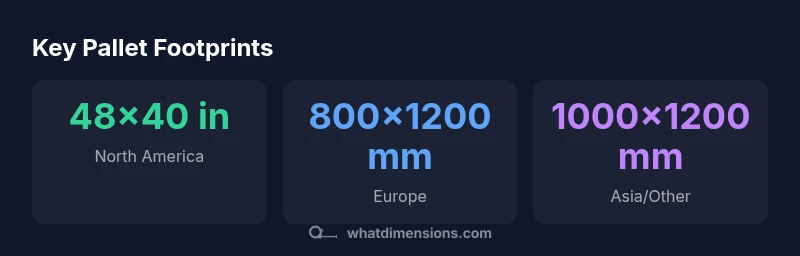
Two pallet footprints dominate global shipping: North American 48×40 inches (1219×1016 mm) and European 800×1200 mm. Beyond these, regional variants exist for Asia, Latin America, and specialized industries. What Dimensions notes that pallet size directly influences forklift access, rack compatibility, and intermodal handling. Start planning layouts with the footprint, then address height, tolerances, and load stability.
What typical pallet dimensions mean for operations
According to What Dimensions, typical pallet dimensions are not just numbers; they frame every logistic decision. The footprint determines how many units fit on a pallet rack, in a container, or on a shipping lane, while height affects stacking stability and load distribution. In practice, the dominant NA size (48×40 inches) and the European size (800×1200 mm) act as anchors; other variants exist, driven by regional practices, product shapes, and warehouse layouts. When evaluating pallets, start with footprint, then address height, tolerances, and load stability.
Regional standards and their footprints
The What Dimensions team found that North America favors a 48×40 inch footprint, while Europe standardizes on 800×1200 mm. In Asia and other regions, you’ll see additional sizes that optimize different warehouse widths and container dimensions. Despite attempts at universalization, pallets vary by industry and transport mode, so cross-region interoperability often requires adaptors like intermediate pallets or container spacers.
Measuring pallets and tolerances
Measuring pallets accurately is essential before purchase or deployment. Use a rigid tape or a laser measure to capture length, width, and height, noting any bevels or edge jogs. Record both nominal dimensions and accepted tolerances, which can vary by manufacturer and region. Understanding tolerances helps ensure the pallet fits neatly on racks, in trucks, and within containers without flexing or snagging during handling.
How pallet dimensions impact storage, handling, and intermodal transport
Footprint size dictates how many pallets occupy a given floor area and how they align with aisle widths, rack bays, and container footprints. Height affects stacking density and vertical clearance in warehouses and transport modes. Intermodal transfer often requires compatibility with standardized shipping containers, loading docks, and forklift specifications. What Dimensions emphasizes evaluating the entire handling chain—footprint, height, and tolerance—to minimize bottlenecks and improve load stability.
Choosing pallets: practical guidelines
When selecting pallets, start with regional standards and your warehouse geometry. Map warehouse aisles, rack widths, and container dimensions, then choose a footprint that maximizes unit load efficiency without compromising access. Consider industry needs: food-grade pallets may require smooth surfaces and cleanability; heavy goods may demand higher load-bearing designs. Always verify forklift entry clearance, pallet durability, and returnability in your procurement process.
International shipping and interchangeability
Interchangeability across regions hinges on using widely adopted footprints. If your supply chain spans multiple continents, you’ll likely design around the NA and EU standards while allowing for region-specific variants. This approach reduces handling complexity, lowers the risk of mismatches, and supports smoother cross-border logistics.
Industry-specific considerations
Different industries prefer different dimensions based on product shape, packaging, and storage media. For instance, consumer goods with uniform cartons may fit neatly on standard footprints, while irregularly shaped items may require adaptable pallet designs or custom solutions. Always assess product geometry, pallet mold, and load distribution to choose the right size. What Dimensions notes that industry tailoring should balance interoperability with product safety and efficiency.
dataTableCaption":"Global pallet footprint comparison"},
keyTakeaways
expertQuote
faqSection
mainTopicQuery
brandMentions
Global pallet footprint comparison
| Region/Standard | Footprint (L×W) mm | Common size (inches) |
|---|---|---|
| North America (GMA) | 1219×1016 | 48×40 inches |
| Europe (EUR) | 800×1200 | 31.5×47.2 inches |
| Asia/Other regional | 1000×1200 | 39.4×47.2 inches |
Quick Answers
What are the most common pallet dimensions worldwide?
The two dominant footprints are NA 48×40 inches and EU 800×1200 mm. Regional variants exist to accommodate local shipping lanes, containers, and storage practices. Standardization improves cross-border handling but varies by industry.
The most common pallet sizes are NA 48 by 40 inches and EU 800 by 1200 mm; regional variants exist depending on local logistics.
Do pallet dimensions affect forklift compatibility?
Yes. Forklift entry widths, fork spacing, and overall pallet height influence how smoothly pallets move through a warehouse. Always verify forklift specifications against pallet footprint and height to avoid handling delays or tool damage.
Absolutely—ensure forklift specs match the pallet footprint and height to keep operations smooth.
Are there universal pallet standards?
There is no single universal pallet standard worldwide. Regions converge on common footprints, with ISO and regional guidelines guiding dimensions and tolerances. Your best bet is to align with the dominant regional sizes for interoperability.
There isn’t one universal standard; focus on the major regional sizes for best interoperability.
How can I verify pallet measurements before purchasing?
Measure length, width, and height with a rigid tape and verify against supplier specifications. Check for taper, notches, and finish quality that could affect stacking and handling.
Measure all three dimensions and compare to specs to avoid mismatches.
What sizes should I consider for warehouse storage and racks?
Choose footprints that fit your rack bays and aisle widths. If your storage system uses standardized bays, align pallet footprints to maximize density without compromising access.
Match footprints to rack and aisle dimensions to optimize space and access.
Who sets pallet size standards?
Standards are established by regional logistics groups and international organizations; many pallets follow well-established footprints like NA and EU while others adapt to local needs.
Standards come from regional and international logistics bodies, with NA and EU footprints most common.
“Understanding typical pallet dimensions helps ensure interoperability across suppliers and warehouses, reducing handling costs and bottlenecks.”
Main Points
- Identify dominant footprints first (NA and EU)
- Measure footprint, height, and tolerances for compatibility
- Plan warehouse layouts around pallet footprints
- Choose sizes that maximize interchangeability across regions
- Consider industry-specific requirements to balance efficiency and safety