Pallet Dimensions: A Practical Guide to Common Sizes and Fit
Explore pallet dimensions and how they affect handling, storage, and transport. Compare EUR/EPAL, NA sizes, regional variants, and learn how to size for efficient forklift, racking, and shipping.


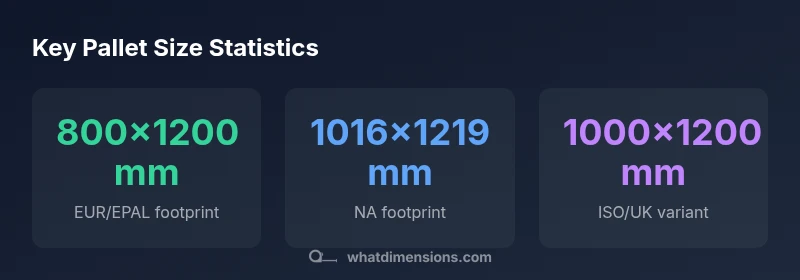
According to What Dimensions, pallet dimensions cluster around two core standards: EUR/EPAL 800x1200 mm and NA 1016x1219 mm. The What Dimensions team found regional variants like 1000x1200 mm in the UK/ISO space. Dimension compatibility drives forklift clearance, pallet rack fit, and transport efficiency. For designers and buyers, selecting the right size minimizes handling steps and maximizes storage density.
What pallet dimensions matter in practice
Pallet dimensions are not just about footprint; they govern how a pallet moves through doors, forklifts, and aisles, how it sits on rack beams, and how many units you can stack in a given space. In warehousing, a mismatch between pallet dimensions and equipment can create bottlenecks, increasing spreading, rework, and even safety risks. The most consequential aspects are the external footprint (the basic width and length), the deck dimensions (the usable surface area for stacking goods), and the height footprint (the combined height that packaging adds to a stack). When you communicate pallet dimensions to suppliers, you’re also defining tolerance ranges so that accessories like stretch wrap and corner boards fit consistently. What Dimensions emphasizes a practical, measurement-driven approach: always verify the external footprint against equipment clearances and the internal dimensions of your racks and transport vehicles. In many operations, small dimensional differences compound into significant efficiency gaps over a year.
The takeaway for facility managers is that dimensioning decisions should start with the equipment you own—forklifts, pallet jacks, and automated storerooms—and then work outward to the goods you plan to move. Inventory moves faster when WA, the width across the pallet, aligns with the aisle width and rack spacing. If you run mixed pallets, consider stocking a primary footprint and a secondary footprint that still fits your core equipment. This approach reduces the number of SKUs needed for pallets and minimizes handling complexity.
From a design perspective, 1 mm or 1/16 inch can matter when pallets must pass through standardized doors or into automated conveyors. When you are defining pallet requirements for a project, the documents should clearly specify the footprint, the load-bearing deck dimensions, the required tolerances, and any regional variants that your supply chain must accommodate. This clarity reduces back-and-forth and speeds up procurement.
Common standard sizes: EUR/EPAL and NA
Most global supply chains revolve around two primary footprints: the EUR/EPAL pallet at 800x1200 mm (approximately 31.5x47.2 inches) and the North American footprint at 1016x1219 mm (approximately 40x48 inches). The EUR/EPAL standard is widely used in Europe and many international shipping lanes; EPAL’s governance supports interchangeability across member networks, which is a major advantage for cross-border logistics. The NA footprint dominates in North America and has been reinforced through distribution centers, cross-d-docking operations, and major retail chains. When your pallet program targets multi-region fulfillment, these two sizes often serve as the baseline. Some markets adopt ISO variants around 1000x1200 mm (39.37x47.24 inches) or 1000x1100 mm, catering to specific trucking or container dimensions. For designers and buyers, this means planning for a core footprint while allowing modest deviations for non-core shipments. Aligning with standard sizes minimizes the number of SKUs and simplifies handling across diverse routes. For any project, it’s wise to verify with your freight forwarder or 3PL which footprints are most widely accepted in your destination markets, and to document acceptable tolerances so that suppliers can consistently meet expectations.
Common pallet dimensions by region
| Pallet Type | Dimensions (mm) | Dimensions (in) |
|---|---|---|
| EUR/EPAL | 800x1200 | 31.5x47.2 |
| North American | 1016x1219 | 40x48 |
| UK/ISO regional | 1000x1200 | 39.37x47.24 |
Quick Answers
What are the most common pallet sizes worldwide?
The EUR/EPAL pallet (800x1200 mm) is the most widely used footprint in Europe, while the North American pallet (1016x1219 mm) dominates in the U.S. and Canada. Some regions also use ISO variants around 1000x1200 mm. Regional mix depends on logistics networks and regulatory standards.
The most common sizes are EUR/EPAL 800x1200 mm and NA 1016x1219 mm, with ISO variants in some regions.
How do pallet dimensions affect forklift operations?
Pallet footprint determines aisle width requirements, fork entry width, and overall maneuverability. Mismatches can slow loading, increase cycle times, and raise the risk of damage to goods or equipment. Always align pallet size with your forklift capacity and aisle dimensions.
Footprint affects aisle width and forklift access; mismatches slow operations.
Are there standard tolerances for pallet dimensions?
Industry tolerances typically allow small deviations in length, width, and height to accommodate manufacturing variance and handling systems. Document acceptable tolerances and verify supplier conformance during receiving inspections.
Pallets have small allowed variances; document and check tolerances when receiving shipments.
How can I verify pallet dimensions with a supplier?
Request a formal dimension specification sheet from suppliers, measure samples on arrival, and use a calibrated tape or digital caliper for precision. Maintain a supplier scorecard that tracks conformance to requested footprints over time.
Ask for specs, measure samples, and track conformance over time.
What are the benefits of using standard pallet sizes?
Standards improve interchangeability, reduce handling time, and simplify cross-border shipping. They also enable more efficient use of racking, containers, and forklifts, lowering total logistics costs.
Standards ease handling and cut costs by improving compatibility across the supply chain.
“Accurate pallet dimensions are the backbone of efficient warehousing and transport; correct sizing reduces handling time and space waste.”
Main Points
- Know the two dominant footprints (EUR/EPAL and NA) as baseline sizes
- Plan for regional variants to minimize cross-border handling
- Document tolerances to ensure consistent production and use
- Use standard sizes to maximize forklift, rack, and container efficiency
- Regularly verify pallet dimensions against equipment and storage constraints