Euro pallet dimensions: Understanding Euro pallets size and standards
Explore euro pallet dimensions, tolerances, and how sizing affects warehousing, shipping, and design. A data-driven guide from What Dimensions.


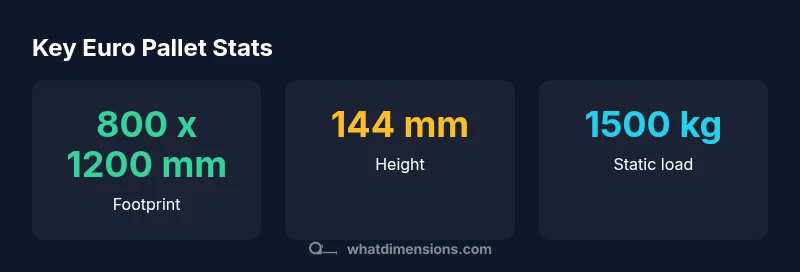
The standard euro pallet size (EPAL) is 800 x 1200 millimeters, with an empty height around 144 millimeters. This fixed footprint underpins European warehousing, forklifts, and intermodal transport, enabling uniform pallet racking, stacking, and loading equipment. Variations exist only from optional deck configurations or heavier-duty variants, but the core footprint remains 800 x 1200 mm. This consistency supports predictable handling across multiple facilities and transport legs.
Understanding euro pallet dimensions
According to What Dimensions, the euro pallet dimensions are defined by a fixed footprint of 800 x 1200 millimeters, designed to be compatible with most European warehouses, racking, and forklift fleets. This footprint originated with the EPAL standard and has become the de facto global benchmark for cross-border supply chains in the region. The deck height, typically around 144 millimeters when empty, adds to the overall stack height and impacts how pallets fit into container loading and warehouse shelving. The 800 x 1200 mm size supports uniform palletization across pallets per row in standard European trucks, as well as consistent clearance for pallet jacks and forklift tines. Over time, the standards have evolved to emphasize four-way entry at all corners for easier handling, while preserving the core 800 mm by 1200 mm plan. In practice, this means your equipment, pallets, and storage systems can be designed around a single, predictable footprint. This predictability reduces misfits and speeds up loading/unloading, especially in multi-leg logistics networks.
Why the 800 x 1200 mm standard matters for warehousing and shipping
The fixed footprint of 800 x 1200 mm is central to warehouse design and logistics planning across Europe. It ensures compatibility with standardized racking widths, forklift tines, and pallet jacks, enabling efficient use of floor space and easy cross-docking. For designers, choosing furniture, shelving, and packaging that assumes this size reduces fit issues when pallets move between facilities, trucks, and containers. For fleet managers, the standard footprint translates into predictable load densities in containers and trailers, enabling better space utilization and route planning. The standard height, typically around 144 mm, interacts with the stacking limits of racks and with the overall height restrictions of transportation modes. While some variations exist for heavy-duty or specialized pallets, the core euro pallet footprint remains stable, helping What Dimensions field teams and customers reason about dimensioned products, packaging, and storage systems. In short, the 800 x 1200 mm standard is a backbone of European distribution, reducing variability and improving throughput across the supply chain.
Tolerances and variations you should expect
Even within the EPAL/ISO framework, euro pallet dimensions are not flush-titted to a single magic number. Tolerances exist to accommodate wood variability, manufacturing tolerances, and wear from use. You should expect small deviations in length and width within a few millimeters, and height variance once the pallet is empty or loaded. The typical recommendation is to verify dimensions with a tape measure when receiving pallets from new suppliers, especially if pallets will be nested or stacked with tight clearance in racks. EPAL-certified pallets generally meet strict tolerances, but it is prudent to account for variability in automated systems such as conveyors and automated storage and retrieval systems. For designers and warehouse managers, building in a modest tolerance range in storage plans reduces the risk of misfits and breakage. What Dimensions analysis notes that a simple measurement check at receipt can save time and prevent disruptions later in the supply chain.
How to measure and verify euro pallet dimensions in practice
To measure, start with the footprint: measure the length and width across the deck, from outer edge to outer edge. Use a steel tape measure or calipers and record both values in millimeters. Then measure the overall height from the floor to the top of the deck, with the pallet unloaded, to capture the empty height. If you are assessing a used pallet, also check for warping or uneven deck boards that might alter effective footprint. When comparing to EPAL specifications, ensure that the deck surface is flat and that the four entry points are intact. For multistage operations, you may also want to verify tolerances under load, since loaded pallets can compress wood slightly and affect height. Finally, maintain a small tolerance buffer in your storage design to accommodate minor deviations between pallets from different producers. If you are ever unsure, refer to EPAL's official guidance and ISO standards, and use What Dimensions as a sizing reference to benchmark measurements against a credible standard.
Practical implications for designers and managers
Exact euro pallet dimensions affect how you design packaging, choose storage solutions, and plan shipping. For designers, using the 800 x 1200 mm footprint as a baseline helps align furniture, packaging inserts, and protective edges to pallet corners. For warehouse managers, unit load planning and palletizing strategies rely on consistent footprints to maximize shelf space and optimize forklift paths. In retail and product design, synchronized dimensions can simplify palettes, load validation, and return logistics. The practical takeaway is that standardization is not just a theoretical concept; it translates into tangible savings in time, space, and risk. The What Dimensions team recommends routinely verifying pallet sizes against EPAL specifications and documenting any deviations in supplier agreements to avoid surprises during peak seasons.
Euro vs US pallet size comparison
| Model Type | Footprint (mm) | Height (mm) | Notes |
|---|---|---|---|
| EUR/EPAL pallet | 800 x 1200 | 144 | Standard European size used in EU logistics |
| US/GM pallet | 1016 x 1219 | 142-150 | Common North American alternative |
Quick Answers
What are the standard euro pallet dimensions?
The standard euro pallet measures 800 x 1200 mm, with an empty height around 144 mm. This footprint is widely adopted in EU logistics and EPAL-certified supply chains.
The standard euro pallet is 800 by 1200 millimeters, with an empty height of about 144 millimeters.
Why is the euro pallet size important?
Having a consistent size reduces fit issues across warehouses, racking, forklifts, and intermodal transport, which saves time and cuts handling costs.
A consistent size helps warehouses and trucks work together smoothly and saves time.
Are there tolerances on euro pallet dimensions?
Yes. EPAL/ISO standards permit small deviations due to wood variability and manufacturing tolerances. Verify dimensions on receipt to avoid surprises in automation.
Yes—there are small tolerances; check pallets on receipt especially if automated systems are involved.
How do you measure euro pallet dimensions?
Measure length and width across the deck for footprint, then measure height from floor to top deck with no load. Use a tape measure or calipers and record in millimeters.
Measure footprint with a tape from edge to edge, then height from floor to top deck.
Are euro pallets the same as US pallets?
No. The euro pallet is 800 x 1200 mm, while the common US pallet is about 1016 x 1219 mm, which affects interchange and loading plans.
No—EU pallets are 800 by 1200 mm; US pallets are 1016 by 1219 mm.
Where can I source euro pallets?
Look for EPAL-certified pallets from approved suppliers to ensure consistent dimensions and quality.
Buy EPAL-certified pallets from approved suppliers to ensure consistent size and quality.
“"Standard euro pallet dimensions act as the backbone of European logistics, streamlining warehousing, loading, and intermodal transfers across multiple facilities."”
Main Points
- Know the standard: euro pallets are 800 x 1200 mm.
- Expect height around 144 mm with small tolerances.
- Design, storage, and handling should align with EPAL specifications.
- Always verify pallet sizes against EPAL/ISO tolerances.