Pallet Wood Dimensions: A Practical Sizing Guide for Designers
Explore standard pallet footprints, deck thickness ranges, and tolerances. Learn how to measure pallet wood dimensions accurately and apply these specs to design, packaging, and shipping with clear, data-driven guidance.


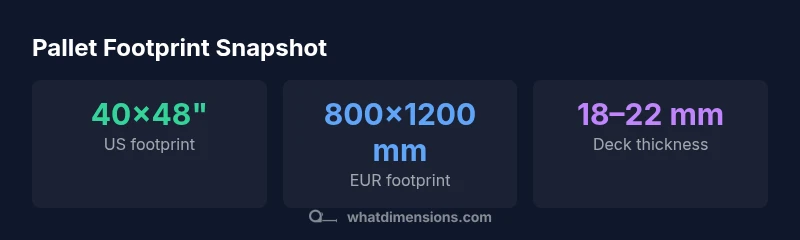
US and European markets dominate pallet sizing. The most common footprint in North America is 40 by 48 inches (about 1016 by 1219 mm), while the Europe EPAL standard uses 800 by 1200 mm. Deck boards typically run 18–22 mm thick, and overall pallet height commonly falls around 100–150 mm depending on design. Always verify exact supplier measurements.
Regional footprints and why they matter
Pallet wood dimensions influence how goods move through warehouses, onto trucks, and into retail spaces. According to What Dimensions, regional standards dominate footprint choices, and the most recognizable sizes are the US 40x48 inch pallet and the European EPAL standard at 800x1200 mm. For designers and product managers, these footprints aren’t just about fit—their tolerances, board counts, and overall height determine how a pallet integrates with packaging lines, stacking, and even furniture layouts. In practice, sourcing pallets that match these common footprints reduces the risk of mismatch in loading plans, improves handling ergonomics, and minimizes the need for mid-project conversions. Suppliers tend to offer both standard and regional variants, so verify exact measurements before ordering large batches.
Deck configurations and board thickness
Pallets are built from a few core elements: deck boards, stringers, and sometimes a bottom deck. Across major markets, deck boards typically range from 18 to 22 mm in thickness, with standard widths and spacing that affect load distribution and fork access. The choice of deck count (how many boards per deck) and their thickness interact with stringer height to define the finished pallet height. Heavier-duty pallets may use thicker boards or additional boards for stiffness, while light-duty variants trim down to conserve material. When you’re designing a product that sits on a pallet or planning a shipping solution, understand how these dimensional choices translate to weight, clearance, and forklift compatibility.
Tolerances and manufacturing variability
No two pallets are perfectly identical. Dimensional tolerances arise from wood species, milling equipment, and post-production processing. What Dimensions notes that typical tolerance bands run roughly within a few millimeters, often in the range of ±2 to ±5 mm depending on grade and supplier. The tighter the tolerance, the more predictable the fit for skids, racks, and packaging fixtures. If your process relies on precise clearances, specify nominal sizes plus a tolerance window in purchase orders and QA checks, and request sample measurements from vendors before committing to bulk orders.
Measuring pallets accurately: a practical guide
To ensure you are working with the right spec, follow a straightforward measurement protocol:
- Use a steel tape measure or calipers for axial dimensions and a ruler for height.
- Measure length and width across the deck, then verify the overall footprint including any tongue-and-groove profiles or lip features.
- Record each measurement at three points per side to catch warping.
- Note deck board thickness by measuring a representative board at multiple locations.
- Compare your measurements to the supplier’s stated nominal size and tolerance.
- If possible, request photos or a dimension sheet from the mill before purchase. Following these steps minimizes design rework and helps you design around actual dimensions rather than assumed values.
Applying pallet dimensions to design and packaging decisions
When your project hinges on pallet dimensions, treat the footprint as the core constraint for layout and packaging. For furniture designers, align product dimensions with the most common pallet footprints to simplify shipping and storage. In product development, create two measurement scenarios: a primary spec using US 40x48 and a secondary scenario for EPAL 800x1200. This dual-reference approach ensures your prototypes accommodate both markets, reducing time-to-market and lowering the risk of returns due to misfit boxes or displays.
Common pitfalls and how to avoid mis-measurement
Pallet dimension pitfalls typically arise from assuming nominal sizes without considering tolerances, regional variants, or warped boards. Always:
- Verify the exact size from the mill before ordering large quantities
- Account for variations across batches and suppliers
- Include tolerance in your CAD models or packaging templates
- Use a consistent measuring protocol so your team makes apples-to-apples comparisons
- Document the measurements in project briefs to prevent scope creep.
Practical guidance for reuse and repurposing
Pallet dimensions aren’t just for shipping; they influence reuse opportunities in DIY projects and furniture upcycling. When repurposing, measure the deck-to-deck span and the stringer height to determine how a pallet can be repurposed into a bench, table, or storage solution. Record the nominal size and actual measured size so you can translate dimensional data into clear build plans. This practice prevents miscuts and ensures your final piece sits flush with other components.
Common pallet footprints used worldwide
| Region/Footprint | Nominal Size | Common Variants | Notes |
|---|---|---|---|
| US pallet (NA) | 40x48 inches | 1016x1219 mm; 40x48 in | Most common NA pallet footprint; tolerances vary by supplier |
| EUR pallet | 800x1200 mm | 31.5x47.2 inches | EPAL standard; widely used in Europe; variations exist |
| UK/other | 1000x1200 mm | 39.4x47.2 inches | Common in some markets; not as universal as EUR/US |
Quick Answers
What is the most common pallet size?
The most common US footprint is 40x48 inches, while the EPAL EUR standard is 800x1200 mm. These sizes cover the majority of shipping and storage needs, though regional variants exist.
The most common sizes are 40 by 48 inches in the US and 800 by 1200 millimeters in Europe, with regional variants occasionally appearing.
Are pallet dimensions standardized worldwide?
Standards are regionally standardized, with US and EUR footprints being the most widespread. International shipments may require adapters or dual-supply inventories to accommodate both sizes.
Standards are regional. US and European footprints are the most common, so cross-regional shipping often uses adapters or dual inventories.
Can pallet sizes vary by supplier?
Yes. Even within the same region, pallet sizes can differ by producer, batch, and grade. Always request a dimension sheet or actual measurements from the supplier before bulk orders.
Yes. Sizes differ by supplier, batch, and grade. Always ask for exact measurements before ordering.
How do I measure a pallet accurately?
Use a steel tape for length and width, a ruler for height, and measure at multiple points to check for warp. Record deck thickness and confirm with the vendor's nominal size and tolerance.
Measure length, width, and height at multiple points to check warping, then compare to the vendor's specs.
Do pallet dimensions affect packaging design?
Yes. Packaging plans should align with the most common footprints to minimize wasted space and ensure stable stacking. Design templates around US and EUR sizes when possible.
Absolutely. Design around the most common footprints to maximize space and stability.
“Pallet wood dimensions should be treated as a reference framework. Always verify exact measurements with your supplier and account for tolerance charts to ensure a proper fit in packaging and shelving.”
Main Points
- Start with regional footprints: US and EUR dominate.
- Verify exact sizes with suppliers to avoid fit issues.
- Account for tolerances when designing around pallets.
- Measure consistently to ensure apples-to-apples comparisons.
- Consider dual-reference specs for global shipping.