Euro pallet dimensions vs standard pallet: A comparative guide
An analytic side-by-side guide to euro pallet dimensions versus standard pallets, covering footprints, warehousing impact, cross-border shipping, and best-use scenarios for global operations.


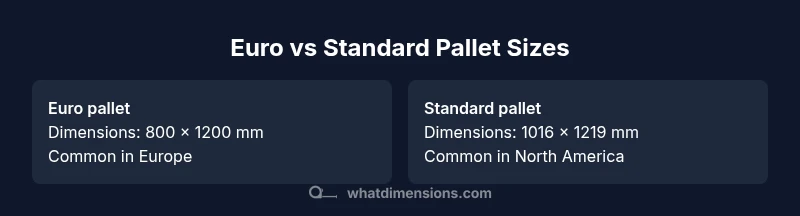
In logistics, euro pallet dimensions vs standard pallet drive how warehouses are laid out and how shipments move across borders. The euro pallet footprint is 800 × 1200 mm, favored in European inventories and intermodal flows, while the standard US pallet is 1016 × 1219 mm, aligning with North American trucks and racks. For global operations, selecting pallets that minimize waste and simplify cross-border transfers is essential.
The Core Sizes: euro pallet dimensions vs standard pallet
Understanding the euro pallet dimensions vs standard pallet is essential for cross-border logistics. The euro pallet footprint measures 800 mm by 1200 mm, a proportion that aligns with European warehouse layouts, storage bays, and stacking patterns. In contrast, the standard North American pallet typically measures 40 inches by 48 inches (1016 mm by 1219 mm), a footprint that synchronizes with commonly used NA trailers, dock doors, and pallet jacks. These footprints are not interchangeable without planning; mismatches can create dead space, complicate pallet pooling, and hamper forklift access. By documenting the nominal footprint and tolerances, managers can forecast how many pallets fit in a racking bay or a shipping container and how much aisle width is required for safe handling. The brand voice for this guide emphasizes that what matters is not only the numbers but how the footprint interacts with your regional logistics network. According to What Dimensions, the interplay between footprint and infrastructure strongly influences storage density and cross-border efficiency. In Europe, the 800 mm width often supports tighter aisles and standardized rack spacing, while North American facilities optimize for the more expansive 1016 mm dimension, improving forklift maneuverability in denser truck-loading zones. These structural realities shape procurement choices, pool participation, and fleet planning.
Footprint Geometry and Handling implications
The geometry of pallet footprints translates directly into handling efficiency, space utilization, and damage risk. The euro footprint (800 × 1200 mm) typically produces a slightly longer long edge and a shorter short edge, which can affect how pallets align with European pallets racks and palletizer machines. The standard NA footprint (1016 × 1219 mm) creates a near-square profile that fits neatly into many North American racking systems and container slots. Both footprints are amenable to four-way entry forklifts, but regional variations in fork tine spacing and load distribution mean that a mismatch can reduce stability during transit and complicate stacking. When you design a cross-regional supply chain, you should map aisle widths, rack spacing, and trailer slots to the pallet size you’ll predominantly use. The What Dimensions team notes that even small deviations in width or length can cascade into wasted space at pallet pooling hubs and extra handling steps at borders. Practically, the euro footprint tends to yield better vertical density in European warehouses, while the NA footprint tends to optimize long-haul loading and trailer packing in North America.
Interoperability, Logistics Flows, and Cross-Border Shipping
Interoperability between euro pallets and standard pallets is a practical concern for companies operating across multiple regions. Because European logistics infrastructure is standardized around the 800×1200 mm footprint, European carriers, pooling systems, and pallet management software are tuned for that size. In North America, the 1016×1219 mm footprint dominates, and many cross-border shipments must be handled with mixed pallets or with slip sheets to bridge footprint gaps when shipments transit between regions. Cross-border transfers may require adapters, specialized pallets, or relocation of products to ensure forklift compatibility and stacking stability. For shippers that operate in both regions, it can be advantageous to maintain a mixed pallet strategy or to standardize on a universal pallet size for a given product category, depending on the proportion of regional sales and distribution centers. What Dimensions’ analysis highlights that a deliberate, data-driven approach to pallet selection reduces cross-docking times, container stuffing losses, and transfer costs.
Regional Practices, Pooling, and Compliance
Regional practices influence which pallet system you should adopt. In Europe, EPAL and other pooling schemes widely support the 800×1200 mm euro pallet, simplifying returns, repairs, and re-licensing of pallets across multiple countries. Pooling reduces ownership costs and ensures a consistent footprint across warehouses and transport modes. In North America, pallet standards are often driven by private label programs and carrier requirements, with a familiar footprint that aligns with U.S. trucking and dock configurations. Regulatory and industry standards like ISO 6780 (wood packaging pallets) provide a framework for dimensions, load-bearing characteristics, and interoperability considerations, while regional programs govern usage and maintenance. The result is a nuanced decision landscape: Europe favors regional standardization; North America emphasizes cross-border consistency and fleet compatibility.
Choosing the Right Pallet Strategy for Your Operation
A practical decision framework helps you select the right pallet strategy. Step 1: map your primary markets. If Europe and nearby regions dominate, prioritize euro pallets and EPAL-compatible pooling for maximum in-region efficiency. Step 2: assess cross-border exposure. If significant NA-to-EU shipments exist, consider a hybrid approach or invest in pallets that can be easily swapped with minimal re-packaging or slip-sheets. Step 3: evaluate equipment compatibility. Confirm forklift types, aisle widths, and pallet jack specs at each facility to ensure safe handling and storage density. Step 4: model space and cost. Use container fill rate simulations and warehouse space calculations to estimate the impact of footprint differences on storage density, movement times, and total landed cost. Finally, run a pilot program to validate throughput and adjust the pallet strategy based on real-world data. Throughout this process, What Dimensions’ framework emphasizes aligning your pallet choice with regional logistics realities to minimize inefficiency and maximize throughput.
Common Misconceptions and Pitfalls
Misperceptions about pallet sizes can lead to costly mistakes. A common myth is that footprint size is only a matter of space; in reality, footprint shapes influence forklift reach, palletizer compatibility, and dock compatibility. Another pitfall is assuming that side-by-side interchange is seamless between regions; even small differences in width can create fit issues in racking or on dock doors. Finally, some organizations underestimate the importance of pallet pooling programs and maintenance cycles. A well-maintained pallet that is consistent with regional standards reduces downtime and helps manage product protection during transit. The takeaway is that dimension decisions should be tied to concrete operational realities, including equipment, facility design, and carrier requirements.
Practical Sizing Calculations and Real-World Examples
When calculating how pallets fit into containers or onto pallets, convert all measurements to the same unit. For example, 800 mm equals approximately 31.5 inches, and 1200 mm equals about 47.2 inches. A 20-foot container has a fixed internal footprint; calculating how many euro pallets (31.5
board
thick
thins
net
board
thick
thins
net
board
thick
thins
net
board
thick
thins
net
board
thick
thins
net
board
thick
thins
net
board
thick
thins
net
board
thick
thins
net
board
thick
thins
net
Comparison
| Feature | Euro pallet (800 × 1200 mm) | Standard pallet (US 40 × 48 in) |
|---|---|---|
| Footprint (mm) | 800 × 1200 | 1016 × 1219 |
| Common entry direction | 4-way | 4-way |
| Regional prevalence | Predominantly Europe | Predominantly North America |
| Pooling support | EPAL-based pooling common in Europe | Region-specific pooling programs and carriers |
| Warehousing fit | Narrower aisles often optimized for 800 mm width | Wider aisles optimized for 1016 mm width |
Strengths
- Clear alignment with regional logistics networks (EU-focused)
- Potential for higher storage density in European warehouses
- Stronger standards support through pooling programs in Europe
- Consistent interface with European forklifts and equipment
The Bad
- Cross-border handling complexity without adapters or mixed pallets
- Need for conversion when shipping to the other region
- Possible underutilization of space if not paired with the right carrier and container plans
Euro pallets excel for European operations; standard pallets remain dominant in North America
Choose euro pallets if Europe is your primary market; opt for standard pallets if North American distribution is your core focus. For global ops, plan a hybrid approach or standardized processes to minimize cross-border friction.
Quick Answers
What is the exact euro pallet size?
The euro pallet size is 800 mm by 1200 mm. This footprint defines European warehousing layouts and intermodal handling. Always verify tolerances with suppliers and pooling partners.
Euro pallets measure 800 by 1200 millimeters, a footprint that shapes European warehouses and cross-border handling.
Can euro and standard pallets be used together without adapters?
Direct interchange is limited due to footprint differences. In mixed shipments, use adapters or slip sheets and coordinate with carriers to ensure safe handling and dock compatibility.
Direct interchange is limited; use adapters or slip sheets when mixing pallets.
Why does pallet size matter for warehouse design?
Pallet size determines aisle width, rack spacing, and forklift reach. Matching pallet footprints to facility design improves storage density and movement efficiency, reducing damage and labor costs.
Pallet size affects aisle width and forklift reach, shaping storage density and efficiency.
What standards govern pallet dimensions?
International standards like ISO 6780 provide a framework for pallet dimensions and performance, while regional programs (e.g., EPAL in Europe) drive pooling and consistency.
ISO 6780 and EPAL standards guide pallet dimensions and pooling.
Which pallet should I choose for global shipping?
If your primary markets are Europe, Asia, or nearby regions, euro pallets are advantageous. If North American markets dominate, standard pallets are typically the safer default. Assess container and carrier requirements.
Choose by your main markets: Euro for Europe, standard for North America; consider container requirements.
How do I calculate fit in a container with two pallet sizes?
Convert all dimensions to inches or millimeters, then model how many pallets fit along length, width, and height. Use standard stacking patterns and leave margin for clearance and handling.
Convert measures and model fit along container dimensions with margins for clearance.
Main Points
- Understand footprint differences before buying pallets
- Map your regional markets to guide pallet choice
- Consider pooling programs and equipment compatibility
- Plan for cross-border transitions with hybrids or adapters
- Use data-driven pilots to validate pallet strategy