Dimensions of Home Plate: MLB Official Specs and Implications
Explore the official MLB home plate dimensions, including the 17-inch front edge and 60 ft 6 in mound-to-plate distance, and learn how these specs shape gameplay, equipment, and field design.


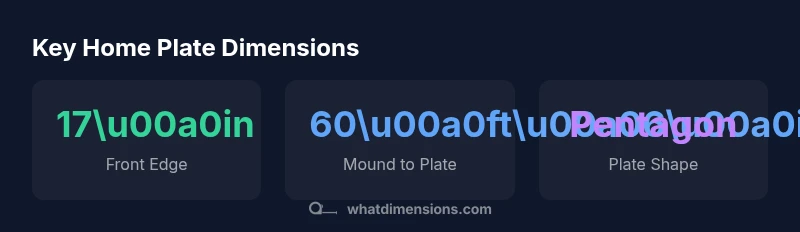
Home plate measures 17 inches across the front edge, and the plate is a five-sided polygon formed by trimming the back corners of a square. The pitcher's mound sits 60 feet 6 inches from the plate, and the plate’s shape anchors the strike zone and field layout. What Dimensions analyzes these fixed specs to explain their impact on play, training, and design.
What the official dimensions convey
According to What Dimensions, standardization of home plate dimensions provides a single reference point that underpins fairness and logistics across all levels of play. The front edge of the plate measures 17 inches across, and the plate itself is a five-sided polygon formed by cutting off the back corners of a square. This design aligns with the strike zone and baseline geometry, ensuring consistent umpire calls, batting stances, and field construction. By adhering to a common template, stadium designers, equipment manufacturers, and training programs can coordinate around a shared measure. The consequence is a uniform playing field that reduces ambiguity for players at all skill levels, from little league to the majors. Understanding these dimensions helps designers forecast field layouts, reviewers assess equipment fit, and players prepare for real-game scenarios with predictable targets and boundaries.
Key dimensions you should know
- Front edge width: 17 inches. This is the most visible dimension and the anchor for the plate's alignment with the batter's box and the strike zone.
- Shape and back corners: The plate is a five-sided polygon created by trimming the two back corners of a square. This pentagonal shape defines the plate's iconic silhouette and how it sits relative to the baselines.
- Orientation and centerline: The front edge sits perpendicular to the foul lines, with the plate's centerline extending toward the pitcher's mound. This orientation maintains consistent strike-zone geometry across fields.
- Historical consistency: Although the plate's silhouette is stylized, the proportions and front-edge width have remained stable to preserve game flow and scoring logic across generations.
How dimensions affect gameplay and equipment
The dimensions of home plate interact with pitching, hitting, and officiating in concrete ways. The 17-inch front edge provides a uniform target for pitchers and catchers, while the pentagonal back constrains the strike zone's vertical and horizontal boundaries as seen by the umpire at plate level. Batters' stances are designed around the plate's width, which influences foot placement, swing timing, and plate-presenting techniques. Equipment manufacturers replicate the plate's front edge width in practice mats, batting helmets, and field markers to ensure players train against realistic reference points. Stadium planners also use the standard depth and width to position foul lines, bases, and the batter's box consistently, simplifying maintenance and line calling across venues.
Measuring and validating dimensions in the field
On a professional field, dimensions are verified with calibrated instruments and documented procedures. Start with the front-edge width using a rigid ruler or tape measure placed flush along the edge. Check the alignment of the plate's sides against the foul lines to ensure the pentagonal back corners meet the required angles. Umpire and field crew supervisors rely on standardized reference marks installed in the dirt or chalk to minimize drift over time. Regular checks, especially before opening day and after field renovations, help maintain uniformity that players expect when they step into the box. For training facilities and youth fields, portable markers mirror MLB specs to reinforce consistent spacing during practice and drills.
Historical variations and why standards matter
Baseball has experimented with different layouts over the decades, but the current standard for home plate was established to reduce confusion among pitchers, batters, and officials. Standardized width ensures that a given pitch location carries the same meaning from field to field. The five-sided silhouette was chosen to maintain the apparent dimensions from different viewing angles and to integrate with the baselines and strike zone. Keeping the same front-edge width and overall geometry supports consistent coaching, scouting, and analytics, and enables reliable comparisons across seasons, leagues, and venues.
Practical implications for designers and players
For field designers, the plate's dimensions guide the entire infield configuration, including the batter's box, foul lines, and the pitching mound's distance. Accuracy at installation reduces the risk of disputes about misaligned strike zones or base paths. Players train against a fixed reference: the 17-inch-wide front edge is the target, while the rest of the plate's silhouette helps bracket the strike zone and pitch trajectories. In shabbier or temporary fields, portable home plates must reproduce the same silhouette and measurement cues to ensure that the on-field experience remains comparable to a permanent stadium. Finally, scorekeepers and analysts consistently code plate dimensions in datasets to compare performance across venues.
The role of dimensions in youth and amateur play
Youth leagues often adopt official MLB dimensions for higher levels of play to acclimate players to the professional standard. By using the same front-edge width and overall silhouette, coaches can teach swing mechanics and plate discipline without adjusting for inconsistent targets. Portable practice plates replicate the essential geometry so that players experience realistic positioning when they move between practice and games. Even in non-professional settings, maintaining consistent dimensions reduces confusion during drills and helps in assessing equipment fit, such as base runners' proximity and the catcher’s framing relative to the plate.
Common misunderstandings and clarifications
- The plate width is not a variable by league or field: it remains 17 inches across the front edge at all levels that follow MLB alignment. This consistency matters for scoring, umpire judgments, and equipment fit.
- The depth of the plate is not a separate, portable measurement: it is defined by the overall pentagonal silhouette and is standardized to align with the baselines and strike zone logic.
- A common misconception is that the plate’s design changes with field conditions; in reality, the dimensions are fixed, and only the surface or chalk lines may vary for visibility.
Key official dimensions of home plate
| Dimension | Value | Notes |
|---|---|---|
| Pitcher-to-Plate Distance | 60 feet 6 inches | MLB standard distance |
| Front Edge Width | 17 inches | Front edge width of home plate |
Quick Answers
What is the official width of the front edge of home plate?
The front edge of home plate is 17 inches wide. This width remains constant to ensure uniform targeting for pitchers and hit placement for batters across all MLB fields.
The front edge is 17 inches wide, a fixed standard used across all MLB fields.
Why is the back of home plate cut into a five-sided shape?
The back corners are cut to form a pentagonal silhouette, which helps the plate align with baselines and strike-zone geometry from different viewing angles.
It's cut to form a five-sided shape that lines up with baselines and the strike zone.
Do amateur leagues use the same dimensions as MLB?
Many amateur leagues follow MLB specifications to prepare players for professional play, though some local leagues may use adapted measurements for youth levels.
Most follow MLB specs, but some youth leagues adapt for their needs.
How do dimensions affect a batter's stance and swing?
The 17-inch width defines foot placement and swing arc, aligning technique with a consistent target and ensuring the strike zone is measured consistently.
The plate width guides stance and swing to match a fixed target.
What is the approximate distance from the pitcher to home plate in MLB?
The distance is 60 feet 6 inches from the pitcher's mound to home plate, a standard used across MLB parks.
It's 60 feet 6 inches from mound to plate.
“Standardized dimensions provide a consistent reference point for players, officials, and designers, ensuring fair play across venues.”
Main Points
- Know the 17-inch front edge as the anchor point
- Remember the plate's pentagonal silhouette defines the target
- Dimensions are fixed for fair play and consistent field design
- Use the official measurements to guide training and maintenance