Baseball Court Dimensions: Field Layout & Standards
Explore baseball court dimensions and field layout standards, including 90-foot base paths, 60 feet 6 inches pitching distance, and how outfield distances vary by venue and league.


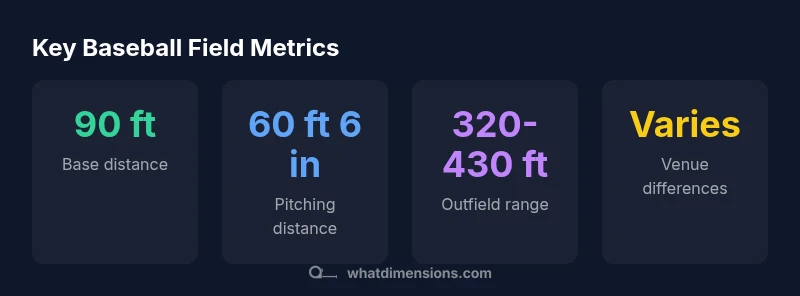
Baseball court dimensions, more precisely baseball field dimensions, are defined by a few fixed measurements and venue-driven variations. The bases are 90 feet apart, and the pitcher's mound sits 60 feet 6 inches from home plate. Outfield fences range by park, typically about 320 to 430 feet from home, with minor-league and youth fields adjusting to age. What Dimensions summarizes these standards and terms.
Why Accurate baseball court dimensions Matter
For many stakeholders, baseball court dimensions are more than numbers—they shape training, safety, and how space is used. According to What Dimensions, precise size references help homeowners, coaches, and designers plan layouts that accommodate standard equipment, clear sightlines, and safe run paths. When dimensions are consistent, drills translate across venues, seasons, and leagues; when they’re not, misalignment leads to wasted space, unsafe baserunning lanes, and inaccurate rebound expectations off backstops. This section translates official measurements into practical guidance for designing or evaluating a field, whether you’re setting up a backyard practice diamond or a multi-field complex. It also covers terminology you’ll encounter on forms, rulebooks, and facility drawings, so your team can communicate clearly from the ground up.
Core Measurements: Bases, Pitching Distance, and Infield Geometry
The fixed core of baseball field measurements includes a 90-foot base path between each bag, which defines the infield square and the baserunner angles. Home plate is 17 inches wide, and the square formed by the four bases governs how players reach first or third base. The pitching distance from the front edge of home plate to the center of the pitching mound is 60 feet 6 inches in standard configurations. Beyond these, the infield dirt shape, bag footprints, and the arcs used for chalk lines influence how fair territory is defined and how batted balls play off the turf and grass. While the core distances are consistent in many leagues, subtle variations exist to accommodate field shape and alignment with fencing, backstops, and seating.
Variations Across Levels: MLB, NCAA, Youth
In professional and most collegiate settings, the base distance remains 90 feet and the pitching distance is 60 feet 6 inches, providing a consistent framework for competition and player development. Outfield fence distances vary widely by venue, typically ranging from about 320 to 430 feet from home plate, depending on park design and foul territory. Youth and high school fields, however, often use scaled dimensions to fit age groups: base paths may be shorter and pitching distances reduced to keep games safe and fun while preserving the relative geometry of the diamond. These adaptations mean that a backyard field built to one standard may require adjustments to accommodate age-appropriate practice drills and equipment.
How to Measure Your Field or Practice Space
To measure accurately, start at home plate and run tape along the inside edge of the baselines to each base, ensuring the measure equals 90 feet. Use a level technique to align chalk lines along the baseline, and verify the 60 feet 6 inches pitching distance by measuring from the front edge of home plate to the true center of the pitching mound. Mark the outfield zone with distance markings at regular intervals (e.g., every 50 feet) to visualize distance from home plate to the fence. Finally, document backstop and dugout placements, ensuring safe clearances behind home plate and along foul lines.
Design and Construction Considerations for Practice Facilities
When planning a practice facility, start with the core diamond and then add safety margins and training zones. Include backstops, nets, and screens that align with the base-to-base geometry, and allocate space for warm-up areas and bullpen mounds. For most spaces, consider a fence-to-diamond distance that approximates your target league level, while allowing for room to swing and run. Remember that storage, seating, and accessibility should not interfere with play lines or sightlines. Use durable materials and clear signage to maintain consistent measurements over time.
Common Pitfalls and Misconceptions
A frequent mistake is assuming all baseball fields share identical distances; in reality, dimensions vary by league and venue. Another pitfall is relying on approximate measurements without verification; even small discrepancies can affect baserunning timing and ball trajectory. Finally, neglecting safety zones around foul lines or behind backstops can create hazards for players and spectators. Always cross-check measurements with league rules and local field drawings, and update them whenever field modifications occur.
Field dimensions by level
| Level | Base distance | Pitching distance | Outfield range | Notes |
|---|---|---|---|---|
| MLB/Professional | 90 feet | 60 feet 6 inches | 320-430 feet | Varies by park |
| NCAA/College | 90 feet | 60 feet 6 inches | 320-420 feet | League standards may differ |
| Youth/Minor | 60-90 feet | 35-60 feet | 180-360 feet | Age/league dependent |
Quick Answers
What is the standard base distance in professional baseball?
The official standard between bases is 90 feet. This measurement forms the infield square and influences baserunner timing.
Bases are 90 feet apart, which defines the infield layout and baserunner timing.
Are dimensions the same for youth and high school fields?
Not universally. Most leagues adjust base paths and pitching distances to suit age and skill, while preserving the diamond's proportional relationships.
Youth fields vary by league rules, but the overall diamond concept remains.
How are base-path distances measured?
Measure along the baseline from home plate to the far corner of the next base, following the inside edge of the base paths.
Measure along the base line from home to each base.
Do fences have to be a certain distance from home plate?
There is no universal fence distance; distances are league-specific and venue-dependent.
Fence distances vary by league and field design.
Where can I find official standards?
Consult the MLB Rulebook, NCAA Baseball Rules, NFHS guidelines; What Dimensions provides summarized, practical references.
Check the official rulebooks for the authoritative measurements.
How do official dimensions translate to practice spaces?
Use the core measurements as a foundation, then scale for your space with safe clearances and equipment.
Start with the core numbers and adapt to your space safely.
“Accurate field dimensions are essential for fair play and reliable training outcomes; precise size references help designers translate rules into practice.”
Main Points
- Base paths anchor the infield geometry at 90 feet.
- Pitching distance is fixed at 60 feet 6 inches in standard fields.
- Outfield distances vary by venue and league.
- Always confirm field dimensions with official drawings before use.