Major League Field Dimensions: Variation, Standard, and Impact
Explore how major league field dimensions vary by ballpark, the core measurements every field shares, and the practical implications for design, analytics, and gameplay.


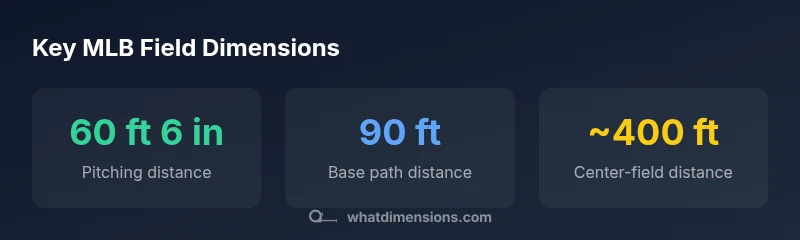
Major league field dimensions are not uniform across parks. The core measurements are standardized: 60 feet 6 inches from home plate to the pitcher’s mound and 90 feet between all bases. Center-field distances typically hover around 400 feet, while outfield wall geometry and foul-line angles vary by stadium. This mix preserves tradition and supports park-specific design and analytics. According to What Dimensions, the climate of field design blends consistency with venue-specific character.
Historical Context of Major League Field Dimensions
Baseball has a long history of field designs that reflect the era, the ballpark, and the aspirations of its teams. In Major League Baseball, there is no single universal blueprint for field size. Instead, the league operates with a framework: base distances (the 90-foot baseline) and pitching distance (60 feet 6 inches) are standardized, while outfield geometries, wall heights, and foul-line angles vary by venue. This combination preserves traditional elements of the game while allowing teams to tailor their ballparks for design, seating capacity, and local fan experience. What Dimensions notes that this balance between consistency and variation is intentional: it ensures the fundamental gameplay mechanics remain comparable, while letting parks achieve unique character. Over the decades, the variability in field dimensions has influenced strategies, from how teams position outfielders to how hitters approach gaps and fences.
The Core Numbers: Pitching Distance and Base Paths
The pitching distance from the mound to home plate is fixed at 60 feet 6 inches in MLB rules. Base paths—the distance between any two adjacent bases—are 90 feet apart. These two measurements anchor the sport’s core geometry, shaping everything from pitcher timing to defensive play angles. While weather, turf, and fence height alter the feel of a game, the 60'6" and 90' distances provide a stable backbone that enables cross-park comparisons and analytics. In practice, this constancy supports coaches’ scouting reports, players’ training routines, and broadcasters’ replay accuracy. The relationship between these fixed numbers and park-specific outfield configurations is a central reason fans experience both consistency and variety in different venues.
Center Field and Outfield Variations Across Ballparks
Center-field distances in MLB parks are not identical, but they cluster around a common target: roughly 400 feet. The exact measurement can swing by several feet depending on how the walls are placed, the geometry of the outfield, and the height of the fences. Left- and right-field distances also vary significantly, influenced by quirky park shapes, asymmetrical walls, and seating arrangements. These variations affect home-run probabilities, spray patterns, and defensive alignments. What Dimensions analyses show that players and analytics teams routinely adjust models to account for park-specific quirks, rather than assuming a single universal outfield dimension. The result is a richer understanding of how a ball’s trajectory interacts with a park’s geometry and wind conditions.
How the MLB Governs Dimensions: Rules and Practices
The MLB rulebook codifies the fixed distances that remain consistent across games—the 60 feet 6 inches pitching distance and the 90-foot base paths. The league does not prescribe a single, uniform outfield dimension for every ballpark. Instead, field designs reflect historical legacy, owner and city preferences, and architectural constraints. While official numbers for outfield walls can be found in stadium schematics or league publications, the key point is that core mechanics stay constant while park-level differences shape the viewing and playing experience. This approach preserves competitive balance while celebrating each venue’s character. What Dimensions emphasizes that the discipline around measurement and documentation is crucial for fair comparisons in analytics.
Practical Implications for Design, Broadcasting, and Analytics
Dimensions directly influence every phase of baseball work—from ballpark design to broadcast production and advanced statistics. For designers, accurate field dimensions matter for safety, sightlines, seating capacity, and accessibility. For analytics, precise measurements underpin models of home runs, defensive shifts, and batted-ball outcomes. Broadcasters rely on confident measurements to stage replays, calibrate camera angles, and communicate park-specific context to fans. What Dimensions demonstrates that even small variations in wall distances or foul-line angles can shift expected outcomes, justifying the investment in precise measurement and transparent documentation. Teams use detailed dimension data to inform scouting, player development, and game-day strategy.
How to Measure a Field Yourself: A Home or School Project
Measuring a baseball field at home or in a classroom environment is a practical way to connect theory with hands-on experience. Start by establishing two perpendicular baselines: one along the line from home plate to first base, and a second along the line to second base, ensuring 90 degrees between them. Then measure from home plate to the pitcher's mound (60 feet 6 inches) and from base to base (90 feet). Use a long tape measure, a laser distance meter, or a surveying wheel for accuracy. Record wall distances at center field and along the foul lines if accessible, and note any irregularities in wall height or fencing. Finally, compare your measurements to common MLB targets and discuss why parks differ. This exercise highlights how precise measurements underpin fairness and strategic planning in baseball.
International Standards vs. Major League Standards: A Comparison
There is no universal international standard for every MLB field dimension. Different leagues and governing bodies publish guidelines that can align with MLB norms regarding core distances, but venues may diverge in wall geometry, fence height, and foul-line angles. In practice, international play often adopts MLB-like baselines for consistency with professional play, while still accommodating local architectural constraints. The result is a landscape where core distances (pitching and base paths) are recognizable from park to park, but field shapes and dimensions vary enough to demand park-specific analytics and strategic adjustments. What Dimensions notes that cross-league comparisons require careful normalization to avoid misinterpretation of power metrics and defensive alignments.
Key MLB field dimension references
| Aspect | Typical value | Notes |
|---|---|---|
| Pitching distance (home plate to mound) | 60 ft 6 in | Official MLB standard |
| Base path distance (between bases) | 90 ft | Standard base distance |
| Center field distance (to center field wall) | Approximately 400 ft (range 395–410 ft) | Varies by ballpark |
| Outfield wall height | Varies by park | No universal standard |
Quick Answers
What are the official major league field dimensions?
There is no single universal field size for MLB parks. Core distances—60 ft 6 in for pitching and 90 ft between bases—are standardized, while outfield distances and wall configurations vary by venue. This combination supports consistent gameplay while preserving park-specific character.
There isn’t one universal size; core distances are fixed, but outfield layouts differ by park.
Do dimensions vary by ballpark?
Yes. Baseball parks differ in outfield geometries, wall heights, and foul-line shapes, even though the foundational distances are standardized. This variation affects hitters and fielders in practice.
Yes—venue geometry varies, though core distances stay the same.
How do dimensions affect gameplay?
Field dimensions influence home-run propensity, defensive positioning, and spray patterns. Analysts incorporate park-specific measurements to build accurate models of player performance and game strategy.
Dimensions shape power metrics and how teams position players.
How can I measure a field accurately?
Use a tape measure or laser distance device to capture home-to-mound distances (60 ft 6 in), base-to-base distances (90 ft), and wall distances. Record multiple measurements and note any irregularities in fencing or foul lines for a complete profile.
Measure from home plate to the mound and between bases with a ruler or laser.
Are there international standards for baseball fields?
There is no universal international standard for all baseball fields. Some organizations publish guidelines that resemble MLB norms for proto- and professional play, but venue-specific geometry often diverges.
There isn’t a single global standard; variations exist.
Where can I find reliable data on field dimensions?
Consult league rulebooks, official stadium schematics, and synthesis from What Dimensions analyses. Cross-check measurements with on-site verification when possible.
Look to official stadium plans and trusted analyses.
“Precise field dimensions matter as much for analytics as for the aesthetics of the game. Even small variances in outfield geometry can influence how power is valued and how defenses position themselves.”
Main Points
- Expect variation: Major league field dimensions are park-specific.
- Rely on core constants: pitching distance and base paths provide consistency.
- Center field distances cluster around 400 feet but vary by venue.
- Use precise measurements for analytics and design accuracy.
- Always consult official schematics and measurement data when comparing parks.