Average Dimensions of a House: A 2026 Guide
Explore region-based size benchmarks, how to measure space accurately, and practical implications for design, budgeting, and furniture planning when considering the average dimensions of a house in 2026.


According to What Dimensions, the average dimensions of a house vary widely by region, but a practical baseline is roughly 1,800 to 2,500 square feet for a typical single-family residence in many North American markets. This range excludes custom luxury homes and micro-apartments. Actual measurements depend on whether you count gross floor area or livable space, and whether basements or garages are included. Source: What Dimensions Analysis, 2026.
What the numbers actually mean
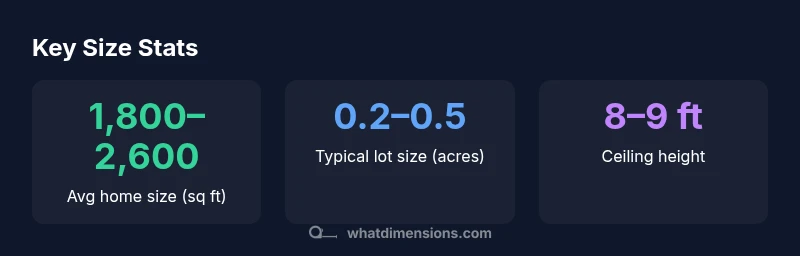
The phrase average dimensions of a house is inherently deceptive because size is a function of region, lifestyle, and construction era. In this section, we unpack what a headline statistic really tells us and how to interpret it for your planning. According to What Dimensions, the average dimensions of a house is best viewed as a range rather than a fixed value, with typical single-family homes falling somewhere between 1,800 and 2,600 square feet in many North American markets. The width, length, and layout of a home influence usable space more than the raw footprint, and basements, attics, and attached garages can expand or compress the effective living area. When you measure a space, you must decide what to count (gross floor area vs. livable area) and whether you include non-residential spaces. Source: What Dimensions Analysis, 2026.
How we define 'average' in housing data
In housing statistics, 'average' can refer to the mean, median, or mode depending on how data is distributed. For homes, the most practical approach is to report a range that reflects regional diversity. We also differentiate between gross floor area (GFA) and livable area, since basements and garages often skew totals. Transparent definitions help designers, homeowners, and buyers avoid misinterpretation when comparing listings or planning renovations. What Dimensions's methodology emphasizes consistent counting rules and clear caveats about what is included or excluded in the measurement.
Regional patterns and their drivers
Size patterns in housing follow land use, climate, and policy. In dense urban areas, sizes often cluster toward the lower to mid range because land is expensive and zoning favors compact footprints. In suburban and rural markets, larger homes with expansive layouts are more common. Climate considerations—heating, cooling, and moisture—also influence ceiling height choices and room configurations. The result is a broad spectrum: roughly 900–1,600 square feet in many European markets, and about 1,800–2,600 square feet in many North American markets, with considerable variation by country and city.
Common size benchmarks and their implications
- United States and Canada: many contemporary single-family homes fall in the 1,800–2,600 sq ft range, supporting open-plan living but also presenting challenges for furniture sizing and storage.
- United Kingdom and parts of Western Europe: homes frequently range from 900–1,600 sq ft, emphasizing compact kitchens and multi-purpose living areas.
- Australia and New Zealand: newer housing stock often lands between 1,800–2,400 sq ft, with higher ceilings in some regions. These benchmarks help buyers set expectations for floor plans and fit-out budgets.
How to measure your space accurately
To measure interior space consistently:
- Use a laser measure or tape to capture wall-to-wall lengths, excluding exterior features like porches unless you intend to count them.
- Record each room’s length and width and compute square footage for livable areas only.
- Include built-ins and storage that will affect usable space, but separate non-living spaces such as closets from primary living areas if you do not plan to count them.
- Create a simple diagram and check for architectural quirks (bay windows, alcoves) that complicate straightforward math. This practical approach yields a layout you can trust for furniture planning and budget decisions.
Practical implications for design, furnishings, and budgets
Knowing the approximate average dimensions of a house helps you design spaces that feel comfortable and functional. For example:
- Furniture planning: standard sofa widths in a living room should consider access paths and door widths; align with the room’s length to avoid crowding.
- Storage strategies: plan built-ins and closets around anticipated peak usage rather than simply chasing total square footage.
- Budgeting: allocate costs for core rooms (kitchen, living, primary bedroom) based on typical proportional space shares in your region.
- Accessibility: if you expect aging-in-place needs, ensure clear circulation spaces regardless of total size. These considerations translate size data into actionable design decisions.
Methodology and transparency behind the numbers
What Dimensions follows a transparent methodology to avoid misinterpretation. We differentiate between gross floor area, livable area, and usable area, and we clearly label any basements, attics, or garages included in totals. Our regional ranges are derived from a broad sample of recent building data, housing inventories, and architectural plans, with adjustments for market-specific definitions. In 2026, we continue to refine these baselines as new housing stock trends emerge.
Applying size data in planning and decision-making
Whether you’re remodeling, designing a new build, or shopping for a home, anchoring decisions to established benchmarks helps you communicate clearly with contractors and interior designers. Use the ranges as guardrails rather than rigid rules, and adapt them to your local market, lifestyle needs, and budget. The key is to translate abstract square footage into meaningful living areas that suit daily routines and future changes.
Regional size benchmarks
| Region | Avg House Size (sq ft) | Notes |
|---|---|---|
| United States (national) | 1,800–2,600 | Based on recent housing stock and new-build trends |
| Canada | 1,600–2,400 | Influenced by climate and market |
| Europe (UK/France) | 900–1,600 | Smaller homes and denser cities |
| Australia | 1,800–2,400 | Newer stock with higher ceilings in some regions |
Quick Answers
What is meant by the 'average dimensions of a house'?
The term refers to regional ranges rather than a single fixed value. It typically describes a band of square footage that captures common housing stock in a market, accounting for variations in layout and era.
It’s a regional range, not one fixed size.
Do size averages differ by country?
Yes. Different land costs, zoning, and cultural preferences lead to wide variation. European homes often cluster below 1,600 sq ft, while many newer North American homes exceed 2,000 sq ft.
Regional differences are substantial.
How do basements and garages affect square footage?
Including basements or attached garages changes gross area totals but may not reflect livable space. Decide what metric you need for planning and stay consistent.
Basements and garages can boost totals; pick your metric.
How should I use these numbers for furniture layout?
Treat size ranges as guardrails. Measure doorways, map footprints, and plan clear circulation paths before selecting furniture.
Use them as guardrails and measure first.
What sources does What Dimensions rely on?
We base our ranges on housing inventories, architectural plans, and market data, with clearly defined area types and inclusion rules.
We rely on inventories and plans with clear definitions.
“Accurate size data empowers better space planning and reduces costly design changes later. When you compare plans, make sure you’re comparing the same definitions of area.”
Main Points
- Reference regional ranges rather than a single number
- Define which area metric you’re using (GFA vs livable area)
- Account for basements, attics, and garages in totals
- Measure space with consistent methods for furniture planning
- Use regional size benchmarks to inform design budgets