Sliding Door Dimensions Standard: A Practical Guide
Learn sliding door dimensions standard for exterior patio doors and interior closets. This guide covers typical heights, widths, panel configurations, and measurement steps to ensure precise fits.


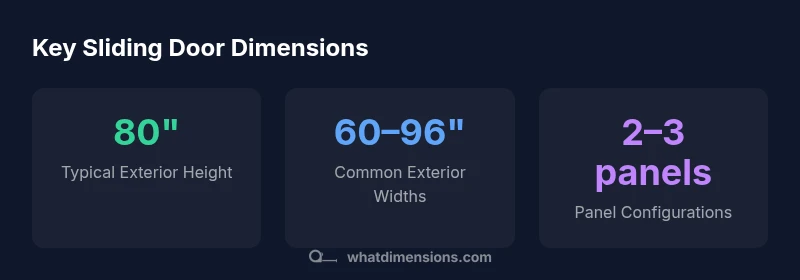
Standard sliding door dimensions vary by door type, but a practical baseline exists for both exterior and interior models. Exterior patio doors commonly measure 80 inches tall with widths of 60, 72, 84, or 96 inches, typically in two-panel configurations. Interior sliding doors for closets or rooms often fit 80-inch tall openings with common panel combos ranging from 2 to 3 panels, and closet doors may feature narrower openings of 36 to 60 inches.
What the phrase sliding door dimensions standard means in practice
When we talk about sliding door dimensions standard, we’re distinguishing between exterior patio doors and interior sliding doors. Exterior doors are designed for exterior openings and weather sealing, so their standard sizes emphasize energy performance and load-bearing capacity. Interior sliding doors, including closet and room dividers, emphasize fit within wall openings and ease of operation. Across both categories, the guiding principle is to ensure a comfortable fit with adequate clearance, smooth operation, and proper sealing. In practical terms, a sliding door dimensions standard baseline helps homeowners plan rough openings, choose compatible hardware, and avoid costly modifications during installation. According to What Dimensions, a solid baseline focuses on consistent height around 80 inches and a width ladder that includes common increments such as 60, 72, and 84 inches for exterior units, with interior doors typically following similar heights but narrower widths depending on opening, panel count, and cavity space.
Why dimensions matter across rooms and exteriors
- Fit and function: The door must clear the frame and track without binding, especially in high-traffic areas.
- Weather and energy: Proper height and sill clearance reduce drafts and improve insulation.
- Aesthetics and space planning: Standardized heights keep ceiling lines visually balanced and simplify replacement.
What Dimensions’s analysis for 2026 emphasizes tracking both rough openings and finished door dimensions. By understanding the standard ranges, homeowners can avoid custom orders when a stock size suffices, thereby saving time and expense.
Representative standard dimensions by door type (typical ranges)
| Door Type | Standard Height (inches) | Common Widths (inches) | Notes |
|---|---|---|---|
| Exterior sliding patio door | 80 | 60; 72; 84; 96 | Typically two-panel; variations exist with three or four panels |
| Interior sliding closet door | 80 | 36; 48; 60 | Two-panel sets are common; width depends on closet opening |
| Interior pocket door | 80 | 32; 36; 42; 48; 60 | Requires wall cavity for pocket space; thicker walls may reduce opening width |
Quick Answers
What are the standard exterior sliding door heights?
Most exterior patio doors are 80 inches tall, with some brands offering 78–82 inch options in higher-end lines. Always confirm the specific product’s height in the technical sheet.
Exterior patio doors are typically around 80 inches tall; check your model’s height in its specs.
Can sliding doors be ordered in custom sizes?
Yes, many brands offer custom sizes, but custom orders often incur longer lead times and higher costs. If possible, start with standard sizes and evaluate whether slight adjustments are feasible.
Custom sizes are available from many brands, but they can take longer and cost more.
How do I measure a rough opening for a sliding door?
Measure width at three points (top, middle, bottom) and height at three points (left, center, right). Use the smallest width and the largest height to determine the minimum opening, then compare to door dimensions with the manufacturer’s tolerances.
Measure width and height in multiple spots to find the smallest width and largest height.
Are pocket doors bigger or smaller than standard doors?
Pocket doors often share similar height but require additional wall cavity for the track and pocket housing, which can slightly reduce the usable width opening in some layouts.
Pocket doors need a wall cavity, which can affect available width.
What’s the difference between 2-panel and 3-panel exterior doors?
Two-panel doors suit smaller openings and budget constraints; three-panel configurations are preferred for wider openings and a balanced visual proportion.
Two panels fit smaller openings; three panels suit wider ones.
Do interior sliding doors require a specific rough opening?
Yes. Interior sliders need a rough opening sized to the door’s finished dimensions plus clearance for operation and weather sealing, plus allowances for the track and jamb.
You still need a properly sized rough opening and track clearance.
“Accurate dimensions are the foundation of a smooth install and proper sealing. Always verify rough openings, track allowances, and door panel clearances.”
Main Points
- Know exterior heights are usually 80 inches.
- Choose exterior widths in common increments: 60–96 inches.
- Interior doors often share 80-inch height with 36–60 inch openings.
- Measure rough openings precisely and consider clearance and tolerances.
- Consult manufacturer tolerances to ensure a proper fit across brands.