Dimensions of Sliding Glass Door: A Practical Guide
Learn how to read, measure, and plan for sliding glass door dimensions. This guide covers width and height ranges, rough openings, trim considerations, and how to choose standard vs custom sizes with precise sizing guidance from What Dimensions.


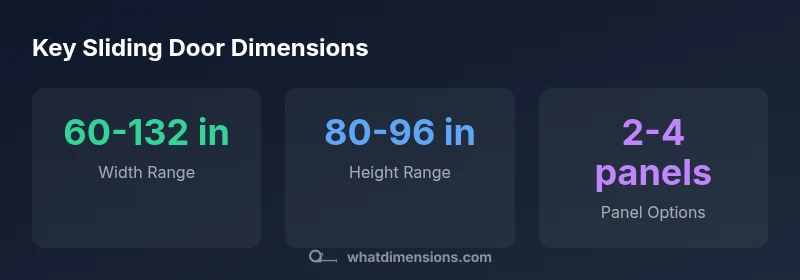
Sliding glass doors typically fit rough openings ranging from about 60 inches to 132 inches in width and 80 inches to 96 inches in height. Most residential options come in 2-panel or 3-panel configurations, with some custom installations expanding reach even wider or taller. Always verify the rough opening and account for trim, sill, and frame clearances before ordering or installing.
What the dimensions of sliding glass doors cover
Dimensions for sliding glass doors are more than just a width and height. They define the door unit itself, the rough opening required in framing, and the finished opening that affects trim and interior space. In practice, dimensioning a sliding glass door means documenting four key elements: the nominal width of the door system, the finished opening that will be visible in the room, the rough opening required by the manufacturer, and the depth of the jamb/seat. The What Dimensions team notes that these measurements influence energy performance, weather sealing, and operation. When you evaluate a project, you should distinguish between standard factory sizes and custom units, and you must plan for installation clearances to ensure smooth operation and an airtight fit. Different configurations—2-panel, 3-panel, or even 4-panel—also change how width is allocated across the opening and how much traffic the door can accommodate without crowding the space.
Typical width and height ranges you’ll encounter
Width and height ranges for sliding glass doors vary by market and climate, but several patterns emerge. The most common residential widths span from about 60 inches to 132 inches, accommodating everything from small balconies to expansive patios. Heights typically range from 80 inches to 96 inches, with some products offering slightly shorter or taller options depending on rooflines, sill heights, and curb appeal. It is important to note that the nominal size of a door system often differs from the finished opening size because of trim, brick mold, and sill configurations. Always compare the rough opening (the space in the wall) with the door’s stated width and height, and confirm the exact finished opening you’ll see after installation. Manufacturer specifications and field measurements should guide every order, even when a unit seems to fit a standard size.
How to measure for a new installation
Measuring accurately saves time and reduces costly fit issues. Start by determining the rough opening: measure width at three vertical points (left, middle, right) and height at three horizontal points (top, middle, bottom). Record the smallest width and the tallest height to ensure the unit will clear framing obstructions and trim. Check the jamb depth and sill height; many sliding doors require a specific floor-to-sill clearance. If you’re replacing an existing door, measure the current finished opening (the visible size once trim is removed) to anticipate trim adjustments. Note any non-standard features, such as a cased opening, masonry, or curved walls, that could affect mounting depth or hardware alignment. Finally, document the required clearances for the door’s hardware, track system, and weatherstripping to avoid interference.
How trim, jambs, and sill affect finished size
Finished size is the dimension you’ll actually see once installation is complete. Trim, jambs, and sills contribute additional thickness and can reduce the clear width by fractions of an inch to an inch or more, depending on the style. Brick mold and window trim add exterior depth that can influence exterior cladding and flashing details. Sill configurations determine the clearance for floor materials and thresholds, which can impact accessibility or appliance placement nearby. When budgeting, include allowances for shims, shimming sequence, and potential leveling adjustments—these steps help ensure a square, plumb installation that minimizes air leakage and wind intrusion.
Custom vs standard sizes: what to expect
Most homeowners can choose from standard sizes, which reduces lead times and cost. Standard sizes cover a broad spectrum of openings and are typically compatible with a wide range of hardware and weather seals. Custom sizes are available when an opening is unusual or architectural features require a tailored fit. While custom units can precisely fit existing rough openings and achieve optimal energy performance, they often come with longer manufacturing times and higher costs. If you anticipate future renovations or room reconfigurations, plan for a door with a slightly flexible width or height within the manufacturer’s tolerance ranges to avoid complete replanning.
Practical examples by door layout: 2-panel vs 3-panel
Two-panel sliding doors typically address narrower openings and are common on small balconies or compact patios. Three-panel configurations provide a wider passage and are popular for living rooms with expansive exterior views. Four-panel doors maximize opening width for large decks and outdoor spaces. In practice, a 2-panel unit might fit openings in the 60–84 inch range, a 3-panel unit in the 84–132 inch range, and a 4-panel unit in the 120–144 inch range. When selecting a configuration, consider traffic patterns, furniture layout, and the direction the door swings when open to avoid obstructing pathways.
Material, mullions, and glass thickness: how they influence size
Beyond the frame dimensions, the choice of mullions and glass thickness can subtly affect the overall unit size and installation complexity. Heavier glass and thicker frames can shift the finished opening requirements, sometimes necessitating deeper sidelights or stronger supporting hardware. Mullions that divide the glass into multiple panes may alter the perceived width and reduce the apparent opening width, depending on layout. When budgeting, include potential adjustments for frame materials, energy ratings, and hardware, as these elements influence the final finished size and how it sits within the wall opening.
Comparison of sliding glass door configurations by opening size
| Configuration | Typical Width Range | Typical Height Range | Notes |
|---|---|---|---|
| 2-Panel Sliding | 60-84 inches | 80-84 inches | Compact option for smaller openings |
| 3-Panel Sliding | 84-132 inches | 80-96 inches | Wider opening with intermediate panel |
| 4-Panel Sliding | 120-144 inches | 80-96 inches | Large openings for expansive patios |
Quick Answers
What is the difference between rough opening and finished opening?
A rough opening is the space framed during construction, while the finished opening is the visible size after trim and casing are installed. Measurements for the door unit must align with the rough opening plus required clearance, and the final visible opening should accommodate hardware, weatherstripping, and floor conditions.
Rough opening is the wall space before trim; finished opening is what you see after trim is added. Match the door unit to the rough opening with proper clearance.
How do you measure a sliding door for replacement?
Measure width at the top, middle, and bottom, and height at the left, center, and right. Use the smallest width and the largest height to ensure the unit fits. Don’t forget jamb depth and sill height, and verify clearances for the track and hardware.
Measure width at three points and height at three points, then choose the smallest width and largest height for a secure fit.
Can custom sizes be more expensive or take longer to ship?
Yes. Custom sizes generally incur longer lead times and higher costs due to specialized fabrication and additional materials. If possible, select closest standard sizes to minimize delays, or work with the manufacturer to confirm exact tolerances and installation considerations.
Custom sizes usually take longer and cost more, so plan ahead and confirm tolerances with the maker.
What is the impact of door dimensions on energy efficiency?
Better-fitting doors minimize air leaks, improve insulation, and reduce drafts. Finishes, weatherstripping, and proper installation around the frame are essential to achieving the expected energy performance.
A precise fit reduces leaks and helps energy performance; seal and install correctly.
What is nominal vs actual door dimensions?
Nominal dimensions refer to the rough size stated for ordering, while actual dimensions reflect the true finished size after framing and trim. Always compare both values with the manufacturer’s specs to ensure proper fit and function.
Nominal is the rough size; actual is the finished size after trim and framing.
“Accurate sizing is the foundation of a successful sliding glass door installation, reducing fit issues and energy loss.”
Main Points
- Measure rough openings precisely before selecting a door.
- Expect width 60–132 inches and height 80–96 inches in most homes.
- Account for trim, sill, and frame clearances in your planning.
- Choose panel configuration to fit your opening and traffic needs.