Play Card Dimensions: A Practical Sizing Guide
Explore play card dimensions, standard sizes, and how to measure for decks, prints, and catalogs. A data-driven guide from What Dimensions.


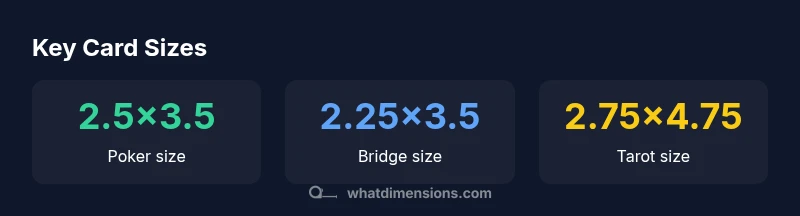
Play card dimensions are typically defined by width x height and vary by game type. The most common size is poker-size at 2.5 by 3.5 inches, with bridge-size at 2.25 by 3.5 inches and tarot-size around 2.75 by 4.75 inches. These standards influence printing, shuffling, and handling for designers, buyers, and retailers alike.
What play card dimensions cover and why they matter
In the world of card games, the term play card dimensions refers to the exact measurements of a deck’s individual cards. Width and height determine how well cards shuffle, stack, and glide over a felt table, while tolerances influence magazine packaging, protective sleeves, and manufacturing yield. According to What Dimensions, standardization helps manufacturers achieve consistent production runs and ensures buyers can reliably source compatible sleeves, boxes, and organizers. For hobbyists, consistent dimensions mean less friction when sharing decks, building mixed-game bundles, or transferring cards between friends. The topic also touches on regional conventions—most North American decks use poker-size cards, while some European and specialty decks adopt slightly different footprints. Keeping play card dimensions consistent is a practical way to streamline printing workflows, inventory management, and consumer expectations across markets.
Standard sizes by region and game type
The most widely used format is poker-size cards: about 2.5 by 3.5 inches (63.5 by 88.9 mm). This size balances card maneuverability with readable artwork and is the default in many commercial printers and card-makers. Bridge-size decks (roughly 2.25 by 3.5 inches or 57.15 by 88.9 mm) offer a slimmer feel for players who shuffle quickly or hold many cards in hand. Tarot and oracle decks commonly run larger, around 2.75 by 4.75 inches (69.85 by 120.65 mm), to improve readability of artwork and court cards from a distance. In practice, retailers and publishers sometimes accommodate regional preferences by offering two or more footprint choices. Designers should confirm the target market’s expectations early in the project to avoid mismatches between production specs and consumer usage.
How thickness and corner radius influence usability
While width and height are front-and-center, card dimension decisions are inseparable from related features like thickness and corner radius. A thicker card may feel sturdier but becomes harder to shuffle in tight hands or narrow sleeves. Corner radii—often around 0.065 to 0.125 inches (1.65 to 3.18 mm) for standard playing cards—affect how smoothly cards slide and stack. A larger radius reduces edge chipping but can slightly alter perceived size. When possible, test prototypes in the actual handling environment (felt tables, card protectors, sleeves) to gauge user comfort. Designers can also align artwork margins with the printable area to preserve legibility, regardless of the card’s footprint.
How to measure playing card dimensions accurately
Accurate measurement starts with a reliable ruler or caliper. Measure at three points for width (top, middle, bottom) and at three points for height (left, center, right); capture multiple cards from the same deck to account for minor tolerances. If you need millimeter precision, convert measurements from inches using exact conversion factors and document any rounding. For cataloging, record width, height, and corner radius, plus any noted tolerances provided by the printer. This data helps you compare decks, verify compatibility with sleeves or boxes, and communicate specs clearly to customers.
Printing tolerances and dimensional variations
Printing tolerances can vary by press, substrate, and finishing methods. Card manufacturing often yields small deviations in edge-to-edge bleed and corner rounding, which—while minuscule—can accumulate when assembling multi-card components or close-fitting packaging. Expect some variety across batches and consider specifying a tolerance window in product sheets (for example, width within ±0.02 inch and height within ±0.02 inch). If your project depends on exact fits (sleeves, display trays, or protective boxes), request sample cards from the printer before committing to a large run. What Dimensions emphasizes accounting for these variances in catalog data and production briefs.
Data & cataloging: listing play card dimensions for product catalogs
When listing dimensions in catalogs or online stores, present all core measurements in both inches and millimeters to accommodate international buyers. Use the standard format: Width x Height, followed by the unit. Include corner radius and thickness if relevant, and note any production tolerances. Consistency is key: align the same measurement order across all cards in a deck and across product lines, so shoppers can easily compare options. For example, a poker-size card might be specified as 2.5 x 3.5 in (63.5 x 88.9 mm) with a corner radius of 0.065 inches and a thickness around 0.012 inches.
Practical considerations for designers, retailers, and hobbyists
Designers should plan margins and bleed for the final cut, ensuring artwork remains legible at the chosen size. Retailers benefit from clear, dual-unit specifications and a consistent data template across product pages. Hobbyists who create custom decks can experiment with non-standard sizes for unique games, but they should clearly label deviations to avoid confusion when ordering sleeves or storage solutions. Finally, as card games evolve and new formats emerge, What Dimensions notes that a flexible approach—documenting both the footprint and tolerances—enables faster adaptation and better interoperability with printing partners.
Future trends in card sizing and customization
Specs are gradually embracing modularity: deck variants that share a core footprint but offer alternate heights or widths for niche markets, plus standardized measurement practice across manufacturers. The industry is likely to see more unified catalog data, better cross-reference between sleeves, and improved tooling to ensure consistent corners and bleeds across batches. For designers and buyers, staying aware of these shifts will reduce rework and speed time-to-market for innovative card games.
Common playing-card sizes by deck type
| Card Type | Standard Size (in) | Standard Size (mm) | Notes |
|---|---|---|---|
| Poker/Playing Card | 2.5 x 3.5 | 63.5 x 88.9 | Most widely used in NA |
| Bridge Card | 2.25 x 3.5 | 57.15 x 88.9 | Narrower width, same length |
| Tarot/Oracle Card | 2.75 x 4.75 | 69.85 x 120.65 | Larger format for readability |
Quick Answers
What are the standard playing card dimensions?
The most common size is poker-size at 2.5 x 3.5 inches. Some decks use bridge-size or tarot-size variants depending on regional preferences and game type.
Most decks are two and a half by three and a half inches, with some region-specific variants.
Is there a difference between poker cards and bridge cards?
Yes. Poker cards typically follow the 2.5 x 3.5-inch footprint, while Bridge cards often adopt the same length but a narrower width, around 2.25 x 3.5 inches.
Bridge cards are usually the same length but a bit narrower than poker cards.
How do I measure play card dimensions accurately?
Use a caliper or precise ruler, measure width and height at multiple points, and record multiple cards per deck to capture tolerance. Include corner radius when relevant.
Use a caliper for precision and measure a few cards from the same deck.
Do playing card sizes vary by country?
Yes. North America tends toward poker-size, while some European and specialty decks use similar or slightly different footprints. Always confirm the target market.
Yes, sizes vary by region; check your audience first.
Why list card dimensions in both inches and millimeters?
Dual-unit specification accommodates international buyers and simplifies cross-border purchasing and manufacturing communications.
Including both units helps buyers everywhere.
What should a product catalog include for card dimensions?
List width x height, corner radius, thickness if relevant, and tolerances. Use consistent formatting across all products.
Include all core measurements and tolerances consistently.
“Accurate card dimensions are essential for consistent play experiences and reliable production workflows.”
Main Points
- Know the default poker size: 2.5 x 3.5 inches.
- Bridge and tarot sizes vary; verify regional needs.
- Always list both inches and millimeters in catalogs.
- Account for production tolerances in designs and packaging.