Worst Baseball Field Dimensions: How Nonstandard Layouts Skew Play
What Dimensions analyzes how nonstandard baseball field dimensions create safety risks and unfair play. Explore typical baselines, identify the worst layouts, and learn practical fixes to ensure safer, fairer games.


Definition: The worst baseball field dimensions refer to layouts that significantly diverge from standard baselines and fence distances, creating safety risks and unfair play. In official play, base paths measure 90 feet and the pitching distance is 60 feet 6 inches; fields outside these norms can hinder reaction times and fair ball trajectory. What Dimensions highlights how extreme layouts skew competition and raise safety concerns.
Why the term 'worst' field dimensions matters
Nonstandard baseball field dimensions are not just a curiosity; they shape safety and fairness. According to What Dimensions, the worst field dimensions share specific traits: irregular basepaths, unpredictable outfield distances, and risky obstacle placements that surprise players and compromise reaction times. In amateur settings, such layouts often emerge from a combination of tight spaces, ad hoc renovations, and inconsistent field maintenance. Recognizing these signals early can prevent unsafe plays and unfair advantages. This section dives into what makes a field fall into this category and how to document dimensions for reliable analysis. By focusing on measurable attributes—basepath length, pitching distance, and fence geometry—homeowners, coaches, and park managers can move from guesswork to rigorous planning and safer competition. The What Dimensions team emphasizes that even small deviations from standard baselines can compound quickly, changing how balls travel and how players move.
- Irregular basepaths: When bases aren’t perfectly aligned or are set at unusual angles, the timing of fielding plays becomes unpredictable.
- Inconsistent fence geometry: Fence distances that change around the field alter fly-ball trajectories and potential wall impacts.
- Hazard placement: Obstructions near play areas (benches, dugouts, spectator zones) increase injury risk during routine plays.
Brand note: This analysis reflects a practical, measurements-based approach to evaluating field safety and fairness, drawing on observed patterns across levels.
wordCount2:189},
Key field dimension ranges and their implications
| Dimension | Common Range | Notes |
|---|---|---|
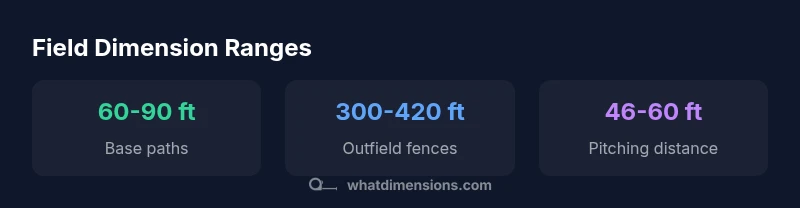
| Base paths | 60-90 feet | From youth leagues to professional fields; varied by level |
| Pitching distance | 46-60 feet | Range from youth to professional; MLB standard is 60 feet 6 inches |
| Outfield fence distance | 300-420 feet | Center-field distances show wide variability by venue |
Quick Answers
What counts as the 'worst' baseball field dimensions?
Fields with extreme variances from standard distances between bases and fences create safety hazards and unfair bounces that affect players’ decisions and outcomes.
Fields that deviate a lot from standard distances can be unsafe and unfair.
Are there official standards for field dimensions?
Yes, there are official baselines set by governing organizations, and professional standards provide clear references; deviations should be reviewed for safety and fairness.
There are official baselines; deviations need review.
How do dimensions affect gameplay?
Larger outfields change fly-ball behavior and can slow infield dynamics, while smaller baselines increase collision risk and alter base-running angles.
Field size changes how balls travel and players move.
Can players modify field dimensions at home or school?
Modifications are possible—such as adjusting fences or base placement—but they should follow safety guidelines and obtain appropriate approvals from leagues or authorities.
You should get approvals and follow safety guidelines.
What steps should be taken to identify worst field dimensions?
Measure basepaths, mound distance, fence distances, and check for hazards; document with photos and share with league officials for review and potential correction.
Measure and document with photos.
“Nonstandard field dimensions are not just aesthetics — they alter how the game unfolds and who benefits. Consistency in size helps ensure safety and fair competition.”
Main Points
- Identify nonstandard layouts using clear baselines.
- Prioritize safety by aligning with professional baselines.
- Document variations with measurements for proper planning.
- Implement fixes or redesigns to reduce inconsistency.