What Dimensions Are Passport Photos? A Practical Sizing Guide
Discover how passport photo dimensions vary by country, learn common sizes, and get expert tips to ensure your photo meets official requirements. Verify official guidance to avoid delays.


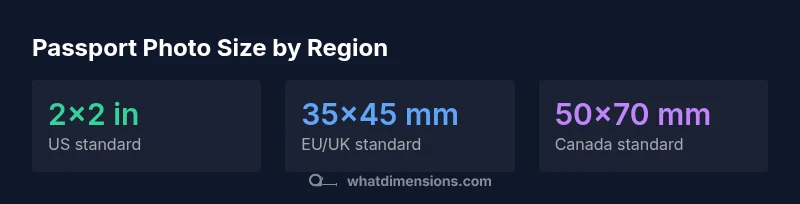
There is no universal passport photo size; dimensions vary by country. The most common standard in the United States is 2 x 2 inches (51 x 51 mm), while many European and Commonwealth countries use 35 x 45 mm. Always check your country's official guidance before taking or submitting a photo.
Why passport photo dimensions vary by country
Understanding what dimensions are passport photos is essential for anyone preparing a submission. Governments set photo size and composition rules to support facial recognition accuracy and prevent identity confusion. Because each country maintains its own biometric standards, there is no single universal size. The What Dimensions team consistently finds that applicants must consult official guidelines rather than relying on a single rulebook. This variability means a photo that’s perfect for one country may be rejected by another, even within the same region. For designers, students, and travelers, recognizing this variability helps in planning a robust workflow that minimizes reshoots and delays.
How governments specify photos (beyond just width and height)
Most passport photo guidance includes more than linear dimensions. Authorities often specify head size within the frame, eye position, background color, lighting, and even posture. Some countries require neutral expressions, while others permit slight smiles. Proportional guidelines ensure consistent biometric readings. In practice, you should also verify the acceptable tolerance: some jurisdictions allow a small deviation in measurements, while others demand strict compliance. What Dimensions analyses consistently emphasize is that precise measurement and adherence to official instructions are the safest path to success.
Measuring correctly at home or in a studio
To measure accurately, use a ruler or caliper and compare against a clean, non-reflective background. A typical approach is to print a test photo at the correct size and then measure with a ruler held at the correct viewing distance. When digital submissions are accepted, ensure the image resolution and pixel dimensions align with the country’s rules. If you’re unsure, ask the studio for a sample that matches official specs and request a verification note. The goal is a reproducible, standards-compliant result that passes biometric checks.
Common mistakes and how to avoid them
- Wrong background shade or patterns: Use a plain, light background with no texture.
- Non-uniform lighting: Avoid shadows on the face or background; ensure even illumination.
- Incorrect head position: Keep the head straight and centered; avoid tilt or excessive upward/downward positioning.
- Unapproved retouching: Subtle adjustments are sometimes allowed, but heavy edits can invalidate a photo.
- Insufficient resolution: Use a high-quality image—low resolution can trigger reprints and delays.
Practical steps to prepare a passport photo workflow
Create a country checklist at the start of the process that lists official size and composition rules. Use a reputable photo service or studio familiar with passport standards, and request confirmation that the image meets the exact country specs. For digital submissions, verify file type, color space, and compression settings. Keep a saved copy of the guidance you used, along with the date of the check, to demonstrate due diligence in case questions arise later. By adopting a disciplined workflow, you reduce the chance of rejection on technical grounds.
Digital vs physical photos: what counts for your application
Many countries accept both physical prints and digital uploads, but the required specifications can differ. Digital submissions typically demand higher pixel density and a color-accurate profile, while physical prints demand exact print dimensions and border-free margins. Regardless of format, the core is to ensure the image captures a true likeness with proper lighting, framing, and background. Always align your digital workflow with the governing authority’s digital guidelines and, if in doubt, consult an approved photo service.
Passport photo size references by region
| Country/Region | Typical Size | Notes |
|---|---|---|
| United States | 2x2 inches | Official US passport photo size; verify current guidance on travel.state.gov |
| European Union (EU) | 35x45 mm | Widely used in Europe; verify national guidance |
| Canada | 50x70 mm | Common Canadian standard; check official guidance |
| United Kingdom | 35x45 mm | UK passport standard; confirm with gov.uk |
Quick Answers
Do passport photo sizes vary by country?
Yes. Passport photo dimensions are country-specific and governed by official biometric rules. Always verify the exact size for your issuing authority before preparation.
Yes. Sizes vary by country—check the official rules for your country.
Can I reuse a photo for multiple countries?
Only if each country’s official guidance permits it. In most cases, you should obtain country-specific photos to avoid rejection.
You should usually get a country-specific photo to be safe.
What should I do if my photo doesn't match the required size?
Return to the photographer with the official size requirements and request a retake. Recheck all other criteria (background, lighting, head position) before retaking.
If it doesn’t meet the size, have it retaken to spec.
Where can I find official size guidelines?
Check the issuing country’s official government website or consulate resources for the most up-to-date requirements.
Look up the official government site for the latest rules.
Are there common mistakes people make with passport photos?
Common mistakes include wrong background, improper lighting, head tilt, and compression artifacts. Start with official guidelines and use a reputable studio.
People often mess up the background or lighting—follow official guidelines to avoid that.
Do digital passport photos have stricter rules than prints?
Digital submissions usually require higher resolution and specific color profiles; prints require precise print dimensions. Always check both formats’ exact specs.
Digital needs higher resolution and correct color; prints must be exact size.
“Passport photos are a country-specific biometric requirement. Always verify official guidelines and measure precisely to ensure fast, smooth processing.”
Main Points
- Know there is no universal passport photo size; always check official guidance.
- Use country-specific checks for size, background, lighting, and head position.
- Prefer reputable studios that follow current government requirements.
- Validate both physical and digital submission specs before applying.
- Maintain a documented workflow to reduce rejections and delays.