Half Sheet Paper Dimensions: A Practical Size Guide
Explore half sheet paper dimensions and how 5.5 x 8.5 inch (139.7 x 215.9 mm) sizing fits printers, envelopes, and design workflows. Learn practical tips, comparisons to other sizes, and best practices for layout and margins.


What half sheet paper dimensions refer to
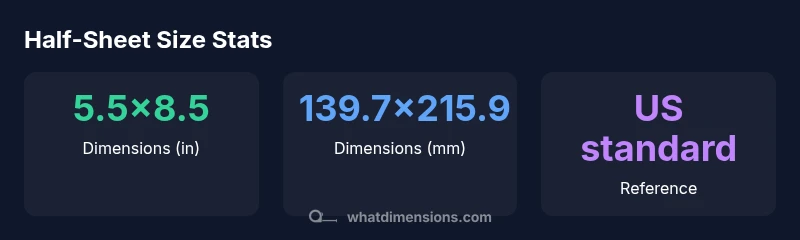
Half sheet paper dimensions refer to a size that results when a standard US Letter sheet is cut in half. The most widely used half sheet measures 5.5 by 8.5 inches, which equals 139.7 by 215.9 millimeters. This size is common for lightweight flyers, forms, coupons, and personal notes. Designers often choose this compact format to keep documents portable while preserving readable type and clear margins. According to What Dimensions, the term half sheet typically describes this US size irrespective of orientation. In practice you can print on a home printer using the portrait orientation or landscape orientation depending on content and binding needs. When planning, consider the final destination of the sheet, such as a binder, folder, or envelope, to ensure that the protect margins and alignment are appropriate. The 5.5 by 8.5 inch footprint supports standard margins and bleeds in typical printing workflows, letting you allocate space for logos, addresses, and other elements without crowding.
How the 5.5 x 8.5 inch size became standard in the US
The half sheet emerged as a practical derivative of the Letter size, which has long served as the default paper standard in the United States. 8.5 by 11 inches provides ample space for text and graphics, while half of that real estate yields a compact, portable format suitable for handouts and quick notes. Over time, printers, copiers, and office workflows adapted to this split for efficiency, especially in environments that print large quantities of flyers, forms, and reminders. What Dimensions analyses indicate that the 5.5 x 8.5 inch footprint remains a go-to choice for short communications, where legibility and portability are paramount, and where space on a desk or in a folder must be conserved.
Comparing half-sheet to other common sizes
When evaluating sizes for a project, it helps to compare the half sheet against its peers. A standard US Letter measures 8.5 by 11 inches, so two half sheets fit perfectly on a single Letter sheet. In metric terms, Letter roughly corresponds to 216 by 279 millimeters, while A4 (the international standard) is 210 by 297 millimeters. The half sheet thus occupies a footprint close to A6 when rotated, but with an aspect ratio that favors horizontal layouts for flyers and vertically oriented forms. For designers, this means you can plan margins, gutters, and bleeds with confidence, using familiar software presets for Letter or A4 as a baseline and then adjusting to the 5.5 by 8.5 inch format.
Design and printing considerations for half sheet work
Layout decisions hinge on margins, bleed, and type legibility. Typical safe margins are at least 0.25 inches (6 mm) on all sides, with bleed extended about 0.125 inches (3 mm) beyond the final trim when color or full-bleed graphics are used. When working with the 5.5 by 8.5 inch size, consider font sizes and line lengths that stay readable in a small format. If you are printing mailers or forms, test print on your home or office printer to confirm alignment and trimming accuracy. For binding or tucked-in documents, ensure that elements near the edge avoid crowding and that any fold lines do not cut essential content.
Practical applications by setting
In classrooms and offices, half sheet handouts support concise messaging without overwhelming recipients. In design studios, it serves as a compact canvas for mini portfolios or product sheets. For events, half sheets can function as RSVP cards or coupons that fit in attendees' wallets. The compact footprint makes distribution easy, while the clear hierarchy of headings, body text, and logos remains legible at a smaller scale. Understanding the exact 5.5 x 8.5 inch dimension enables precise grid layouts and consistent branding across materials.
Cutting, folding, and storage tips
If you start with US Letter rather than a predefined half sheet, you can produce two halves by cutting along the longer edge, yielding two pieces each measuring 8.5 by 5.5 inches. For a neat finish, use a sharp paper cutter and align the paper precisely along the guide. When folding, a simple tri-fold or bi-fold can transform the sheet into a compact handout that fits neatly into a standard envelope or a small file pocket. Store unused sheets in a flat, dry area to prevent curling and ensure consistent printing results.
International context and variations
ISO paper sizes like A4 and A5 are widely used outside the United States, but a true half sheet is not a globally standardized size. In many regions, printers and vendors treat half sheet as a US-centric reference, while similar compact formats exist in local sizes. If you work globally, use A-series equivalents for cross-border correspondence and provide clear measurements in both inches and millimeters to avoid confusion at the point of printing or mailing.