How to Change PDF Dimensions: A Step-by-Step Guide
Learn how to change PDF dimensions safely, including page size adjustments, cropping, and content reflow. This expert guide from What Dimensions covers tools, steps, tips, and common pitfalls for accurate results.


If you're asking can you change dimensions of a pdf, the short answer is yes. You can adjust page size during export, crop margins, or reflow content with reformatting. The method you choose depends on whether you want to resize the entire page or preserve elements at a fixed scale.
Can you change dimensions of a PDF: foundational ideas
When people ask can you change dimensions of a pdf, they usually mean altering the page size, the printable area, or how content scales to a new format. PDFs encode pages in fixed coordinates, so resizing often means one of several approaches: changing the page dimensions, cropping visible regions, or reflowing content to fit a different layout. What Dimensions emphasizes that understanding these options helps you preserve readability while achieving the desired physical or digital output. Remember, the goal is to keep content accessible and legible at the new size, not just to stretch images. This distinction matters for designers, students, and homeowners who rely on precise size specs for printing or sharing documents.
Practical context for readers
For most workflows, you’ll either adjust the page size to a new standard (e.g., A4 to Letter) or crop the page to reveal a different framing. In some cases, especially with text-heavy documents, reflowing or reformatting content is necessary to prevent overlapping or illegible lines. The What Dimensions team notes that choosing the right method depends on whether you need a faithful page-for-page resize or a content-first adjustment that preserves flow and readability. Always start with a backup of the original PDF in case you need to revert.
Tools & Materials
- PDF editing software(Examples: Adobe Acrobat Pro, Foxit, or open-source editors with page-size controls)
- PDF printer/export dialog(Use Print to PDF or Save as PDF to apply new page dimensions)
- Target page size specification(Know your final size (e.g., A4, Letter, or custom dimensions))
- Crop/margin adjustment tool(Helpful if you only want to reveal or hide portions of a page)
- Verification tool(A ruler or screenshot compare to confirm the new layout aligns with expectations)
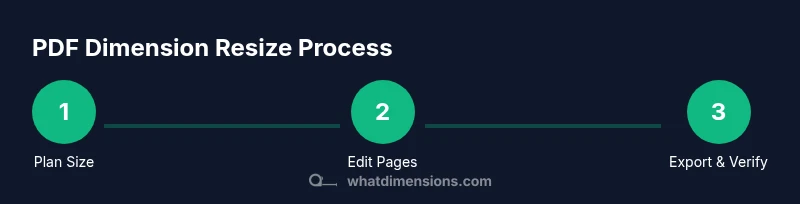
Steps
Estimated time: 30-60 minutes
- 1
Identify the final page size
Decide the exact target page dimensions and orientation (portrait or landscape). This guides all subsequent steps and helps avoid content clipping or excessive white space.
Tip: Document the target size before starting; it saves multiple back-and-forth adjustments. - 2
Open the PDF in your editor
Launch your PDF editor and load the file you intend to resize. Ensure you have a duplicate backup to prevent data loss.
Tip: Use a versioned filename like document_v2.pdf. - 3
Apply the new page size
Use the page setup or crop tool to apply the new page dimensions. If the editor prompts for reflow, choose an option that preserves text clarity.
Tip: If cropping, constrain changes to avoid removing essential content. - 4
Adjust content to fit
Review each page to ensure margins, headers, and images remain legible. You may need to reposition elements or scale images modestly.
Tip: Avoid excessive scaling that reduces readability or introduces pixelation. - 5
Export or Save as a new PDF
Export the document with the new page size. Check export settings for compatibility (PDF version, image Quality, fonts embedding).
Tip: Use a descriptive filename indicating the new size (e.g., report_A4.pdf). - 6
Verify the final output
Open the exported PDF on different devices or print a test page to confirm the new dimensions appear correctly.
Tip: Compare the printed output to the on-screen view to catch mismatches early.
Quick Answers
Can you resize a PDF without losing content quality?
Resizing a PDF can affect quality if fonts or images are scaled aggressively. Choose methods that preserve readability, such as reflowing text or maintaining a high-resolution image scale. Always preview the results before finalizing.
Resizing a PDF can impact quality if you scale elements too much. Preview the results to ensure readability and adjust as needed.
What’s the difference between resizing and cropping a PDF?
Resizing changes the page dimensions and layout, potentially altering margins and text flow. Cropping hides parts of a page, revealing a new frame without changing underlying content.
Resizing changes the page size and layout; cropping hides areas of pages without altering the content.
Do I need special software to change PDF dimensions?
A PDF editor with page-size and crop controls is typically required. Some editors offer equivalent functionality through print-to-PDF workflows or export options.
Most PDF editors with page-size controls can resize PDFs; some tasks can be done via print-to-PDF workflows.
Is it safe to resize PDFs for printing at retail shops?
Yes, but verify your final file’s dimensions align with the shop’s print settings and paper stock. Carry a test print if possible.
Resizing for printing is generally safe, just confirm the shop’s print settings match your new dimensions.
Can I resize from a custom page size to standard sizes like A4?
Yes, you can resize to A4, Letter, or other standard sizes by setting the target dimensions in your editor and adjusting margins accordingly.
You can resize from a custom size to standard sizes like A4 by setting the target dimensions and margins.
What should I do if fonts appear distorted after resizing?
Embedded fonts generally resize cleanly, but on some viewers, you may need to re-embed fonts or convert text to outlines as a last resort.
If fonts distort, try re-embedding or, as a last resort, convert text to outlines to preserve appearance.
Watch Video
Main Points
- Identify target page size before editing.
- Choose between page-size change, crop, or reflow based on content.
- Back up originals and verify output on screen and print.
- Embed fonts if needed to preserve appearance.
- Test across devices to ensure readability