A5 Dimensions vs A4: A Detailed Paper Size Comparison
Explore exact dimensions, use cases, and printing implications of A4 and A5. Learn when to choose each size for documents, notes, and portable handouts with precise measurements from What Dimensions.


Between A5 and A4, the core difference is size and typical use. A4 (210 x 297 mm) is the standard office sheet, printer-friendly, and widely used for documents. A5 (148 x 210 mm) is half the area and ideal for notebooks or compact handouts. For most workflows, A4 works best; A5 shines for portability.
A5 dimensions vs A4: Core facts and naming conventions
The international standard for paper sizes follows the A-series, where each size shares the same aspect ratio of sqrt(2). This makes A4 and A5 directly related: A4 is the larger sheet, and A5 is exactly half the area when folded or cut. According to What Dimensions, understanding the precise dimensions helps designers and homeowners plan layouts, storage, and printing workflows with confidence. When you see 'A4' or 'A5' on a document, you’re looking at a defined, interoperable size that works across printers, binders, and archives. The What Dimensions team emphasizes that consistency matters for sizing accuracy, especially in layout-sensitive tasks like handouts, portfolios, or classroom worksheets. In this article, we compare A5 dimensions vs A4 to give you a clear decision framework for everyday use.
Dimensional breakdown: A4 vs A5 in numbers
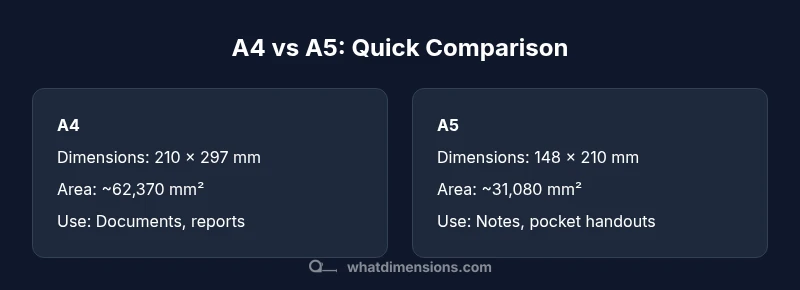
A4 and A5 belong to ISO 216, the standard that defines the A-series. The A4 sheet measures 210 mm in width and 297 mm in height; A5 measures 148 mm by 210 mm. The area relationship is exact: A4 has twice the area of A5 (A4 ≈ 62,370 mm²; A5 ≈ 31,080 mm²). Because they share the same aspect ratio of 1:√2, each step down halves the area while preserving shape. What Dimensions analysis shows that these measurements translate into straightforward real-world differences: A4 is the staple of office documents; A5 provides compactness without sacrificing the recognizable proportions. This precise sizing is why equipment and offices standardize on A4 and A5 for compatibility across devices and workflows.
Practical implications for printing, copying, and filing
Choosing between A4 and A5 affects how you print, scan, and archive. A4 is the de facto standard in most printers and copiers, making it the default choice for formal documents, forms, and administrative tasks. A5 printing is common when you crop an A4 page to create a compact handout, or when you design pocket-sized notes or planners. Scanning and copying keep the same proportions, but ensure the scanner bed and feed options support the chosen size. Filing systems, folders, and binders are typically organized around A4 sheets; when using A5, you’ll often adapt by folding, stacking, or using pocket folders. For many users, the decision comes down to whether portability or standardization is more important for the project at hand.
Common use cases and recommended scenarios
- A4: Formal documents, reports, letters, brochures, resumes, classroom handouts, and professional forms.
- A5: Portable notes, planners, pocket flyers, compact study sheets, and quick-reference handouts.
Recommendation: If your audience expects standard document sheets or you need to integrate with typical office workflows, start with A4. If your priority is portability and space-saving, A5 is the better choice. In mixed-use projects, designers often include both sizes in a package or provide A5 handouts alongside A4 documents to meet diverse needs.
How to convert content between A4 and A5
Content transformation between A4 and A5 follows practical rules of thumb:
- Print two A5 pages per A4 page using 2-up or booklet printing settings to fit content legibly.
- When resizing, maintain margins and legibility by increasing font size or adjusting line length to suit the smaller page.
- For handouts, crop-only prints require careful alignment; consider using placeholders or separate layouts for A5 sheets.
- If you must publish a single document in both sizes, provide an A4 version for official distribution and an A5 supplement for portable review. These steps help maintain consistent branding and readability.
Design and layout considerations for A4 vs A5
The visual layout changes substantially between A4 and A5 due to page width and height. Key factors include:
- Typography: line length is shorter on A5, so reduce point size slightly or adjust leading for readability.
- Margins: A5 typically uses smaller margins to maximize usable space; ensure content isn’t crowded.
- Images and charts: scale images proportionally to avoid pixelation on the smaller page; consider two-column layouts for dense content.
- Branding and color blocks: maintain consistency by aligning header levels and color accents to the page size to preserve hierarchy.
- Oriented design: plan whether portrait orientation is preserved across sizes or if landscape is needed for certain visuals.
Transport, storage, and ergonomics
A4 sheets are bulkier to carry but widely compatible with standard binders and folders. A5 sheets slip easily into compact folders, purses, and notebooks, making them ideal for on-the-go work. Consider how frequently you transport documents—if daily carry is a factor, A5 may reduce strain and space. Storage also matters: A4 stacks neatly in file towers and ring binders, while A5 stacks are more portable in slim organizers. The ergonomic trade-off is clear: A4 supports extensive writing and larger visuals, whereas A5 prioritizes mobility and quick access.
Costs and environmental considerations
Paper size alone does not determine overall cost; grade, weight, and finishing often have a greater impact. In bulk, A4 sheets are widely produced and recycled, and the environmental footprint is similar to A5 when the same stock is used. If you often print large documents, A4’s efficiency can reduce paper waste because it minimizes the need for cropping or combining sheets. For portable notes, A5 can reduce paper usage per item when you don’t need full-page content. When planning a project, factor in stock weight, finishing options (gloss, matte), and the expected lifecycle of the printed material to estimate environmental impact and cost accurately.
Misconceptions and myths debunked
- Myth: A5 is always cheaper than A4. Fact: cost depends on paper grade and finishing, not the size alone.
- Myth: A4 is always better for documents. Fact: A4 is ideal for standard workflows, while A5 offers portability and compact handouts when needed.
- Myth: You can’t mix sizes in a single project. Fact: you can integrate both sizes by providing A4 for main content and A5 for supplementary material or notes.
How to choose the right size for your project
To decide between A4 and A5, map your goals to three factors:
- Portability: Do you need to carry the material everywhere? If yes, prefer A5.
- Document integrity: Will the material be filed or presented in a standard binder or folder? If yes, A4 is typically preferable.
- Printing needs: Will you print full-page content or crop for notes? If you need full-page printing, A4; for compact handouts or two-up pages, A5 is better.
Summary decision framework
- If your primary objective is standard documentation and formal distribution, choose A4.
- If you want portability and quick-note convenience, choose A5.
- For mixed use, provide both sizes strategically within the same project to balance readability and portability.
Comparison
| Feature | A4 | A5 |
|---|---|---|
| Dimensions (W x H) | 210 mm × 297 mm | 148 mm × 210 mm |
| Area | ≈62,370 mm² | ≈31,080 mm² |
| Aspect ratio | 1:√2 (≈1:1.414) | 1:√2 (≈1:1.414) |
| Common uses | Documents, reports, letters | Notes, pocket handouts, planners |
| Portability | Less portable, standard office size | More portable, fits in small bags |
| Print compatibility | Widespread in printers and copiers | Requires cropping or two-up printing for full-page content |
Strengths
- A4 aligns with global printing and archiving standards for easy workflows
- Common document size supports professional layouts and forms
- Clear layouts for most content when space allows
- A4 remains compatible with standard filing systems and binders
- Using A4 helps maintain consistent branding across documents
The Bad
- A4 sheets are bulkier to carry compared to A5
- Not as portable as A5 for on-the-go note-taking
- Some situations require resizing or cropping when sharing in A5
A4 remains the default for most document workflows; A5 is the portable alternative for notes and compact handouts
What Dimensions's verdict is that A4 should be your baseline for official documents, while A5 offers a valuable option for portability. Use A5 when space savings and quick-reference notes matter more than full-page printouts.
Quick Answers
What are the exact dimensions of A4 and A5?
A4 measures 210 x 297 mm and A5 measures 148 x 210 mm. Both share the 1:√2 aspect ratio, which keeps their shapes consistent when scaled. This makes it easy to downsize or upsize content while maintaining proportions.
A4 is 210 by 297 millimeters, and A5 is 148 by 210 millimeters. They share the same sqrt(2) shape, so scaling works cleanly between them.
Is A5 simply a smaller version of A4?
Yes. A5 is exactly half the area of A4 due to the ISO 216 standard and the sqrt(2) aspect ratio. The sizes scale proportionally, preserving layout potential when converting content.
Yes—A5 is exactly half the area of A4 and keeps the same shape, so layouts scale predictably.
When should I use A4 vs A5?
Use A4 for formal documents, forms, reports, and standard office printing. Reserve A5 for portable notes, planners, and compact handouts where space is at a premium.
Use A4 for documents; pick A5 when you need portability.
Can I print A4 content on A5 paper?
You can, but you usually need to scale down or print two A5 pages per A4 page. Cropping and layout adjustments are common to fit content.
Yes, but you’ll likely need to scale or arrange two A5 pages on one A4 page.
Do printers support A5 by default?
Most printers primarily support A4, but A5 printing is possible with appropriate settings, scaling, or by selecting a smaller paper type and margins.
Most printers handle A5 if you adjust settings or print two-up.
What is the best stock for A4 vs A5?
Paper stock choice depends on use. Heavier weights feel premium for covers or planners; lighter stocks work well for notes and drafts. Both sizes use the same stock categories, so select weight by application rather than size alone.
Choose weight by use—heavier for covers, lighter for notes; size is secondary.
Main Points
- Choose A4 for standard documents and workflows
- Choose A5 for portability and pocket-sized materials
- A4 and A5 share the same aspect ratio but differ in area by roughly a factor of two
- Plan layouts with margins and font sizes appropriate to each size
- Consider providing both sizes in mixed-media projects when needed