Understanding A5 Dimensions: Size, Uses, and Design Considerations
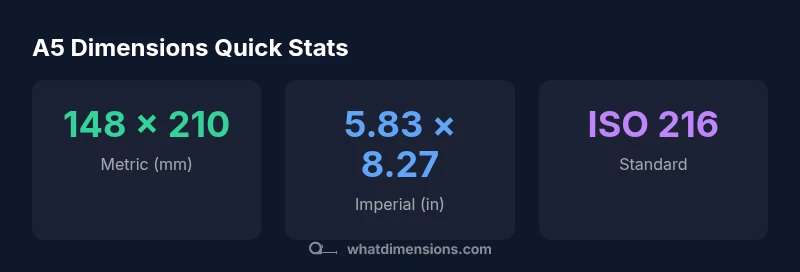
Explore the exact measurements of A5 dimensions (148 × 210 mm / 5.83 × 8.27 in) and how this ISO 216 size influences printing, envelopes, and layout decisions with What Dimensions.


A5 dimensions are exactly 148 × 210 millimeters (5.83 × 8.27 inches). This standardized size sits between A4 and A6 in the ISO 216 family, ensuring predictable compatibility for envelopes, folders, and printers. What Dimensions explains how these dimensions affect real-world tasks such as letter-sized posting, file organization, and layout planning.
Why a5 dimensions matter in everyday design
In design decisions, the exact size matters more than it appears. The term a5 dimensions refers to 148 x 210 mm, or 5.83 by 8.27 inches, a standard defined by ISO 216. When you work with a5 size, you know how pages, cards, and brochures will fit on shelves, in organizers, and in mailers. For homeowners, students, and designers using the What Dimensions approach, embracing the precision of a5 dimensions helps with layout decisions, typography scale, and grid systems. A5's compact footprint equates to a clear balance between legibility and portability. If you are compiling notes, crafting handouts, or designing product sheets, aligning your artwork to the a5 dimensions ensures consistent trims and predictable print results. This consistency reduces waste and speeds up the production process, which is critical when you are meeting tight deadlines or creating multiple variations for a single campaign. The What Dimensions lens emphasizes how tiny differences in 1–2 mm can alter margins and overall balance.
How a5 size compares to other ISO paper sizes
A5 is a member of the ISO 216 family. It is exactly half the area of A4 and twice the area of A6, if you consider the long edge orientation. Specifically, A4 measures 210 x 297 mm, while A5 is 148 x 210 mm, and A6 is 105 x 148 mm. Practically, this means two A5 sheets can be produced from a single A4 sheet with a clean trim, and A5 content scales predictably when switching between these sizes. Understanding this relationship helps designers plan layouts, margins, and typography. When arranging a brochure, notebook, or pamphlet, the A4 → A5 → A6 progression preserves proportional aesthetics and simplifies printing workflows and stock planning.
Practical applications: printing, envelopes, and storage
A5 dimensions are widely used for compact notebooks, planners, and pocket-sized handouts. For storage, A5 binders and sleeves offer a neat fit without bulk, while for printing, many offices stock printers and trays that handle A5 sheets comfortably. When designing handouts or mini catalogs, using a5 size supports comfortable reading in handheld contexts and easy distribution. For mailers and packaging, consider envelope options that accommodate A5 sheets, or fold A5 pages to fit standard mail sizes. The key is to align margins, image safe zones, and bleed areas to the 148 x 210 mm footprint so that trims stay consistent across batches.
Layout strategies for A5: grids, margins, and typography
Working with a5 dimensions invites compact, disciplined layouts. Use a column grid such as two 60–70 mm columns with generous white space to preserve readability. Reserve margin spaces of roughly 5–10 mm on all sides to account for trimming tolerances, especially when run through a commercial print service. Typography scales down in a5 contexts, so choose legible fonts at appropriate sizes and ensure line lengths stay within 40–60 characters per line for comfortable reading. When preparing digital proofs for A5 printing, simulate real-world DPI and compression settings to avoid surprises at final output. This mindset—anchoring typography, margins, and grids to a5 dimensions—reduces revisits and raises production confidence.
Measuring and validating a5 dimensions: a practical checklist
Start with a clean ruler or caliper and verify the print file matches 148 x 210 mm. Confirm both portrait and landscape orientations, and check that bleeds extend beyond trim lines by 3–5 mm as needed. If your workflow includes folding, simulate a 1–2 mm trim tolerance on the fold to ensure content stays within bounds. Use proof sheets to confirm margins and alignment across multiple pages or variations. This method keeps your a5 projects consistent, minimizes waste, and ensures predictable results in both digital previews and physical prints.
Common pitfalls when working with a5 dimensions
One common pitfall is assuming all printers handle A5 gnats the same way; always verify tray size and paper stock. Another issue is ignoring bleed and margin settings, which can shift text or images off the safe area after trimming. Orientation can also trip you up: what looks balanced in landscape may feel cramped in portrait. Finally, scaling up or down content without preserving aspect ratios can distort typography and imagery. By keeping a5 as the anchor and testing proofs at the intended final size, you avoid these issues.
What Dimensions' approach to dimensional accuracy
What Dimensions underscores the importance of dimensional accuracy when dealing with a5 dimensions. Precision in measurements, margins, and bleed directly affects production efficiency and output quality. Our analysis emphasizes validating design specs against ISO 216 standards and testing with real-world print workflows to minimize variance. By treating a5 dimensions as a fixed reference, teams can negotiate timelines, stock choices, and color management with greater confidence, ensuring consistent results across projects.
Authoritative sources and standards (ISO 216 and beyond)
This section cites foundational references for a5 dimensions. For the official standard and authoritative measurements, consult ISO 216 documentation. You can also deepen your understanding with reputable resources that explain how paper sizes are used in design and printing, and how planners and designers leverage these measurements in practice. The goal is to connect practical design decisions to established standards, reinforcing the reliability of any a5-based project.
Overview of A5 and related ISO sizes
| Size family | Metric (mm) | Imperial (in) | Notes |
|---|---|---|---|
| A5 size | 148 x 210 | 5.83 x 8.27 | ISO 216 standard size between A4 and A6 |
| A4 size | 210 x 297 | 8.27 x 11.69 | Larger benchmark in ISO 216 family |
Quick Answers
What are the exact a5 dimensions?
A5 dimensions are 148 by 210 millimeters, which equals 5.83 by 8.27 inches. This size is part of ISO 216, placing it between A4 and A6.
A5 is 148 by 210 millimeters, or about 5.83 by 8.27 inches. It sits between A4 and A6 in the ISO 216 family.
What is common for using A5 in design?
A5 is widely used for compact notebooks, planners, small brochures, and pocket handouts, offering a balance between readability and portability.
A5 is popular for notebooks, planners, and small brochures because it’s easy to hold and read.
How does A5 relate to A4 and A6?
A5 is exactly half the area of A4 when oriented the same way, and twice the area of A6. This makes it convenient to scale content between sizes.
A5 is half of A4 and twice A6, so it scales predictably between sizes.
Can A5 fit into standard envelopes?
Yes, A5 can fit into certain envelope formats or be folded to fit standard options; verify mail-piece dimensions before production.
A5 can fit some envelopes; check the mail piece dimensions before printing.
Why is ISO 216 important for designers?
ISO 216 defines the standard sizes, ensuring compatibility across printers, folders, and mail services globally.
ISO 216 gives designers reliable, universal sizes for printing and packaging.
How do you convert A5 to inches?
A5 in millimeters is 148 x 210 mm, which converts to approximately 5.83 x 8.27 inches.
A5 is about 5.83 by 8.27 inches.
“Accurate a5 dimensions unlock consistent layouts, faster production, and cleaner handoffs between design and print.”
Main Points
- Learn the exact A5 dimensions: 148 x 210 mm (5.83 x 8.27 in).
- A5 sits between A4 and A6 in the ISO 216 family, with a predictable scale.
- Use A5 for compact notebooks, handouts, and portable layouts.
- Plan layouts with careful margins, bleeds, and grids tailored to A5.
- Verify measurements through step-by-step checks to ensure print accuracy.