box dimensions usps: Mastering Packaging Sizing
Learn how USPS box dimensions work, including the 108-inch length+girth rule, flat-rate sizing, measurement tips, and practical workflows for homeowners, students, designers, and shoppers.


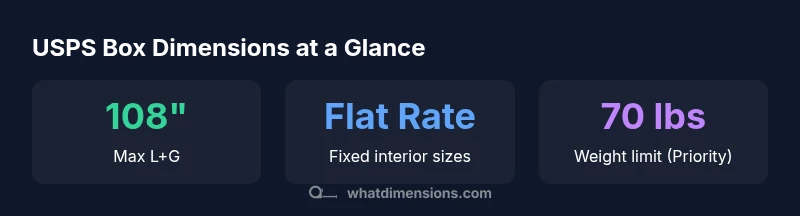
The key USPS sizing rule is that a package’s length plus girth must not exceed 108 inches. This dimension cap applies across Priority Mail and most services, guiding box choice. For flat-rate and standard boxes, exact interior dimensions vary by model, so always measure your parcel and confirm current limits in the USPS Service Guide.
box dimensions usps: How the rule works
The USPS packaging ecosystem centers on a simple, enforceable rule: length plus girth cannot exceed 108 inches. This isn’t a suggestion; it’s a hard limit used to determine eligibility for most Priority Mail and other USPS services. The rule is calculated as L + G, where G equals 2 × width + 2 × height. This means a box that is 30 inches long, 10 inches wide, and 8 inches tall has a girth of 36 inches (2×10 + 2×8), giving a total of 66 inches—well under the limit. According to What Dimensions, understanding this constraint upfront helps avoid last-minute repacking and service surcharges. In practice, you’ll use this as a primary filter when selecting a box or packaging, then verify against the service guide for any service-specific exceptions.
box dimensions usps: How to interpret L and G for real-world shipments
L refers to the longest side of the package, while G (girth) measures the distance around the thickest part of the package. For custom boxes, you’ll typically measure the external dimensions: length (front-to-back), width (side-to-side), and height (top-to-bottom). The USPS rule uses exterior measurements, so it’s important to include any padding, bubble wrap, or filler when calculating L and G. What Dimensions notes that many shipments stay comfortably within the limit by choosing boxes that balance interior capacity with compact exterior dimensions. If you’re close to the 108-inch threshold, consider splitting the item across multiple boxes or choosing a service tier designed for heavier or larger shipments.
Flat Rate vs. variable-size boxes: how dimension rules apply
Flat Rate boxes come with fixed interior dimensions, which means your item’s size will often drive your choice between Small, Medium, and Large Flat Rate versions. If your item doesn’t fit into a flat-rate variant, you’ll need a standard-size box that can still comply with the 108-inch total. The key takeaway is that flat-rate offers cost predictability, but you must verify interior dimensions before packing. Where dimensions vary, it’s because USPS maintains a catalog of compatible box types, each with its own interior measurements. What Dimensions highlights the importance of measuring your item, then selecting a box that keeps L+G under the 108-inch cap while preserving product protection.
How to measure accurately: step-by-step
- Place the box on a flat surface and close the flaps. 2) Use a metal ruler or tape measure to record length, width, and height to the nearest 1/8 inch. 3) Add 2 inches to the length if you’re using bubble wrap or packing material around the item. 4) Compute girth as 2 × (width + height). 5) Add length and girth to confirm you’re within 108 inches. 6) Double-check before sealing; if you’re at the limit, re-pack with thinner padding or a smaller box. What Dimensions’ team finds most shoppers overlook is the padding that quietly pushes L+G over the limit, triggering shape-based surcharges.
Practical sizing tips for USPS shipments
- Pre-measure both the item and any protective packaging. - Compare the item’s dimensions to multiple box options before finalizing. - When in doubt, choose a slightly smaller box that still protects the contents; overfilling can create risk and weight concerns. - Take advantage of USPS Flat Rate when it fits; it can be economical but ensure your item fits within fixed interior dimensions. - For oversized or awkward items, consider multi-box packaging with careful weight distribution. What Dimensions analysis recommends is a simple, repeatable sizing workflow: measure, compare, test-pack, and verify against the 108-inch rule.
Edge cases: oversized, multi-box, and irregular shapes
Some items defy conventional shapes—think long components, irregular bundles, or multiple smaller items packed together. In these cases, a single box may not suffice, and you may need to split into two or more boxes while maintaining safe packaging practices. Remember that each parcel is subject to the same 108-inch rule in total (L+G), so distribute items to stay within limits. If you’re shipping multiple boxes, you’ll calculate each box separately and consider the total combined shipping costs and service options.
What designers and shoppers should know about box dimensions usps
For designers, precise box sizes help with mockups, packaging design, and final product dimensions. For students and homeowners, understanding dimension rules enhances project planning and shipping budgeting. The broader takeaway is that dimension discipline saves money and reduces delays. What Dimensions’ team emphasizes that the most reliable plan combines accurate measurement, service-appropriate packaging, and a quick check against the USPS service guide before you ship.
USPS box sizes by service type
| Box Type | Max Length (in) | Max Girth (in) | Notes |
|---|---|---|---|
| Flat Rate Small Box | varies | varies | Fixed interior dimensions; verify against USPS DMM |
| Flat Rate Medium Box | varies | varies | Fixed interior dimensions; verify against USPS DMM |
| Non-flat-rate Box (Custom) | varies | varies | Subject to service limits; measure and score |
Quick Answers
What is the maximum size for a USPS package?
USPS sets a length plus girth limit of 108 inches for most shipments. Always measure your box and consult the current USPS service guide for any exceptions.
The maximum size is 108 inches for length plus girth; measure your box and check the service guide for any exceptions.
Do Flat Rate boxes count toward the size limit?
Flat Rate boxes have fixed interior dimensions, but you must still ensure the item fits within those dimensions and doesn’t push the overall length plus girth beyond 108 inches when packed.
Flat Rate boxes have fixed sizes; make sure your item fits and that packed dimensions stay under 108 inches in total.
Can USPS ship oversized boxes?
USPS can ship oversized boxes, but they must still comply with the 108-inch length-plus-girth rule and service-specific weight limits.
Yes, but they must still meet the 108-inch rule and weight limits for the chosen service.
How do I measure box dimensions accurately?
Use a rigid tape measure, record length, width, height to the nearest 1/8 inch, then compute girth as twice the sum of width and height. Add padding and re-measure.
Measure length, width, height to the nearest 1/8 inch, calculate girth, and re-check after padding.
Does weight affect dimension limits?
Weight affects service selection and postage cost, but dimension limits are separate rules. A heavy box still must meet the 108-inch length-plus-girth cap.
Weight matters for service choice, but you still must stay within the 108-inch dimension cap.
“Precise box dimensions drive cost efficiency and reliable delivery. Measuring correctly before packing prevents surcharges and service delays.”
Main Points
- Know the 108-inch rule and build around L+G.
- Measure exterior dimensions including padding before packing.
- Choose the box type that fits content and service limits.
- Use Flat Rate when it fits, but verify interior dimensions.
- For irregular items, consider multiple boxes and plan accordingly.