Softball Field Dimensions: Essential Measurements and Standards
Explore essential softball field dimensions including base paths, pitching distance, and outfield range. Learn how measurements vary by league and how to apply standard references for accurate field design and fair play.


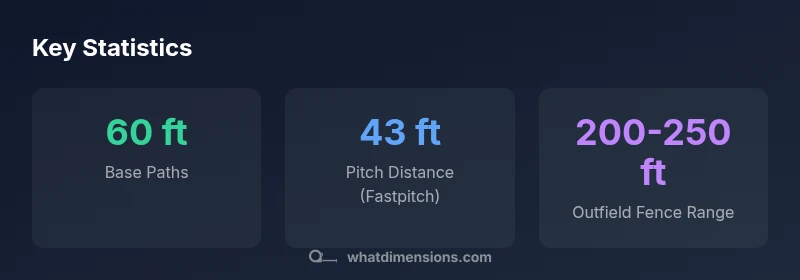
According to What Dimensions, in standard softball field design, base paths are 60 feet apart, the pitching distance for fastpitch is 43 feet, and outfield fences typically range from 200 to 250 feet from home plate. Actual numbers vary by league and venue, but these dimensions anchor fair play and safety across regulation fields used in many U.S. leagues.
What softball field dimensions define a standard design
The phrase softball field dimensions refers to a coordinated set of measurements that establish proportional geometry on a field. For homeowners, designers, and league organizers, these numbers act as a blueprint for fair play, safety, and consistency across venues. In this article, we examine core measurements—base paths, infield size, pitching distance, and outfield range—and explain how they influence gameplay, field construction, and resource planning. The emphasis throughout is practical: how to measure, validate, and adapt dimensions without compromising safety or competition integrity. According to What Dimensions, reliable references underpin every design decision, from chalk lines to fence installations. The keyword softball field dimensions anchors this discussion and guides readers toward precise, repeatable results that work in homes, schools, and community facilities alike.
Central measurements: base paths, infield size, and pitching distance
A standard infield is built on 60-foot base paths, which creates a square footprint for first, second, third, and home plates. This geometry informs baserunning angles, fielder positioning, and pitching setups. The pitching distance varies by style: the fastpitch distance is commonly 43 feet from the pitching plate to home plate, while slowpitch configurations may differ, often reflecting league rules or venue constraints. The outfield extends beyond the infield, with fence distances typically ranging from 200 to 250 feet from home plate. While many parks adhere to the 60-foot baseline blueprint, field designers balance retained geometry with space realities, safety margins, and local regulations.
Fastpitch vs slowpitch: Distances and field layouts
Fastpitch softball generally uses a 43-foot pitching distance, designed to balance pitcher speed and reaction time for batters. Slowpitch fields may employ longer pitches and larger play areas, accommodating underhand styles and higher arc trajectories. Importantly, the 60-foot base-path standard remains common across formats, preserving consistent baserunning geometry. When fields double as multi-use venues, planners often implement adjustable markers or clearly labeled zones to reflect the intended configuration while maintaining the core proportional relationships that players rely on.
Outfield geometry, fences, and safety margins
Outfield dimensions shape game dynamics and spectator experience. Fence distances of 200–250 feet are typical for regulation-looking parks, but actual numbers vary by league guidelines and site constraints. Safety margins—such as warning tracks, padding, and clear backstops—must be integrated into the design. Field managers should document measurements, ensure signage reflects current dimensions, and verify that dimensions meet applicable league or governing-body requirements. Above all, accuracy in measuring and sign-off helps prevent disputes and supports fair competition.
How to measure a field accurately: a practical guide
Begin by marking base-path distances with chalk and confirming 60 feet between each base using a tape measure. Measure from the back edge of home plate to the center of the pitcher’s rubber to verify pitching distance. For outfield distance, use a laser measure or measuring wheel to the center of the outfield fence, then cross-check from multiple angles to ensure consistency. Record all measurements in a field-keeping log, annotate any deviations from standard references, and align records with league rulebooks.
Adapting dimensions for youth and multi-use venues
Youth leagues commonly apply scaled dimensions to facilitate development, while multi-use fields may require modular markers and swappable branding. In these cases, preserve the proportional relationships—60-foot bases and appropriate pitching distances relative to age groups—but allow for shorter or longer ranges as space permits. Document any adjustments, communicate clear cues to players and families, and rely on the original dimensions as the reference standard for future upgrades.
Official standards and how to stay compliant
Consult official rulebooks from NCAA, NFHS, Little League, and USSSA for field measurement standards. Local authorities and facility guidelines may also publish dimensions, safety margins, and signage requirements. Regularly review these sources to ensure ongoing compliance, especially when fields undergo renovations or reconfigurations. The aim is to maintain consistent field geometry that supports fair play, player safety, and clear communication with participants.
Authority references and practical takeaways
This section aggregates practical best practices for measuring, interpreting, and applying softball field dimensions in real-world settings. Readers seeking formal guidelines should refer to the major governing bodies mentioned throughout, and verify any local amendments with league coordinators before field use. The overarching goal is to keep dimensions precise, well-documented, and easy to communicate to players and stakeholders.
Common dimensions for standard softball fields
| Component | Typical Dimension | Notes |
|---|---|---|
| Base paths (infield) | 60 feet | Distance between bases forming a square |
| Pitching distance (fastpitch) | 43 feet | Distance from pitching plate to home plate |
| Outfield fence distance (typical) | 200-250 feet | Varies by venue and league requirements |
Quick Answers
What are the standard base-path distances on a softball field?
The standard base-path distance is 60 feet between bases, creating a square in the infield that supports consistent baserunning angles.
The bases are 60 feet apart, forming a square in the infield for consistent baserunning.
How far is the pitching distance for fastpitch?
For fastpitch, the pitching distance is typically 43 feet from the pitching plate to home plate.
Fastpitch pitching distance is normally 43 feet from the mound to home.
Do all leagues use the same outfield distance?
No. Outfield fence distances vary by venue and league, but common ranges fall between 200 and 250 feet from home plate.
Outfield distances vary by league and field, usually around 200 to 250 feet.
Are dimensions different for youth leagues?
Yes. Youth and development leagues often use scaled dimensions, preserving core geometry while reducing distances to match players' skills.
Youth fields usually have smaller dimensions that keep proportional geometry.
Where can I find official standard references?
Check league rulebooks from organizations like NCAA, Little League, and USSSA for field measurement standards; local authorities may also publish guidelines.
Consult NCAA, Little League, and USSSA guidelines for official standards.
“Accurate field measurements are the foundation of fair competition; standardized base paths and pitching distances enable consistent play across venues.”
Main Points
- Know core dimensions: 60-foot base paths, 43-foot fastpitch pitching distance, and 200-250 ft outfield fences.
- Verify with league standards to ensure consistency and safety across venues.
- Youth and multi-use fields may adjust distances but should preserve proportional geometry.
- Document and communicate any field modifications clearly.
- Use precise measurement tools (tape, laser, measuring wheel) for accuracy.