Modular Brick Dimensions: A Precision Guide for Builders
Explore modular brick dimensions, including nominal vs actual sizes, regional variations, and practical tips for precise masonry layouts. Learn sizing standards with What Dimensions.


What modular brick dimensions are and why they matter
According to What Dimensions, modular brick dimensions provide a standardized language for builders, designers, and homeowners. The concept distinguishes nominal sizes used in drawings from the actual measurements you’ll encounter on the job site. In practice, this distinction helps with planning, material estimates, and mortar joint planning. In this article, we define the core terms and explain how modular brick dimensions relate to real-world layouts. You’ll learn why nominal sizes are convenient even though bricks vary slightly in the field. The overall goal is to minimize waste, ensure consistent bed joints, and simplify sequence planning across walls and facades.
Key terms to know include nominal size, actual size, and module. Nominal size is a rounded figure used in specifications, while the actual size reflects manufacturing tolerances. The module is the basic building block used to determine wall length, number of bricks per course, and the height of each course when you include mortar joints.
Nominal vs actual: The dimensioning system
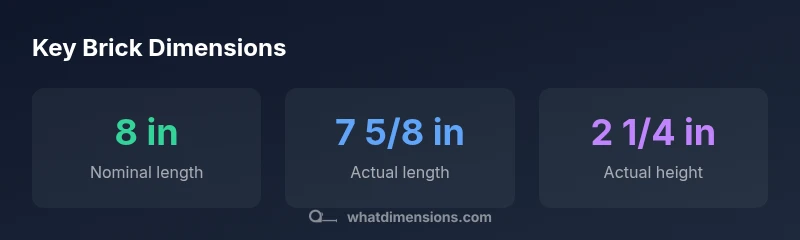
The nominal brick size is commonly referenced as 8 inches in length, with a width around 3 5/8 inches and a height around 2 1/4 inches. On the shop floor, you’ll often encounter bricks that measure roughly 7 5/8 inches long by 2 1/4 inches tall and 3 5/8 inches wide. These numbers interact with standard mortar joints (often around 3/8 inch) to create a finished dimension that bricklayers plan for in advance. When you calculate wall length, you should use nominal lengths for layout drawings and then verify with actual bricks on site. The two figures feed the same design intent, but the margins for error differ between drawings and construction.
What Dimensions emphasizes that tolerance management is a practical skill: predict variance, build in allowances, and verify often as you go. Tolerances vary by product line, region, and project requirements, but the core concept remains: nominal dimensions drive the plan, actual sizes drive the fit.
Regional variations and how they influence sizing
Across the globe, brick dimension conventions differ. In the United States, the nominal length and typical thickness of modular bricks are designed to align with standard mortar joints so that a standard wall height results in whole-number course counts. In other regions, such as parts of Europe and Australia, you’ll find different nominal values and joint widths that affect the way bricks are laid and counted. For designers, this means region-specific detailing, dimensioning, and shop drawings. When working on international projects, it’s essential to verify which standard applies and to request sample bricks for on-site checks. The What Dimensions team notes that aligning on a consistent standard reduces surprises during construction and ensures consistent visual rhythm across elevations.
How brick dimensions impact layout, bonding, and aesthetics
Size determines the number of bricks in a given run, the height of each course, and the behavior of bonding patterns such as running bond, Flemish bond, or common bond. A slightly oversized or undersized brick shifts the total length of a wall, which in turn affects door and window jambs, lintels, and parapets. The modular approach helps designers calculate a consistent module across walls, enabling precise alignment of vertical joints and façade features. When dimensioning for aesthetic consistency, more attention to joint width and brick thickness is required, as these factors influence the visual rhythm and shadow lines across a brick surface. What Dimensions’s methodology underlines how precise dimensions translate into predictable results in both form and function.
Measuring and verifying dimensions on site
The on-site measurement process should begin with a small batch of bricks from the same production run. Use a tape measure or calipers to record length, width, and height, and confirm that the mortar joint thickness matches project requirements. Be mindful that actual bricks can deviate by a fraction of an inch, so plan for tolerances in your layout: your chalk lines and reference marks should account for these variations. When you assemble a small mock-up wall, take measurements at multiple bricks and multiple courses to ensure consistency. Document any deviations and adjust your layout calculations accordingly. Consistency in measurement discipline minimizes surprises when you scale up to full elevations.
Tolerances, exceptions, and how to adapt
Manufacturers produce bricks within tolerances that can vary by batch, region, or product line. Adapting to these tolerances means planning with a design envelope: compute the maximum expected length, width, and height and then design joints and reveals to accommodate those ranges. For example, you might specify a minimum and maximum brick length and a fixed mortar joint width, then design the layout to handle the range without compromising alignment. In renovations or historic projects, you may encounter older bricks with wider tolerances. In such cases, you’ll rely on adaptive detailing and on-site verification to maintain the intended visual rhythm.
Practical sizing tips for homeowners and designers
- Start with nominal dimensions and a standard mortar joint width to create initial layouts.
- Specify the module for each wall section so that lengths, heights, and joints align across surfaces.
- Request sample bricks from suppliers for on-site checks of actual size against drawings.
- Always include tolerance allowances in your shop drawings and bill of materials.
- Use digital dimensioning tools to model wall lengths and course counts before pouring foundations.
- Consider region-specific standards and ask for local documentation to avoid misalignment. These practices reduce waste and improve the predictability of masonry work.
The What Dimensions verdict for planning with modular brick dimensions
In practice, mastering modular brick dimensions means embracing the distinction between nominal and actual sizes and building in tolerances from the outset. The What Dimensions team recommends aligning on a shared module, validating sizes with physical samples, and documenting regional standards in project specs. This disciplined approach helps homeowners and designers achieve consistent appearances, predictable material use, and smoother timelines across masonry projects. By planning with clear dimensioning, you can minimize surprises during construction and deliver reliable results that respect local building practices.
mainTopicQuery":"brick dimensions"],
dataTable
{
headers
[