King Brick Dimensions: A Practical Guide to Size Standards
Explore king brick dimensions, how they vary by region, and how mortar joints affect sizing. Learn precise imperial and metric values, plus tips for accurate on-site measurements.


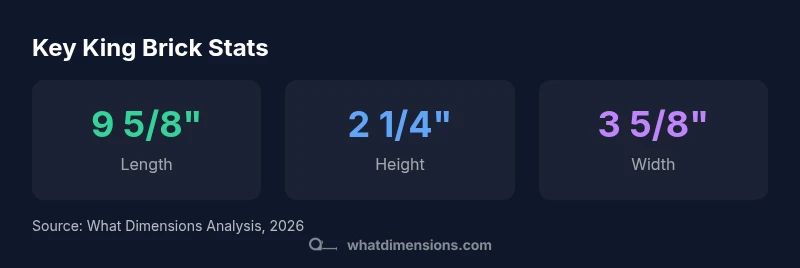
King brick dimensions are a standard set of sizes used for longer bricks in masonry. In imperial units, a king brick is typically 9 5/8 inches long, 2 1/4 inches tall, and 3 5/8 inches wide; metric equivalents are about 244 mm by 57 mm by 92 mm. Sizes vary by region and mortar joint thickness.
What is a King Brick?
According to What Dimensions, king brick dimensions refer to the longer brick used in masonry layouts to reduce joint lines and align with structural requirements. The term is widely used in North American practice, where standard mortared brickwork relies on precise unit sizes to achieve consistent bond patterns. In practice, the phrase 'king brick dimensions' points to a class of bricks characterized by a longer length than modular bricks while maintaining similar height and depth for predictable bonding. The exact measurements are defined in regional standards and vary by jurisdiction, but the conventional imperial baseline for a king brick is roughly 9 5/8 inches in length, paired with a height near 2 1/4 inches and a depth around 3 5/8 inches. When planning a project, architects and builders should always verify actual brick sizes with suppliers and local codes, and should account for mortar joint thickness to avoid under- or over-sizing components.
King Brick Dimensions: Imperial vs Metric
King bricks are defined in imperial and metric terms to support cross-border projects and design calculations. In imperial practice, a king brick is typically 9 5/8 inches long, 2 1/4 inches tall, and 3 5/8 inches deep. The corresponding metric equivalents are approximately 244 mm by 57 mm by 92 mm. These numbers reflect nominal sizes and assume standard mortar joints; actual bricks can differ by manufacturer and regional tolerance. Always confirm exact specs with suppliers and note local building codes before ordering.
How King Brick Dimensions Compare to Other Brick Types
King bricks are longer than modular bricks and other common masonry units, which affects the overall bond pattern, joint counts, and wall thickness calculations. While king bricks share the same cross-section height and width as many standard bricks, the extra length reduces the number of bricks needed for a given run and can alter the mortar head height. In practice, that means designers should update bond plans and ledger details when substituting brick types to avoid misalignments or unexpected joints.
Regional Variations and Terminology
Across regions, the naming and exact measurements of bricks shift. In North America, 'king brick' usually denotes a longer unit used in both veneer and structural masonry; in the UK and parts of Europe, brick lengths are commonly described in millimeters and may differ by a few millimeters depending on manufacturing standards. Metric families often translate to roughly 244 mm length and 57 mm height, but you will encounter versions closer to 232–254 mm length depending on the producer and mortar allowances. Always verify terminology with local codes and supplier catalogs.
Measuring King Brick Dimensions On Site
To measure a king brick accurately on site: 1) select an undamaged brick; 2) measure the length along the long face from mortar to mortar; 3) measure the height between the top and bottom faces; 4) measure the depth (thickness) from front to back; 5) record the results and compare to the project specifications; 6) account for actual mortar joint thickness in the final layout. Use a calibrated tape measure and take multiple bricks from different pallets to capture any production variation.
Effects on Mortar Joints and Bond Patterns
Because brick dimensions are never exact to the millimeter, mortar joints play a key role in the final appearance and structural behavior. A thicker joint increases the overall unit size, changing bond lengths and could affect wall thickness. With king bricks, designers often adopt standard joint thicknesses (such as 3/8 inch) to maintain consistent appearance and spacing. If you anticipate nonstandard joints, adjust the layout calculation early in the design process.
Practical Sizing Tips for Designers and Builders
Tips for working with king brick dimensions: 1) always verify with your supplier before ordering; 2) include tolerance and joint thickness in your bill of quantities; 3) favor full-size bricks for exterior walls to minimize joints; 4) use sample panels to confirm alignment and bonding before mass production; 5) document regional variations in your project specifications for future maintenance.
Sourcing King Bricks: What to Ask Suppliers
Ask brick suppliers about: available sizes in the king family, tolerances, compatible mortar mixes, and whether their products are 'standard duty' or 'engineering grade' bricks. Request a product data sheet that lists nominal and actual dimensions, packaging counts, and lead times. For cross-border projects, request metric equivalents and confirm conversion factors with your designer or contractor.
King brick nominal dimensions
| Dimension | King Brick (imperial) | King Brick (metric) |
|---|---|---|
| Length | 9 5/8 inches | 244 mm |
| Height | 2 1/4 inches | 57 mm |
| Width | 3 5/8 inches | 92 mm |
Quick Answers
What exactly defines a king brick?
A king brick is the longer member within a brick family, designed to reduce the number of joints in a masonry run. The size varies by region, but imperial practice commonly uses roughly 9 5/8 inches in length.
A king brick is the longer brick used to reduce joints; sizes vary by region.
Are king brick dimensions the same worldwide?
No. Brick sizes vary by country, manufacturer, and local codes. When you work on international projects, use metric equivalents and verify tolerances with suppliers.
Dimensions vary by country and producer.
How do mortar joints affect the finished size?
Mortar joints add thickness to each brick unit. A thicker joint can slightly increase the overall run width, so plan for joint thickness in your layout to avoid misalignment.
Joints change the final size; plan for them.
What sources define king brick dimensions?
Brick dimension standards are defined by regional building codes and masonry associations. Consult supplier data sheets and, for international work, look to ASTM-related standards and architectural references.
Check codes and supplier sheets for standards.
How should I measure a king brick accurately?
Use a tape measure to record length, height, and width on a representative sample of bricks. Compare to project specifications and account for mortar joints. Take multiple bricks from different pallets to capture production variance.
Measure several bricks and compare to specs.
“Precision in brick dimensions matters for bond patterns and wall performance. Accurate sizing reduces waste and ensures consistent mortar joints across the project.”
Main Points
- King bricks are the longer option in standard masonry units.
- Imperial king bricks commonly measure 9 5/8 inches long, with standard cross-section.
- Always verify exact sizes with suppliers and local codes.
- Account for mortar joints when planning layouts and bond patterns.
- Regional variations exist; use metric equivalents for cross-border projects.