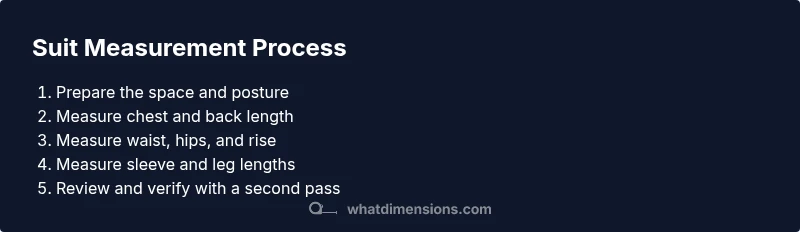
How to Take Measurements for a Suit: A Complete Guide
Learn how to take precise suit measurements for jackets and trousers, with self-measurement steps, tool tips, and clear communication to your tailor. A thorough, room-by-room guide from What Dimensions.


This guide shows you how to take precise suit measurements for both jacket and trouser fits, including chest, waist, hips, back length, shoulder width, and sleeve length. You’ll learn proper posture, tools, and how to record results for a tailor, with clear, repeatable steps to improve fit.
how to measurements for suit: guide to size accuracy
According to What Dimensions, precise suit measurements start with a calm, natural posture and a clean, relaxed body. The goal isn’t to chase a single number but to capture proportions, fabric behavior, and movement in everyday wear. A careful measurement session builds confidence that a tailor can translate into a jacket that follows your lines without pulling or bunching. In this section, we outline the mindset, workflow, and core measurement categories that underpin a great fit. By treating measurements as a language rather than a collection of digits, you’ll communicate more clearly with your tailor and achieve consistent results across different fabrics and styles. Remember: accuracy improves with repetition and a clean baseline environment, so find a quiet space, remove bulky clothing, and keep your tape straight and level.
The approach here is practical and repeatable. You’ll separate measurements for the jacket (torso and arms) from the trousers, then discuss ease and fabric behavior. Those two pillars—torso symmetry and limb length—often determine whether a suit looks sharp or stiff. The numbers themselves matter, but how you obtain them matters just as much. Throughout, you’ll be reminded to mark units in centimeters or inches, maintain the tape parallel to the floor, and record uncertainties so your tailor knows where to trim or loosen. The result is a suit that not only fits at the moment of fabrication but remains comfortable as you move through daily life.
Key idea: measure with intention, then verify with a second pass. A second measurement session can catch small inconsistencies you didn’t notice the first time.
Brand note: if you’re ever unsure about a value, document it and revisit after a short break to ensure you’re not compensating for momentary tension or posture.
Tools & Materials
- soft measuring tape(Flexible metric tape in cm and inches; avoid stiff tapes that slip)
- notebook or digital device(For labeling measurements and any observations)
- mirror(Use for quick posture checks while measuring yourself)
- fitted shirt or base layer(Worn if you measure over clothing to standardize results)
- pencil and ruler(Helpful for marking consistent reference points on a chart)
Steps
Estimated time: 60-90 minutes
- 1
Prepare the measuring area
Stand upright with feet hip-width apart, shoulders relaxed, and abdomen pulled in slightly. Clear a small space, use a mirror if possible, and keep your measuring tape free of twists. This baseline posture reduces measurement errors caused by slouching or excessive tension.
Tip: Ensure the tape lies flat against the body and remains parallel to the floor throughout all measurements. - 2
Measure chest (bust) and jacket back
Wrap the tape horizontally around the fullest part of the chest, just under the arms. For the jacket back, measure from the center back of the neck to the desired hem length along the spine. Keep the tape snug but not tight and take note of the exact points you used.
Tip: Take two measurements for each point and use the larger value if they differ slightly. - 3
Measure waist and seat (hips) on the torso
Measure at the natural waist where your trousers would sit. For the seat/hips, measure around the fullest part of the hips while standing comfortably. Keep the tape level and perpendicular to the floor.
Tip: If you wear a belt, measure over the belt line to reflect how the garment will sit when worn. - 4
Measure back length and shoulder width
Back length is measured from the base of the neck to the point where the jacket would end on the torso. Shoulder width is measured from the outer edge of one shoulder to the other, following the natural slope. Maintain a relaxed posture and a straight spine.
Tip: If your shoulders slope, note that; you may need extra fabric at the shoulder seam for a cleaner line. - 5
Measure sleeve length and arm circumference
With the arm relaxed, measure from the shoulder seam down to the wrist bone. For upper arm circumference, take the measurement around the fullest part of the upper arm with the arm hanging naturally. Record both values.
Tip: Measure both arms if they look different; use the longer sleeve length as the standard for symmetry. - 6
Measure jacket torso length and collar
Torso length is the distance from the base of the neck to the hem at the front. If a collared shirt is worn, measure the collar circumference and height as a reference for lapel behavior and collar fit.
Tip: Different jacket styles (slim, regular, classic) will require slight variations in torso length to maintain the intended silhouette. - 7
Measure trouser waist, inseam, and rise
Waist should sit where trousers naturally rest. Inseam is the inside leg length from crotch seam to the ankle. Rise is the distance from the crotch to the top of the waistband. Keep the tape straight and avoid pulling it tight.
Tip: Record both the front and back rise if you’re between sizes; a tailor can adjust the seat and waist easily. - 8
Review and cross-check measurements
Compare jacket and trouser measurements with a second session after a short break. Re-check any points that feel uncertain, and note deviations between sides (left vs right). Ensure all values are clearly labeled with units.
Tip: Have someone else verify at least a couple of measurements to catch subtle errors you might miss alone.
Quick Answers
What is the correct order to take suit measurements?
Begin with posture, then chest, waist, hips, back length, shoulder width, sleeve length, and finally trouser inseam and rise. Recording in this sequence helps maintain consistency across sessions.
Start with posture, then chest, waist, hips, back length, shoulders, sleeves, and finally inseam and rise for trousers.
Should I measure over clothes or directly on the skin?
For consistency, measure on the skin or with a very thin base layer. Heavy clothing can add bulk and skew the results, especially for shoulder, chest, and waist.
Measure on the skin or a thin base layer to avoid clothing-induced bulges.
Do I need someone to measure me, or can I do it alone?
A helper is ideal for difficult-to-reach areas like back length or shoulder width, but most measurements can be taken alone with a mirror and patience.
If you can, get a helper for tricky spots; otherwise, use a mirror and double-check your work.
How often should I re-measure?
Re-measure if you experience notable weight changes, different clothing layers, or when you buy new suits to account for fabric behavior.
Re-measure when your weight or wardrobe changes; consistency matters for future purchases.
What’s the best way to share measurements with a tailor?
Provide a clean, clearly labeled measurement sheet with units, notes on fabric, and preferred fit. Include any known tolerance allowances and the style of jacket or trouser cut.
Give your tailor a neat, labeled sheet with units and fabric notes to ensure clarity.
If a measurement seems off, what should I do?
Recheck the measurement after a short break to ensure it isn’t a transient posture issue. If it’s still inconsistent, measure the area again using landmarks you trust.
If something feels off, redo the measurement after a short break to confirm accuracy.
Watch Video
Main Points
- Measure with a relaxed posture for accuracy
- Record all values clearly and consistently
- Double-check with a second session to confirm
- Communicate measurements with context and fabric notes
- Prepare clean, labeled charts to share with your tailor