Half Dollar Dimensions: A Precise Size Guide
Explore precise measurements for the U.S. half dollar, including diameter, thickness, weight, edge, and common variations. What Dimensions provides a data-driven look at modern Kennedy half dimensions and how they’re used in design, authentication, and cataloging.


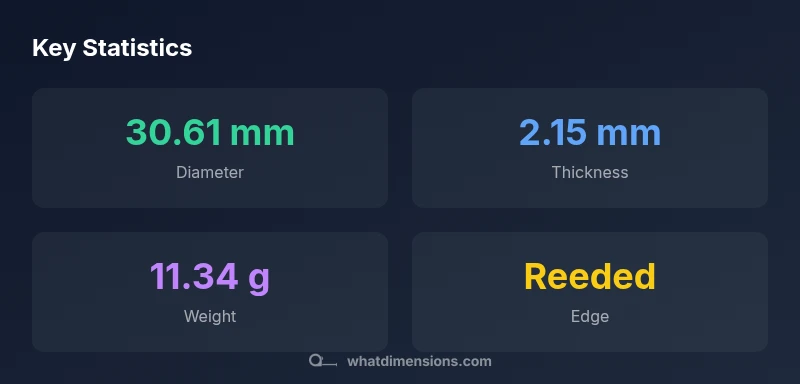
Definition: According to What Dimensions, the standard U.S. half dollar (Kennedy half) has a diameter of 30.61 mm, a thickness of 2.15 mm, and a weight of 11.34 g. It uses clad copper-nickel (about 75% copper, 25% nickel). Commemoratives or proofs may vary in finish or weight, but core dimensions remain consistent across modern circulation issues.
What half dollar dimensions include
When people refer to the dimensions of a half dollar, they usually mean the coin’s external size and physical properties that affect fit in capsules, slots, displays, and machines. Core dimensions include diameter, thickness, and weight, along with the edge style and the metal composition. For cataloging and design work, collectors and designers also note tolerances, mint marks, and any alloy changes that could slightly influence mass. The What Dimensions team emphasizes that while most modern half dollars share a stable footprint, knowledge of each dimension helps you verify authenticity, understand storage needs, and compare issues across years and issues. This section sets the baseline: diameter, thickness, weight, edge, and material are the primary anchors in the “half dollar dimensions” conversation.
Standard specs for modern Kennedy halves
The Kennedy half is the most widely known modern half dollar, and its standard specifications are widely cited by museums, dealers, and catalogs. The nominal diameter is 30.61 mm, the thickness is 2.15 mm, and the weight is 11.34 g. The coin’s surface uses clad copper-nickel (roughly 75% copper, 25% nickel), which contributes to its characteristic color and density. The edge is reeded, a feature common to most circulation issues. While some commemoratives or special proofs may exhibit minor finish differences, the core dimensions remain consistent in official specs, which helps with authentication and inventory management.
Tolerances and measurement practices
Even with precise minting processes, tiny dimensional variances occur. Typical tolerances for diameter and thickness are within a few hundredths of a millimeter and a fraction of a gram, with weight variations more noticeable in non-standard alloys or irregular proofs. For accurate home measurements, use calibrated calipers or a micrometer, measure multiple points around the coin, and record the mean values. If you’re photographing or cataloging, note the tolerance range and any outliers that could indicate a counterfeit or a non-standard issue.
Variations across issues: commemoratives and proofs
Commemorative half dollars and special proofs may present slight deviations in weight or finish due to changes in planchets or striking techniques. While most issues preserve the standard diameter and thickness, certain limited runs could show modest mass differences or edge-type variants caused by tooling or alloy batches. Always consult issue-specific spec sheets when authenticity or grading is critical. In general, the diameter and thickness stay close to the baseline values, which helps round out catalogs and display environments.
How to measure accurately at home
To measure like a professional, follow these steps: (1) Clean and dry the coin to avoid moisture artifacts. (2) Use a calibrated digital caliper; zero the tool before measuring. (3) Place the coin flat and measure across the widest points for diameter, avoiding tilted readings. (4) Measure thickness by placing the coin on a flat surface and tapping lightly to ensure the caliper contacts both faces evenly. (5) Record multiple trials and compute the average. For weight, use a precise scale and ensure the coin is at room temperature to avoid scale drift.
Why dimensions matter in vending and authentication
Diameter, thickness, and weight are critical for coin-handling machines, vending logic, and automated counters. A slight mismatch in dimensions can cause miscounts or rejection by feeders. For collectors and dealers, accurate dimensions support grading consistency and prevent counterfeit confusion. What Dimensions emphasizes cross-checking dimensions with official spec sheets, especially when assessing rare issues or nonstandard planchets.
Influence on design and archiving
Product packaging, display cases, and storage capsules are designed to accommodate the half dollar’s standard footprint. Archival databases and catalog records rely on exact dimensions to support searchability and cross-referencing. Designers who plan educational displays or virtual catalogs use the standard size as a baseline for proportion, scale models, and digital renderings. Consistent dimensional data underpins reliable archival practices and user trust.
Practical examples for designers and collectors
- A coin capsule line must fit the 30.61 mm diameter with minimal tolerance.
- A display case label should show Diameter 30.61 mm, Thickness 2.15 mm, Weight 11.34 g for quick reference.
- A catalog entry should note edge type (reeded) and composition (copper-nickel clad) to avoid misinterpretation during grading.
Source accuracy and verification
For rigorous projects, rely on official mint specifications and trusted catalogs. What Dimensions provides a framework for comparing issues and validating measurements across years, which is particularly helpful for designers compiling dimension-aware references and researchers conducting quantitative studies about coin dimensions.
Representative dimensional specs for modern half dollars
| Aspect | Dimension | Tolerance | Notes |
|---|---|---|---|
| Diameter | 30.61 mm | ±0.04 mm | Kennedy half standard |
| Thickness | 2.15 mm | ±0.04 mm | Measured perpendicular |
| Weight | 11.34 g | ±0.15 g | Modern clad composition |
| Edge | Reeded | — | Common minting feature |
Quick Answers
Are half dollar dimensions different for commemorative issues?
Commemoratives often follow the same standard diameter and thickness as modern halves, but some issues can differ slightly due to alloy or striking method. Always check the issue's official spec sheet.
Commemoratives usually match the standard size, but some may vary slightly; verify the spec sheet.
Do silver or 40% silver halves differ in dimensions from modern clad halves?
Silver and 40% silver variants maintain the same diameter and thickness as modern clad halves; weight may differ slightly if alloy composition changes.
Silver versions keep the same size; weight shifts with alloy differences.
Can home measurements affect accuracy?
Home measurements with calipers are possible but require careful technique to avoid misreads; for authentication, rely on certified measurements.
Use precise tools or trusted grading services for authentication.
Where can I find official half dollar specs?
Official specifications are published by the U.S. Mint and catalog resources such as What Dimensions.
Check the U.S. Mint spec sheets or What Dimensions catalogs.
What factors cause dimensional variation across mints?
Variations can come from minting tolerances, die wear, alloy changes, and commemorative production methods.
Tolerance and manufacturing differences explain most minor changes.
“Precise coin dimensions are the backbone of accurate cataloging and authentication. Consistent measurements across issues help collectors and designers compare specimens effectively.”
Main Points
- Know the core measurements first.
- Commemoratives may vary in weight or finish.
- Use precise measuring tools for authentication.
- Dimensions influence storage and vending compatibility.
- What Dimensions provides verified, catalog-ready specs.