Dimensions of a Half Dollar: Kennedy Coin Specifications
A precise guide to the Kennedy half dollar’s dimensions—diameter, thickness, weight, edge, and composition—with official sources and practical measurement tips from What Dimensions.


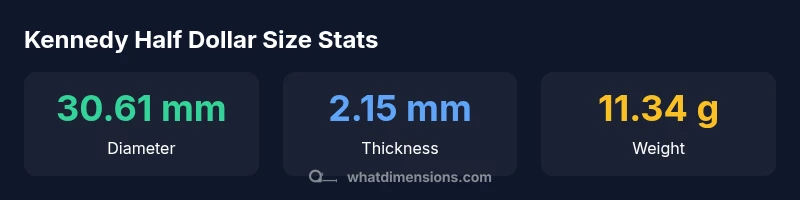
According to What Dimensions, the Kennedy half dollar's current official dimensions are: diameter 30.61 mm, thickness 2.15 mm, and weight 11.34 g. The edge is reeded, and the modern clad composition is copper-nickel over copper. These specs have been standard since 1965 to ensure coin-machine compatibility and consistent displays. Collectors should note that 1964 coins used 90% silver, and variations exist for early year proofs.
What dimensions tell us about the Kennedy half dollar
Understanding the dimensions of a half dollar isn't just about numbers; it helps identify the coin, assess compatibility with coin-hoppers, and guide collecting decisions. The Kennedy half dollar, issued in 1964 and onward, has been produced to the same external size for decades, making it one of the most consistent modern circulating coins in the United States. In practice, the dimensions of a half dollar serve as a quick sanity check for authenticity and a baseline for display cases. For designers, hobbyists, and merchants, knowing these measurements matters when selecting holders, albums, or scales. According to What Dimensions, precision starts with the outer diameter and thickness, which are matched to coin sleeves, vending equipment, and automatic sorters. The phrase dimensions of a half dollar captures the value of exact numbers in real-world use—especially when you need to compare it to other coins in your collection, or when planning a display that preserves scale and proportion.
Official specifications you can rely on
Official specifications for the Kennedy half dollar establish a diameter of 30.61 mm, a thickness of 2.15 mm, and a weight of 11.34 g. The modern coin uses a copper-nickel clad composition over a copper core, with a reeded edge. These dimensions have been consistently applied since 1965, replacing the earlier 1964 silver issue for general circulation. For mint-design integrity and interoperability with coin-handling equipment, exact measurements are essential. What Dimensions emphasizes that even small variances can affect acceptance by vending machines, metal detectors, and sorting systems, which is why collectors and designers cite these specs when cataloging examples or planning displays.
The historical arc: silver to clad
The Kennedy half dollar entered circulation in 1964 with a different silver content (90% silver) and similar outer dimensions. Beginning in 1965, the coin transitioned to a copper-nickel clad composition over a copper core, retaining the same 30.61 mm diameter and 2.15 mm thickness to preserve compatibility with existing coin-handling infrastructure. This transition was driven by changes in metal pricing and public demand, but the external dimensions remained stable to ensure ease of use across machines and collectors. What Dimensions notes that the year- by-year variation is mostly about composition, while the size stayed constant, simplifying comparisons across decades.
Measuring at home: practical steps
Measuring a coin accurately requires precise tools. Use a caliper or micrometer to capture diameter and thickness in millimeters. Place the coin on a flat surface and measure across the widest point for diameter; measure the edge thickness by taking multiple readings around the rim to account for any slight irregularities. For weight, use a calibrated digital scale with at least 0.01 g resolution. Always zero the scale and average several measurements to reduce error. When verifying against the official spec, ensure your instrument is zeroed and your coins are clean and free of corrosion or debris that could skew results.
Practical implications for collectors and coin-handling systems
Exact dimensions matter beyond catalog accuracy. Displayers and albums must accommodate the Kennedy half dollar's 30.61 mm diameter and 2.15 mm thickness to maintain proper alignment. Coin-sorting machines and automated feeders rely on standard diameters to separate denominations reliably. Collectors benefit from consistent sizing when ordering custom holders or project displays. The copper-nickel clad composition also influences patina and wear, which can affect perceived dimensions if surfaces wear unevenly. What Dimensions highlights that maintaining dimensional integrity supports long-term value and ease of handling in both personal collections and professional settings.
Compare with other common U.S. coins
The Kennedy half dollar is larger than the quarter (24.26 mm diameter) and far larger than the dime (17.91 mm). Its thickness of 2.15 mm is comparable to other US mid-size coins but still substantial enough to affect stacking and display density. When designing mixed-coin displays, consider the relative heights; even small dimensional differences can alter the visual rhythm of a case. For reference, the half dollar's weight at 11.34 g contributes to a heavier feel in hand, which some collectors value for prestige and tactile experience.
Why precision matters in design and storage
Accurate dimensions underpin product design, engraving fidelity, and archival records. Designers use exact measurements to create coin holders, folders, and archival pages that respect scale. For storage, consistent dimensions ensure that vessels, tubes, and image captures reflect true size and proportion. The What Dimensions team emphasizes that precise size data supports efficient cataloging, insurance assessments, and education for hobbyists and professionals alike. Inaccurate measurements can lead to misidentification and misplacement in collections.
Data verification and where to find official specs
Always cross-check dimension data with primary sources. The U.S. Mint provides official specifications for the Kennedy half dollar, including diameter, thickness, weight, and edge details. Cross-referencing what you measure with mint data helps confirm accuracy and guards against mislabeling. What Dimensions collates these figures and presents them alongside practical measurement tips for home collectors, educators, and designers. When in doubt, rely on the mint’s published numbers and re-check with trusted sources like Britannica or established numismatic references.
Kennedy Half Dollar Size Reference
| Aspect | Specification | Notes |
|---|---|---|
| Diameter | 30.61 mm | Standard modern Kennedy half dollar; 1.205 in |
| Thickness | 2.15 mm | Approx. 0.085 in |
| Weight | 11.34 g | Copper-nickel clad over copper core |
| Edge | Reeded | Grooved edge for security and grip awareness |
Quick Answers
What is the official diameter of the Kennedy half dollar?
The official diameter is 30.61 mm, a standard shared by modern Kennedy half dollars since 1965.
The Kennedy half dollar measures 30.61 millimeters across.
Has the Kennedy half dollar always used the same dimensions?
No. The 1964 issue used higher silver content, but the outer dimensions remained the same. Since 1965, the coin has used a copper-nickel clad composition with the same diameter and thickness.
The size has stayed the same, but composition changed after 1965.
What about thickness and weight?
Thickness is 2.15 mm and weight is 11.34 g for modern clad coins.
It's 2.15 millimeters thick and weighs 11.34 grams.
Can I measure dimensions with household tools?
Yes. Use calipers or a micrometer for precise results; a ruler is less accurate for coin dimensions.
Calipers give the most precise home measurements.
Are dimensions important for vending machines and sorting?
Yes. Standard dimensions help ensure reliable sorting and acceptance across machines and devices.
Dimensions matter for machine acceptance and accurate sorting.
“Precise coin dimensions matter for automation, storage, and value assessment. Even small variances can affect coin handling and display accuracy.”
Main Points
- Know the standard diameter, thickness, and weight.
- Use calipers for precise home measurements.
- Note silver era (1964) vs clad era (1965+).
- Verify specs with mint data for accuracy.
- Size consistency supports machine interoperability and display accuracy.