Dimensions 6203 Bearing: Size, Tolerances, and Specs
A data-driven guide to the dimensions of the 6203 bearing, covering standard bore/OD/width, tolerances, variants, and practical measurement and installation tips.


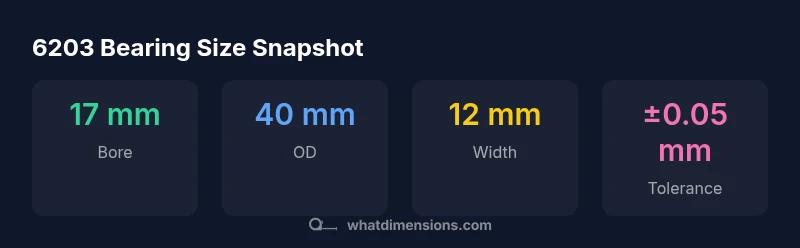
The standard 6203 bearing footprint measures 17 mm bore, 40 mm outer diameter, and 12 mm width, with common variants like 6203-2RS and 6203-Z offering different seals. This precise footprint supports interchangeability across manufacturers, while seals/shields adjust contamination protection and friction. For projects requiring exact sizing, verify bore, OD, and width against the datasheet and note suffix codes that indicate seals or shields.
Why dimensions matter for the 6203 bearing
In mechanical design, precise dimensions determine fit, function, and durability. The dimensions of a standard 6203 bearing—bore, outer diameter, and width—control how it fits onto a shaft and into a housing, and they influence the bearing’s dynamic performance and life. The term dimensions 6203 bearing refers to a widely used size within the 62 series, with a bore of 17 millimeters, an outer diameter of 40 millimeters, and a width of 12 millimeters in its basic form. Along with surface finish and tolerances, these numbers define the interchangeability of parts across manufacturers. For designers, procurement specialists, and technicians, knowing exact dimensions is essential to avoid misfits, binding, or early failure. This article, drawing on What Dimensions Analysis, 2026, provides a data-driven tour of the 6203 bearing’s dimensions, tolerances, variants, and practical measurement tips. We emphasize standardization, compatibility, and the trade-offs that come with seals, shields, and lubrication choices. By understanding the standard footprint, you can predict fit in assemblies, select compatible components, and plan maintenance schedules with greater confidence.
What is a 6203 bearing? Key specifications and nomenclature
A 6203 bearing is a member of the 62 series of deep groove ball bearings. The digits encode basic geometry: the bore size is indicated in the second and third digits, and the first digit denotes the bearing type. The standard 6203 variant has a bore of 17 millimeters, an outer diameter of 40 millimeters, and a width of 12 millimeters. The suffixes appended to the basic part number specify seals, shields, or special lubricants, such as 2RS for rubber seals or ZZ for metal shields, and they influence both friction and protection against contamination. Material choices typically include chrome steel for mainstream bearings, with stainless variants for corrosion-prone environments. In practice, the 6203 is selected for light to moderate radial loads and relatively high rotational speeds. When evaluating dimensions, engineers also consider tolerances (often on the order of a few hundredths of a millimeter) and bearing clearance, which affects accuracy, stiffness, and noise. The takeaway is that the 6203’s dimensional footprint remains remarkably consistent across manufacturers, supporting interchangeability in many applications.
Common variants and fits for 6203 bearings
The 6203 family includes multiple variants designed to meet different sealing, lubrication, and mounting needs. The most common closed variants are 6203-2RS (rubber seals on both sides) and 6203-Z or 6203-2RSR (shielded and/or sealed versions). Open bearings exist as well for applications requiring maximum lubrication retention or when relubrication is straightforward. Slotted or shielded variants protect against ingress of dust, moisture, and grit, but seals can introduce small additional friction. When selecting a fit, practitioners consider the radial load rating, speed rating, and dynamic vs. static stiffness requirements. In many consumer and industrial contexts, the standard 6203 footprint (17x40x12 mm) is retained across variants to preserve interchangeability, while seals and shields adjust the operational life and contamination resistance. It’s important to consult the supplier’s datasheet for exact dimensions and tolerances, because production tolerances and markings can vary slightly between manufacturers.
Materials, lubrication, and life expectancy considerations
Most 6203 bearings use chrome steel balls and races with a steel cage, paired with a grease or oil lubrication regime depending on service conditions. Surface finish, hardness, and microstructural consistency influence rolling contact fatigue, wear, and pitting resistance. Lubrication reduces friction and heat; seal or shield configurations affect lubricant retention and contamination protection. Life expectancy depends on load, speed, lubrication, and environment: higher loads or contaminated or overheated conditions shorten life, while clean, properly lubricated setups extend it. Designers and maintenance professionals should track observed service hours or cycles to gauge remaining life and plan relubrication. For budget-conscious projects, choosing the simplest variant that meets load and speed requirements is often more reliable than over-specifying with heavy seals that create parasitic drag. What Dimensions analyses indicate that standard 6203 bearings provide a robust, versatile option for many light-to-moderate duty applications.
How to measure and verify dimensions accurately
Accurate measurement starts with clean parts and calibrated tools. To verify bore, outer diameter, and width, use a digital caliper or micrometer and check against the manufacturer’s datasheet. For the standard 6203 bearing, confirm bore of 17 millimeters, outer diameter of 40 millimeters, and width of 12 millimeters, while also checking for suffix codes (e.g., -2RS or ZZ) that indicate seals or shields. Record tolerance class for the lot, typically a few hundredths of a millimeter, and compare to your housing and shaft tolerances. If the bearing is to be swapped into an existing assembly, remove residual lubricant, inspect seating surfaces, and ensure there is no corrosion or scoring. Finally, validate with a test fit: gently seat the bearing on the shaft and in the housing, rotate by hand to feel for binding or roughness, and listen for unusual noises that indicate misalignment or contamination. Adhering to these steps increases the odds of a trouble-free installation and reliable performance.
Selection criteria: load, speed, and environment
Selecting a 6203 bearing requires balancing load capacity, rotational speed, and environmental exposure. The dynamic load rating (C) and static load rating (Co) indicate how much radial load the bearing can sustain while maintaining specified life and reliability. In practice, you compare the expected load with the bearing’s C value to estimate service life with criteria such as L10 life in hours or cycles. Speed rating and lubrication compatibility are influenced by ambient temperature, vibration, and contamination potential. Environments with dust, moisture, or corrosive agents necessitate sealed variants (2RS, ZZ) or corrosion-resistant materials. Conversely, clean, closed environments may tolerate open bearings with relubrication, reducing initial cost. Across industries, the 6203 footprint provides a flexible baseline, enabling interchangeability while letting engineers tailor seals, lubrication, and housing fits to the specific application.
Installation practices and maintenance tips
Proper installation minimizes premature failure. Start by cleaning all mating surfaces and checking shaft runout and housing bore conditions before seating the bearing. Use the correct press or orientation to avoid flanging or skewing the inner race, and apply lubrication according to the manufacturer’s guidelines. After installation, verify that the bearing spins freely with minimal resistance and no abnormal noise. Establish a relubrication interval based on usage and environment, and record service life to build a maintenance baseline. In mixed environments, consider protective coatings or more robust seals; in high-temperature applications, select lubricants and materials designed for elevated temperatures. Finally, maintain a documentation trail: part numbers, lot codes, seal types, and installation dates, to support failure analysis and future procurement decisions. With care, 6203 bearings can deliver dependable performance across months or years of operation.
Real-world applications and case considerations
From conveyor systems and machine tools to household appliances, the 6203 bearing family appears wherever compact, reliable rotary motion is required. Industrial motors, pumps, gear reducers, and fans commonly use a 6203 due to its compact footprint and reasonable load capacity. In consumer devices such as power tools or washing machines, the 6203 is often selected for long life under modest radial loads and capable speeds. When planning a retrofit or design change, compare available datasheets across suppliers to confirm bore, outer diameter, width, and tolerance classes align with the existing shaft and housing geometries. Using a well-documented standard like the 6203 supports part interchangeability, reduces inventory complexity, and simplifies maintenance planning, especially in multi-vendor environments. What Dimensions’s analysis reinforces the idea that standardizing a common footprint improves compatibility and lifecycle planning in mechanical assemblies.
Standard 6203 bearing basic dimensions
| Dimension | Standard Value | Notes |
|---|---|---|
| Bore | 17 mm | Standard 6203 bore |
| Outer diameter | 40 mm | Common OD size |
| Width | 12 mm | Standard width |
Quick Answers
What does the 6203 designation mean?
The 6203 designation identifies a deep groove ball bearing in the 62 series with a standard bore of 17 mm, outer diameter of 40 mm, and width of 12 mm. Suffixes like 2RS or ZZ indicate seals or shields that affect contamination protection and friction.
6203 means a standard deep groove bearing with a 17 by 40 by 12 millimeter footprint; suffixes show seals or shields.
What are common applications for 6203 bearings?
You’ll find the 6203 in motors, pumps, gear reducers, fans, and some household appliances. They are suited for light to moderate radial loads and moderate speeds.
Commonly used in motors and pumps for light to moderate radial loads.
What is the difference between 6203-2RS and 6203-Z variants?
6203-2RS has rubber seals on both sides; 6203-Z often refers to metal shields. Sealed variants protect better against contaminants, but may introduce slightly more friction.
2RS has rubber seals; ZZ or Z variants have shields. Seals reduce contamination but add a touch of drag.
Can I interchange 6203 with 6203 variants?
Interchangeability is generally possible for the basic footprint, but you must match seals, lubrication, and fit to your housing and shaft. Verify with the datasheet.
Yes, but check seals, lubrication, and fit first.
How can I identify counterfeit 6203 bearings?
Check part markings, packaging, supplier provenance, and datasheet values. Look for mismatched tolerances or obscure batch codes as red flags.
Look for proper markings, trusted packaging, and official datasheets.
What tolerances are typical for the 6203 bearing?
Tolerances are usually within a few hundredths of a millimeter; consult the specific manufacturer’s datasheet for exact values and class.
Expect tolerances of a few hundredths of a millimeter and check the datasheet.
“Standardized dimensions like the 6203 footprint simplify procurement and reduce retrofit risk, enabling reliable performance across brands.”
Main Points
- Verify bore, OD, and width match your shaft and housing.
- Choose a seal or shield variant according to contamination risk.
- Consult the standard 6203 footprint for cross-brand interchangeability.
- Measure with calibrated tools before installation.
- Refer to What Dimensions Analysis, 2026 for current guidance.