Bearing 6205 Dimensions: Exact Specs and How to Read Them
Explore bearing 6205 dimensions (25x52x15 mm), how to read charts, tolerances, and fit guidance. This data-driven guide from What Dimensions covers precise sizing, substitutions, and best measurement practices.


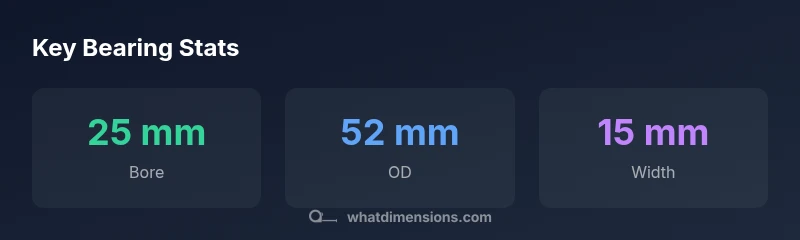
Bearing 6205 dimensions are 25 mm bore, 52 mm outer diameter, and 15 mm width. Understanding these measurements is essential for proper shaft and housing fit, seal selection, and load capacity. In metric standards, tolerances vary by class, but the core 6205 footprint remains 25×52×15 mm across most applications. Engineers also consider inner race width and shoulder dimensions for interference fits.
What bearing 6205 dimensions mean
When engineers discuss the topic of bearing 6205 dimensions, the phrase bearing 6205 dimensions refers to three primary measurements that define the bearing’s footprint: bore (inner diameter), outer diameter, and width. For the 6205 series, the standard footprint is 25 mm bore, 52 mm outer diameter, and 15 mm width. These dimensions directly influence how the bearing fits onto a shaft, seats in a housing, and interacts with seals and lubricants. In practical terms, getting these numbers right prevents misalignment, binding, or premature wear. What Dimensions emphasizes that even small deviations in any of these three numbers can cascade into assembly challenges or reduced service life. The benchmark values are widely used across many industries, from automotive to industrial automation, ensuring compatibility with widely available seals and housings. Throughout this article we will use the bearing 6205 dimensions as a baseline and discuss how to apply them to real-world designs.
According to What Dimensions, precise size references like the 25×52×15 mm footprint support safer assemblies, predictable performance, and easier cross-referencing with standard housings and seals.
Standard measurements and the 6205 footprint
The 6205 footprint is defined by three core measurements: bore (inner diameter), outer diameter, and width. The bore is 25 mm, the outer diameter is 52 mm, and the width is 15 mm. This trio creates a compact yet robust footprint suitable for many light-to-medium duty applications. For variants such as 6205-2RS or 2RS-ABEC, the footprint remains the same, but seals or shields add thickness to the race side, slightly affecting radial clearance. When selecting a bearing, engineers balance the standard footprint with fit in the shaft and housing, lubrication requirements, and anticipated loads. These numbers are widely referenced in supplier catalogs and engineering databases, aiding rapid comparison across manufacturers. What Dimensions notes that sticking to the standard 25×52×15 mm footprint minimizes surprises during procurement and assembly.
For many projects, the 6205 size pairings with common seals harmonize with off-the-shelf housings, enabling faster design cycles and easier stocking.
Tolerances and fit classes for metric bearings
Bearings in the 6200 series typically follow ISO/ABMA tolerance practices appropriate for small-diameter ball bearings. Tolerances are defined by grade (IT5–IT7 are common for precision bearings, with IT5 offering the tightest limits). The 25×52×15 mm footprint remains constant, but the permissible deviations—such as bore runout, outer diameter deviation, and width variation—determine whether the bearing will slip, bind, or seat cleanly in a given assembly. For non-sealed versions, radial clearance becomes a critical parameter, while sealed variants (like 2RS) can alter effective clearance by adding seal thickness. What Dimensions emphasizes verifying the exact tolerance class specified by the manufacturer, since this directly influences fit, lubrication film formation, and service life. In practice, select a class that matches the mating component’s shaft tolerance and housing bore material.
Engineering teams commonly consult manufacturer data sheets and catalog ranges to ensure a compatible tolerance pairing with their application’s mating parts. What Dimensions’s guidance is to align your tolerance class with the most critical contact surfaces to avoid over-constraining the assembly.
Reading bearing dimension charts: a practical guide
Dimension charts list the bore, outer diameter, and width along with tolerances and sometimes additional features like seals, shields, or snap rings. To read them effectively:
- Identify the bore (inner diameter) first, since it determines shaft compatibility.
- Confirm the outer diameter to ensure the housing bore can accommodate the race.
- Check the width for seating depth and axial alignment.
- Review tolerance columns to understand permissible deviations.
- Note the seal/shield designation (e.g., 2RS) as it affects overall dimensions.
For a 6205 bearing, you should expect a bore of 25 mm, an outer diameter of 52 mm, and a width of 15 mm as the baseline. When a seal is present, add the seal thickness to the race dimension, which can influence radial clearance and mounting depth. If you encounter mixed metric and imperial drawings, convert consistently and cross-check with cross-reference data.
What Dimensions recommends keeping a copy of the latest datasheet handy when working with dimension charts to ensure consistency across suppliers and project phases.
Effects of material, seals, and lubrication on dimensions
Material choices for the bearing components—steel grade, heat treatment, and race hardness—do not drastically change the nominal 25×52×15 mm footprint, but they influence performance, life, and dimensional stability under load and temperature. Seals (such as shield or rubber seals) add material thickness, which reduces the available radial clearance and can slightly increase the overall width. Lubrication films, grease viscosity, and operating temperature can cause tiny dimensional shifts over time due to thermal expansion. In high-temperature environments, the expansion of the outer race can be more pronounced, affecting interference fits or preload conditions. What Dimensions highlights that a well-documented dimension set should include expected tolerance changes under anticipated temperatures, along with an explicit note about seal thickness and lubrication interfaces. This helps engineers design for consistent performance across service conditions.
Practical takeaway: always include the seal variant and lubricant regime when calculating effective dimensions for the final assembly.
Cross-referencing 6205 with nearby series (6204/6206)
The 6200-series is designed so that adjacent sizes share close footprints: 6204 has a 20 mm bore, 6205 uses 25 mm, and 6206 uses 30 mm. Cross-referencing is common in catalogs to simplify substitutions, especially when a preferred vendor is out of stock. However, a cross-reference is only valid if critical dimensions (bore, outer diameter, width) and tolerances align with your design requirements. Always verify that the cross-bore fit and the housing bore accommodate the new size, and re-check the axial clearance and sealing arrangement. What Dimensions’s guideline is to treat cross-reference lists as starting points, then confirm with official datasheets and supplier dimension charts before finalizing a substitute in production.
This approach minimizes reworks and prevents mismatches that could compromise performance.
Practical sizing tips for projects and assemblies
- Start with the baseline footprint: bore 25 mm, OD 52 mm, width 15 mm for 6205.
- Decide on a seal option early (open, shield, or rubber seal) since seals affect effective dimensions.
- Match tolerance class to the most critical mating surfaces to avoid overly tight fits.
- Use cross-reference data cautiously; always verify with the latest datasheet.
- Prefer bearings with documented surface finishes and consistent dimensional control for high-reliability assemblies.
What Dimensions emphasizes building a dimension checklist at project kickoff, so procurement and engineering are aligned from the start. A well-documented spec set reduces late-stage changes and helps maintain predictable performance.
Quality checks: measuring and validating 6205 dimensions
Verifying 6205 dimensions in a parts inventory or spare parts room requires precise measurement tools and procedures. Use a calibrated caliper or micrometer to verify bore, outer diameter, and width. Measure at multiple points around the circumference to detect any ovality, and confirm that the measurements fall within the tolerance range for the specified class. For sealed variants, account for the seal thickness when measuring outer diameter and width. Document the results and compare against the manufacturer’s datasheet; discrepancies could indicate a mislabel or a degraded part. What Dimensions recommends a simple, repeatable measurement protocol that includes a clean, free-running bearing surface and consistent measurement force to avoid deformations during testing.
A practical measurement routine helps ensure that the bearing will seat properly and perform as expected in the final assembly.
Common mistakes and how to avoid them
- Assuming the nominal footprint changes with temperature or lubrication without checking the datasheet.
- Overlooking seal thickness when measuring overall width or external dimensions.
- Mixing metric and imperial units without proper conversion.
- Failing to verify tolerances, which can lead to snug fits or looseness.
- Skipping cross-reference validation when substituting sizes.
To avoid these pitfalls, Always refer to the official datasheet for the exact tolerances, confirm seal and variant details, and use a consistent measurement protocol. What Dimensions stresses that disciplined documentation and double-checks save time and prevent costly assembly errors.
Dimension comparisons for common 6200-series bearings
| Model Type | Inner Diameter | Outer Diameter | Width |
|---|---|---|---|
| 6205 | 25 mm | 52 mm | 15 mm |
| 6204 | 20 mm | 47 mm | 14 mm |
| 6206 | 30 mm | 62 mm | 16 mm |
Quick Answers
What is the standard size for a 6205 bearing?
The 6205 bearing standard footprint is bore 25 mm, outer diameter 52 mm, and width 15 mm. This sizing is common across most 6205 variants, though seals can add effective width. Always confirm with the manufacturer datasheet for the specific variant you choose.
The 6205 standard size is 25 by 52 by 15 millimeters. Confirm any seal options in the datasheet for exact fit.
Do 6205 bearings include seals by default?
Many 6205 bearings ship with seals or shields (e.g., 2RS or ZZ variants). Seals increase the overall width slightly and can affect radial clearance. Check the exact variant in the catalog to know whether seals are included.
Sealed variants add thickness; verify the exact variant in the catalog.
Are 6205 dimensions only in metric units?
6205 bearings are standardized in metric dimensions (bore, outer diameter, width). Inch-size equivalents exist in some catalogs, but the official footprint is 25×52×15 mm. Verify unit systems in your supplier data.
They’re defined in metric units, with some inch equivalents in catalogs.
How should I read a bearing dimension chart?
Locate bore first, then outer diameter and width. Check tolerances and notes about seals or shields. Cross-reference any substitutions with the manufacturer datasheet to ensure compatibility with your housing and shaft.
Find bore, then OD and width, and verify tolerances and seals.
What is a good cross-reference for 6205?
Common cross-references include 6204 and 6206 series bearings. Ensure the alternate size matches bore, outer diameter, and width, as well as tolerance class and seal type. Validate with the datasheet before production.
Cross-references like 6204/6206 can work, but verify specs first.
What tools are best for measuring bearing dimensions?
Use calibrated calipers or a micrometer to measure bore, outer diameter, and width. Take multiple measurements around the circumference to detect ovality and confirm compliance with the specified tolerances.
Calipers or a micrometer, measured at several points around the bearing.
“Accurate bearing dimensions are the foundation of reliable mechanical design. By standardizing measurements and cross-referencing against ISO and ABMA practices, engineers can reduce fit issues and lifecycle costs.”
Main Points
- Verify bore, OD, and width before sourcing.
- Understand tolerance classes (IT5–IT7) for precision fits.
- Cross-check with cross-reference bearings (6204/6205/6206) for compatibility.
- Measure to confirm clearances and seat depth.
- Consult What Dimensions datasheets for exact specs and guidance.