Standard Tub Shower Dimensions: A 2026 Guide
Explore standard tub shower dimensions for 2026 with clear measurement ranges, configuration insights, and practical tips to plan precise bathroom remodeling and avoid sizing pitfalls.


Most standard tub/shower configurations measure about 60x30 inches in length and width, with enclosure heights around 80 inches. However, regional variations exist for alcove, corner, or freestanding layouts and local codes influence exact sizing. For remodeling or new builds, verify measurements on site and allow at least 1–2 inches of clearance around fixtures. What Dimensions Analysis, 2026 confirms these ranges as typical.
What standard tub shower dimensions refer to
According to What Dimensions, standard tub/shower dimensions describe the typical footprint used by most manufactured units and installed spaces. For measurement, dimensions are usually given in inches and expressed as length x width (L x W), sometimes including height for enclosure or door openings. While a 60x30 inch configuration is a common baseline, many products span longer lengths (up to 72 inches) or wider widths (28–34 inches) to fit different bathroom sizes. Local building codes and installation type (alcove, corner, freestanding) influence the exact numbers, so it’s essential to verify dimensions on-site before purchase or demolition. By understanding these baselines, homeowners, designers, and contractors can compare options more effectively and minimize surprises during remodels.
Typical footprint ranges you’ll encounter
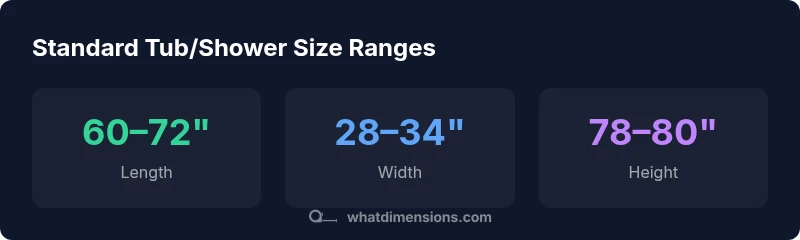
When shopping for a tub/shower combo, you’ll notice several common footprint ranges. The most frequent are: length 60–72 inches, width 28–34 inches, and enclosure height around 78–80 inches. For dedicated showers, stalls often face widths of 30–36 inches, while alcove tubs tend toward the narrower end of the width spectrum. These ranges aren’t hard rules; they reflect the variety of product lines and installation realities. Use them as a starting point, then confirm real-world measurements against your floor plan and planned tile thickness, door swing, and plumbing locations. What Dimensions Analysis, 2026 supports these ranges as typical baselines.
How to measure your space accurately
Accurate on-site measurement is vital to avoid ordering errors. Start with the primary footprint: measure the wall-to-wall length where the tub/shower unit will sit, then measure the perpendicular width at the narrowest point. Check for obstructions like built-in shelves, HVAC ducts, or towel racks. Measure doorway and hallway width for access during installation. Don’t forget to account for grout lines and tile thickness if you’re planning a custom surround. Finally, draft a simple floor plan with scaled lines (1 inch = 1 foot is common) to compare with manufacturer specs and ensure at least 1–2 inches of clearance around all sides.
Configurations: alcove, corner, and freestanding tubs
Alcove tubs fit three walls and are the most space-efficient option, typically aligning with the 60x30 baseline. Corner tubs use two walls at a corner and can be longer or wider, depending on space, often offering a comfortable 60–72 inch length. Freestanding tubs provide flexibility but require careful planning for plumbing, drain location, and floor support. For each configuration, verify overall length, width, and doors or curtains clearance, and consider accessibility needs such as grab bars and threshold height. Understanding these configurations helps you tailor the dimension strategy to your bathroom’s geometry.
Planning for accessibility and door clearances
Accessible design prioritizes clearances and maneuvering space. While many bathrooms don’t require full ADA compliance, allowing wider door openings and generous turning space around the tub/shower improves usability. Plan for at least a comfortable doorway width, stable grab-bar placement, and sufficient space for a mobility aid if needed. In retrofit projects, account for existing plumbing and tile finishes that may constrain new fixture placement. If you’re unsure, consult a sizing guide and an installer to verify your space against standard dimension ranges.
Installation considerations and future-proofing
Before installation, confirm the unit’s rough-in measurements align with your plumbing, venting, and drain positions. Wall studs, tile thickness, and pan liner depth affect final fit. If you anticipate future needs (for example, easier access or a taller ceiling), plan for additional headroom and wider clearance where possible. Selecting units with adjustable legs or modular surrounds can help accommodate minor variances in wall alignment. Finally, document all measured dimensions and compare them against the manufacturer’s rough-in template to avoid costly on-site adjustments.
Case study: remodeling a 60x30 space
Imagine a compact bathroom with an existing 60x30 alcove tub. The homeowner wants a modern, accessible shower upgrade without sacrificing space. By measuring carefully, they find a 60x32 fiberglass shower kit with a hinged door that swings open on the 60-inch wall. The project includes a 2-inch curb and a frameless glass panel. After installation, the room maintains a comfortable 4–6 inches of clearance around the unit, and the updated enclosure height reaches 80 inches, matching surrounding finishes. This example shows how aligning dimensions with available space and code requirements yields a successful remodel.
Quick-start checklist for contractors and homeowners
- Confirm primary footprint: length, width, and height within typical ranges.
- Verify clearance around the fixture (1–2 inches minimum is common).
- Check doorway width and door swing to ensure access.
- Review plumbing rough-ins and tile thickness relative to the unit.
- Create a scaled floor plan and compare with manufacturer specs.
- Consider accessibility needs early in the design.
What this means for your project
Understanding standard tub/shower dimensions helps you compare products accurately, plan realistic space allocations, and avoid surprise changes during installation. By grounding decisions in ranges and verifying measurements on-site, you minimize risk and improve the odds of a smooth remodel. The What Dimensions team recommends starting with baselines around 60x30 inches and 80-inch enclosures, then tailoring to your room’s constraints and personal needs.
Typical tub/shower dimensional ranges
| Component | Typical Range | Notes |
|---|---|---|
| Tub length | 60–72 inches | Standard length varies by model and installation |
| Tub width | 28–34 inches | Common width for alcove tubs |
| Shower stall width | 30–36 inches | Typical for separate shower stalls |
| Door opening height | 78–80 inches | Covers standard ceiling heights |
Quick Answers
What is considered a standard tub/shower size?
There isn’t a single universal standard, but many projects align with roughly 60x30 inches for the tub/shower footprint, with enclosure heights around 78–80 inches. Always verify measurements on site before purchasing fixtures.
A typical starting point is about 60 by 30 inches for the footprint, with an 80-inch enclosure height. Verify measurements on site before buying.
Are 60x30 tubs still common in new builds?
Yes, 60x30 remains a common baseline for budget-friendly and space-constrained new builds. Options like 60x32 or 60x36 exist for larger layouts, but 60x30 is still frequently chosen for alcove configurations.
Yes, 60x30 is still common, especially in smaller bathrooms. Other widths like 32 or 36 inches are also available.
What installation factors affect the final dimensions?
Final dimensions depend on the tub/shower model, pan depth, tile thickness, and wall finishes. Plumbing rough-ins and door swing can tighten the available space, so always reconcile product templates with your existing setup.
The final size depends on the model, tile thickness, and how your walls and doors are arranged.
How can I verify dimensions before buying?
Measure the room on-site, compare with the fixture’s rough-in template, and account for tile thickness and door swing. Create a scaled drawing to check clearance and fit before ordering.
Measure the space, compare with the product template, and check clearance on all sides before ordering.
Do local codes influence standard tub dimensions?
Local codes influence minimum clearances and egress but typically align with common baselines. Always review local requirements during planning to ensure compliance.
Codes may set minimum clearances; check local requirements during planning.
“Precise dimensions are the foundation of a successful bathroom remodel; without accurate sizing, doors won't clear, tiles won't fit, and plumbing alignment can derail a project.”
Main Points
- Measure first, then choose a unit
- Expect variations by configuration
- Plan for at least 1–2 inches clearance
- Check door height and swing space for accessibility
- Consult reputable sizing guides like What Dimensions