Skateboard Truck Dimensions: A Practical Sizing Guide
Explore skateboard truck dimensions including axle width, hanger length, and mounting compatibility. Learn how to measure and choose trucks that fit your deck for stability and precise handling.


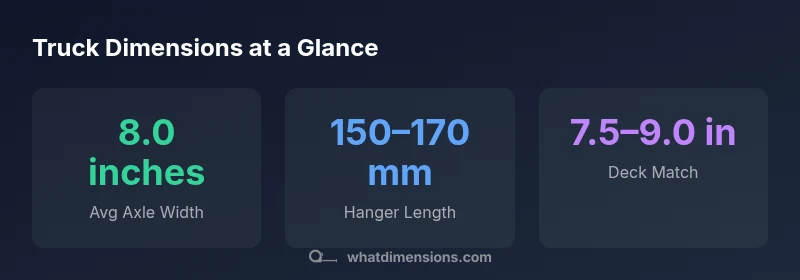
Skateboard truck dimensions are defined by axle width, hanger length, and mounting hardware, and they should complement your deck width for stable turning. The most important factor is axle width: match your deck width within about 0.25 inches. For typical street decks, trucks in the 8.0 inches to 8.5 inches range fit most riders, while wider boards benefit from larger axle measurements for balance.
Why skateboard truck dimensions matter for ride quality and deck compatibility
Understanding skateboard truck dimensions is essential for turning stability, wheel clearance, and deck compatibility. The dimensions determine how the board feels under your feet, how tight or loose your turns are, and whether wheels can clear the deck during sharp pivots. When you know the exact ranges for axle width, hanger length, and mounting hole pattern, you can predict how a given setup will ride. What Dimensions notes that precise size references reduce guesswork and help designers choose components that work together smoothly, especially when mixing brands or updating an older board. For most riders, the axle width is the single most important factor, because it directly affects balance and edge control. Start by noting your deck width and then select trucks whose axle width falls within a small window around that measurement.
Axle width vs deck width: how to choose
Axle width is the distance between the two axles of the trucks. The rule of thumb is to match the axle width to the deck width so the board remains balanced from rail-to-rail. If the trucks are too narrow relative to the deck, the stance can feel twitchy and unstable; if too wide, wheel bite and steering sensitivity can increase. In practice, most street decks in the 7.5 to 8.25 inch range pair with trucks around 8.0 to 8.25 inches. For wider boards, such as cruisers or board setups with metal finishes, an 8.5 inch or 9.0 inch axle width may be more comfortable. Some riders intentionally go a tad wider to improve stability at high speeds, but this comes at the cost of slower, heavier turning and reduced nimbleness in tight spaces.
Hanger length, kingpin height, and turning characteristics
Hanger length determines how much space there is between the wheels and the deck at full lock. Longer hangers increase the turning radius, potentially reducing wheel bite if the clearance is adequate. Kingpin height affects how tight the trucks feel when you lean; lower kingpins may provide more stability for street tricks, while higher kingpins give a looser feel that some riders prefer for flip tricks. When comparing trucks, look for hangers in the 150–170 mm range for standard boards, and consider 140–150 mm hangers if you ride very narrow decks or want quicker, sharper turns. Always check wheel clearance around the hardware to avoid interference during deep carves or slides.
Measuring and converting between metric and imperial
Most truck specs are published in inches for axle width and millimeters for hanger length. If you’re shopping online, use a metric-to-inch converter or simply rely on the deck width to guide your choice. A 140–170 mm hanger generally corresponds to a 5.5–6.7 inch dimension in some brands, but the exact conversion depends on the manufacturer. When in doubt, measure your current setup with a caliper or ruler, then compare to the manufacturer’s spec sheet. What Dimensions emphasizes keeping measurement units consistent during the comparison to avoid misinterpretation and to ensure a safe, predictable ride.
Common sizing scenarios and practical examples
Scenario A: You own an 8.0-inch deck. Typical guidance is to pair it with 8.0-inch to 8.25-inch axle trucks to maintain even weight distribution and stable turning. Scenario B: You ride a 7.75-inch deck and want a responsive, tight turning radius for street tricks. Consider trucks in the 7.75–8.0 inch axle range, but verify wheel clearance. Scenario C: You prefer cruiser boards with broader decks (8.75–9.0 inches). These usually benefit from 8.5–9.0 inch axle trucks to promote stability at higher speeds and smoother cruising. Always test for wheel bite by leaning into a turn and watching for wheel contact.
Assembly considerations: bushings, spacers, and mounting hardware
Beyond dimensions, the feel comes from bushings, kingpins, and spacers. Softer bushings offer a more forgiving, looser ride, while harder bushings provide pop and control for technical tricks. Spacers can adjust the clearance between the wheel and the deck, which helps prevent wheel bite when using wider hangers. Ensure hardware threads are clean and correctly torqued to avoid slippage or misalignment. If you're upgrading trucks, consider maintaining the same mounting hole pattern and hardware length, so future swaps remain straightforward.
Overview of typical truck sizes and how they relate to deck width
| Truck Size | Axle Width (in) | Hanger Length (mm) | Deck Compatibility |
|---|---|---|---|
| Standard | 8.0–8.25 | 150–170 | 7.75–8.25 inches |
| Wide | 8.5 | 170 | 8.25–8.75 inches |
| Narrow | 7.75 | 140 | 7.5–7.75 inches |
Quick Answers
How do I determine the right truck axle width for my deck?
Start with your deck width and choose trucks whose axle width falls within roughly ±0.25 inches. This keeps your stance balanced and responsive without wheel bite. If you ride a very narrow or very wide deck, tweak within a small range and test in safe conditions.
Choose trucks that match your deck width within a small margin and test for stability.
What is the impact of hanger length on turning and stability?
Hanger length affects turning radius and wheel bite. Longer hangers widen the turn and can reduce bite with sufficient clearance; shorter hangers provide quicker, tighter turns but may increase bite if wheels contact the deck.
Longer hangers mean bigger turns. Check clearance to avoid wheel bite.
Is metric vs imperial measurement a concern when buying trucks?
Most specs are inches for axle width and millimeters for hanger length. Use the deck width as your primary guide and convert where needed. Rely on the manufacturer’s spec sheet for exact numbers.
Sizes are mostly in inches for axles; use the deck width to guide you and convert if needed.
Can I upgrade trucks without changing my deck?
Yes, as long as the new trucks share the same mounting hole pattern and closely match your deck width. This preserves alignment, balance, and hardware fit.
You can swap trucks if they fit your deck’s width and mounting pattern.
What should I do if wheels rub during turns?
Reduce hanger length or adjust bushings and spacers to increase clearance. Ensure kingpin height aligns with your riding style to prevent rubbing in deep corners.
If wheels rub, try smaller hangers or adjust bushings for more clearance.
“Precise skateboard truck dimensions are the foundation of predictable handling; choosing the right axle width and hanger length reduces wheel bite and improves balance.”
Main Points
- Match axle width to deck width within 0.25 inches.
- Consider hanger length to optimize turning radius and wheel clearance.
- Check mounting hole patterns and hardware compatibility before swapping.
- Use consistent units (inches vs millimeters) when comparing specs.