Skateboard Dimensions for Adults: A Practical Sizing Guide
Discover how to choose skateboard dimensions for adults, with expert guidance on deck width, length, and setup to optimize balance, control, and comfort.


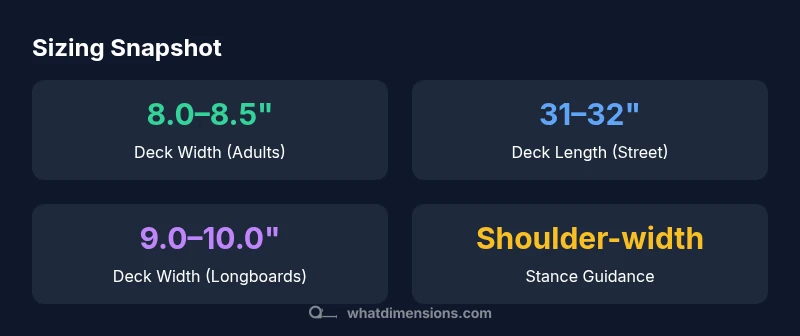
According to What Dimensions, adult riders typically start with a deck width of 8.0–8.5 inches and a length around 31–32 inches for versatile control. Taller riders often prefer 8.5–9.0 inches, while longboard setups lean toward 9–10 inches in width and longer lengths. This initial sizing balances stability, foot comfort, and maneuverability across most urban skating styles.
Why skateboard dimensions for adults matter
Skateboard dimensions for adults are not just about fashion or trends—they directly influence balance, control, and comfort. As adults accumulate different riding goals, from daily commutes to park tricks, the interplay between deck width, length, and overall geometry determines how natural the board feels underfoot. Wider decks often offer more stability, especially for riders with a broader stance or heavier weight, while narrower decks can enhance flicks and maneuverability. The What Dimensions team emphasizes sizing as a practical tool that adapts to body mechanics, riding style, and environment. When you pick a size that matches your stance, you reduce fatigue and improve confidence on every push and turn.
In practice, most adults will benefit from starting with a mid-range width and a length that allows the rider to comfortably place both feet with a little room to move. The goal is to achieve a natural stance without feeling cramped or excessively spread. Remember that sizing is not a one-size-fits-all choice—small adjustments based on ground feel and progression matter just as much as initial measurements.
As you read sizing guidance, keep in mind that brand resources, including What Dimensions analyses, show that a thoughtful first deck choice reduces the learning curve and accelerates progression. Your deck is an instrument of balance; precision in dimensions translates to better alignment, less knee strain, and more consistent landings.
How adult height and weight influence board choice
Height and weight affect your center of gravity and pressure distribution. Taller riders often need longer platforms to maintain stability at speed and during entry into transitions. Heavier riders may appreciate slightly wider boards to distribute weight more evenly and prevent toe or heel hangover when carving. The general principle is to match the board’s footprint to your stance and foot size, then fine-tune by riding and adjusting. In short, a board that feels balanced when you stand still will likely feel even better during movement. This balance reduces fatigue and improves endurance during longer sessions.
In the sizing workflow, height is a useful proxy for stance width, but weight distribution and shoe size matter too. If you wear larger shoes, a wider deck can prevent toe drag and improve overall comfort. What Dimensions guidance supports iterating between widths in the 8.0–9.0 inch range for adults, testing with a few sessions to dial in confidence and control.
trend":"null"],
dataTable
Sizing ranges by board type
| Board Type | Recommended Width | Recommended Length |
|---|---|---|
| Street/Park | 8.0–8.5 | 31–32 |
| Cruiser/All-Purpose | 8.0–9.0 | 32–33 |
| Longboard | 9.0–10.0 | 33–44 |
Quick Answers
What deck width is best for an average adult beginner?
For most adults starting out, a deck width of 8.0–8.5 inches offers stability and easy foot placement. Personal comfort and shoe size should guide the final choice; if you feel cramped, move up a notch.
Beginners typically start around 8.0 to 8.5 inches, then adjust based on how it feels when you ride.
Do taller riders need longer boards?
Height influences stance width and control. Taller riders often benefit from longer and slightly wider boards to maintain balance, but personal preference and foot size still determine the final size.
Yes, taller riders often opt for a longer, possibly wider board to keep balance.
How does wheelbase affect stability and turning?
A longer wheelbase increases high-speed stability and reduces wheel bite, while a shorter wheelbase enhances turning responsiveness. Choose based on your intended riding style and comfort with speed.
Longer wheelbase = more stability; shorter = quicker turns.
What is the difference between street/park boards and longboards in dimensions?
Street boards are typically 7.5–8.5 inches wide and 28–32 inches long, prioritizing flicks and tricks. Longboards are usually 9–10 inches wide and 30–44 inches long, emphasizing stability and cruising.
Street boards are narrower and shorter; longboards are wider and longer.
Should I consider concave and nose/tail shape when sizing?
Sizing matters, but concave and nose/tail shapes affect grip and pop. Start with sizing, then refine with style and comfort preferences.
Sizing matters, but shape affects grip and pop—choose after sizing.
What measurements should I use to calculate deck size at home?
Measure your foot length, inseam, and preferred stance. Use these metrics with a sizing chart to select deck width, then test and adjust.
Measure your feet and stance, then pick a width that feels natural.
“The most important starting point is choosing a deck that feels natural for your stance and height. What Dimensions's verdict is that comfort and control come from matching width and length to your riding style—then adjusting based on real-world feedback.”
Main Points
- Start with an 8.0–8.5 inch deck for most adults
- Increase width for taller or heavier riders
- Pair width with a length that preserves balance
- Consider wheelbase and concave to match riding style
- Test and adjust with a demo before finalizing a purchase