How to Know What Size Door You Need: A Practical, Step-by-Step Guide
Learn how to determine the right door size with precise opening measurements, swing direction, and standard dimensions. This educational guide from What Dimensions walks homeowners through every step, from rough openings to final fit.


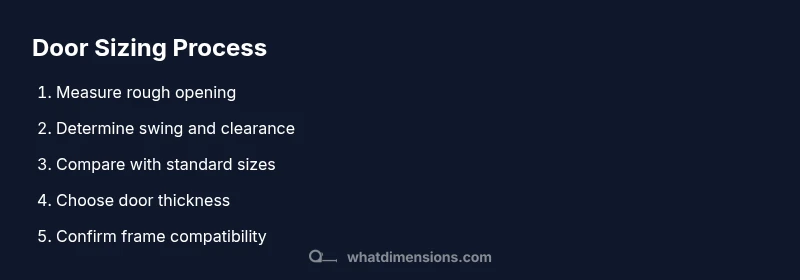
By the end of this guide, you'll know how to determine the door size you need by measuring the rough opening, accounting for swing, frame thickness, and clearance, and selecting standard dimensions that fit your space. Start with the rough opening height and width, add clearance for hinges and weatherstripping, and verify with a preferred door type (interior vs exterior).
Why accurate door sizing matters
Doors that don’t fit flush can cause drafts, binding, and costly retrofits. Accurate sizing starts with the rough opening and continues through swing clearance and frame thickness. According to What Dimensions, precise measurements reduce surprises and ensure the final door aligns with trim, weather stripping, and hardware. Getting this right the first time helps avoid delays, rework, and the need to reorder parts. A well-sized door also improves energy efficiency, sound control, and accessibility, especially in spaces with unusual layouts or non-standard wall depths. When you know the exact size you need, you can confidently compare products, plan for hardware, and coordinate trim and casing more smoothly.
Understanding door types and how they affect size
Doors come in several categories, each driving sizing considerations differently. Interior doors are typically lighter and may come in a narrower range of standard widths. Exterior doors often require more clearance for weatherstripping, thresholds, and security hardware, which can push you toward larger finished openings or custom sizing. Specialty doors (sliding, double-egress, or pocket doors) add an extra layer of measurement complexity. The key is to match the door type to the intended use and to size the opening for a comfortable fit, rather than forcing a door to fit an ill-suited opening. This alignment reduces installation issues and ensures long-term performance.
Key measurements you must take
Begin with the rough opening: width, height, and depth of the jamb. Record the wall thickness around the opening, the levelness of the floor, and the swing direction you want. Note the hinge locations and the planned hardware footprint. Don’t forget to account for weatherstripping and trim. A clean log of width, height, and depth at multiple points helps you spot non-square openings and align your final door size with real-world conditions. If you’re unsure, document both the largest width and the tallest height you found, then compare to standard sizes.
How to measure the rough opening
Measure the opening at three horizontal points (top, middle, bottom) and three vertical points (left, center, right). Use the widest width and the tallest height as your planning targets. Verify square by checking that the two diagonal measurements are equal or very close; if they differ, plan for trim adjustments or floor clearance changes. Make sure you measure with the door in mind: if you’ll add weatherstripping, subtract the thickness from the measured width to retain a proper finished fit. Keep your notes organized on a sketch for accuracy.
Standard sizes vs. custom sizing: when to choose
Most interior doors fit common widths such as 28, 30, or 32 inches with heights around 80 inches. Exterior doors are generally larger and can require custom sizing for non-standard openings. If your rough opening sits between standard sizes, you can often trim the door or adjust the frame, but you should budget for trim, hardware, and potential shims. In spaces with unusual dimensions, a custom slab or a modified frame may be the best long-term solution, especially where structural constraints or historical architecture are involved.
interior vs exterior doors: what changes for sizing
Exterior doors typically need more clearance for weatherstripping, thresholds, and security hardware. They often have thicker frames and heavier slabs, which reduces the usable width inside the opening. Interior doors, while simpler, still need to accommodate hinge-side clearance and door thickness. Always verify that the finished opening will accommodate the door plus all hardware without binding or rubbing and that the weatherseal or strike plate aligns with the frame.
Adjusting for hinges, weatherstripping, and trim
Hinge thickness and strike plate depth can subtly affect finished width. Weatherstripping adds width and must be included in width calculations if you’re designing a tight fit. Trim or casing adds visual width and can hide minor gaps, but it also reduces available clear width. If measurements land between standard options, consider trimming the door or slightly widening the frame, but factor in the cost and labor. When in doubt, simulate the fit with a cardboard or physical template before ordering.
Common mistakes and how to avoid them
Rushing measurements, using a single point, or ignoring non-square openings leads to poor fits. Always measure in two directions (width and height) at multiple points and recheck before ordering. Do not assume that one doorway will mirror another within the same house. Documenting your findings and comparing them against a precise set of standard sizes reduces back-and-forth with suppliers.
Quick reference: size ranges by door type
Interior doors commonly range from 28–32 inches in width and about 80 inches tall. Exterior doors are typically around 34–36 inches wide and 80 inches tall or taller, depending on local codes and climate considerations. When your rough opening doesn’t align with standard sizes, plan for trimming or a custom frame and consult a professional if needed.
Tools & Materials
- Measuring tape (25 ft or 5 m)(Long enough to span width and height; use both metric and imperial units.)
- Pencil or marker(Mark measurements on paper or the sketch you create.)
- Notepad or clipboard(Keep measurements organized with clear labels.)
- Level(Helpful to verify openings are plumb and square.)
- Stud finder (optional)(Useful for locating studs if you plan trim or framing changes.)
- Small flashlight(Inspect corners and search for obstructions in the opening.)
- Calculator or ruler conversion tool(For converting between metric and imperial measurements.)
Steps
Estimated time: 45-60 minutes
- 1
Measure the rough opening width
Stand at the opening and measure width at three points: top, middle, and bottom. Record the widest width as the planning target and verify consistency across points.
Tip: Measure twice, and note whether any trim or casing would affect the final fit. - 2
Measure the rough opening height
Measure height at left, center, and right. Use the tallest measurement to determine the required finished opening height, accounting for any flooring irregularities.
Tip: Check for variations between points; a non-square opening will influence trim decisions. - 3
Check jamb depth and wall thickness
Determine how deep the jamb sits and how thick the surrounding wall is, as this affects frame selection and hinge placement.
Tip: If the wall is uneven, plan for shims or a custom frame to improve alignment. - 4
Assess swing direction and clearance
Decide whether the door will swing left or right and open inward or outward. Ensure there’s enough clearance for hinges, latch hardware, and any weatherstripping.
Tip: Consider reversible doors if you foresee a need for future orientation changes. - 5
Compare to standard sizes
Look up common widths and heights and see if your rough opening aligns with a standard size. If not, plan for trimming or a slightly larger frame.
Tip: Document the closest standard sizes to guide purchasing decisions. - 6
Factor hardware and weatherstripping
Include the thickness of hardware and any weatherstripping in width calculations to avoid final oversize.
Tip: Add a small safety margin if you’re unsure about weatherstripping thickness. - 7
Finalize size and place an order
Choose the door slab size, frame options, and hinge position. Confirm with the supplier and request a sample or test fit when possible.
Tip: If in doubt, request a professional consultation to prevent costly mistakes.
Quick Answers
What is the difference between rough opening and finished opening?
The rough opening is the structural space before trim, while the finished opening includes trim, casing, and hardware. Measure both to ensure the door slab and frame fit correctly.
The rough opening is the bare space you measure before trim; the finished opening includes trim and hardware. Check both to ensure a proper fit.
How much clearance should I leave on each side?
Typically, leave about a half-inch of clearance per side to accommodate hinges and weatherstripping, but always verify based on door type and local standards.
Leave about half an inch of clearance on each side, but check your door type and local codes for exact guidance.
Can I replace a door without resizing the frame?
Often, a standard door size can fit a pre-existing frame, but you may need to adjust hinges, trim, or weatherstripping. If the opening is between sizes, plan for minor frame modifications.
Usually you can replace a door within a standard frame, but you might need some hinge or trim tweaks.
What if my rough opening is not square?
Measure diagonals to assess squareness. If off, you may need trimming, shims, or a slightly larger frame. Plan for potential adjustments before ordering.
If the opening isn’t square, expect some trimming or shimming before the door fits.
Are exterior doors bigger than interior doors?
Exterior doors typically require thicker frames, more weatherstripping, and larger clearances. Interior doors are generally lighter and have simpler hardware; confirm sizes with the supplier.
Exterior doors need more clearance and a thicker frame, while interior doors are usually simpler in size.
Watch Video
Main Points
- Measure the rough opening first and log all points.
- Account for swing direction and hardware in width calculations.
- Compare measurements to standard sizes before ordering.
- Verify fit with suppliers and plan for trim and weatherstripping.