DIY Bar Dimensions: A Practical Guide for Your Home Bar
Learn exact diy bar dimensions for home bars, including counter heights, depths, knee space, and seating clearance with step-by-step planning and measurement tips.


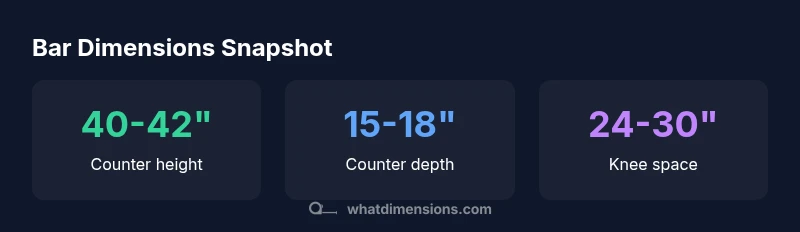
According to What Dimensions, diy bar dimensions balance comfort and practicality. Typical bar seating counter heights run around 40-42 inches, with a counter depth of 15-18 inches. Plan knee space of roughly 24-30 inches to keep legroom clear, and account for stool width and clearance under counters. Accurate measurements at the start prevent mismatches between stools, countertops, and appliances.
What 'diy bar dimensions' encompass and why they matter
In any home-bar project, starting with accurate measurements saves time, materials, and disappointment. The term diy bar dimensions covers counter height, counter depth, knee space, seating clearance, and the overall footprint. According to What Dimensions, the goal is to create a study-ready plan that aligns work surfaces with seating and workflow. When you size for real use, you consider both ergonomics and circulation: you want guests to pull up a stool without bumping into appliances, and you want to be able to reach bottles and glassware without leaning or straining. In this section we break down each element, explain why it matters, and show how to translate a sketch into a concrete plan you can build or order from a carpentry shop.
Standard dimensions you can rely on
The core of successful diy bar dimensions is to start with widely accepted ranges that fit most spaces and stools. A common bar-height setup uses a counter height of about 40-42 inches (102-107 cm) to accommodate standard bar stools. Counter depth often falls in the 15-18 inch range, balancing workspace with knee clearance and wall clearance. Knees and feet need room, so aim for under-counter knee space of 24-30 inches. If you’re planning a dining-style counter, a 36-inch height may be more comfortable for certain seating arrangements. Keep in mind these are guidelines; your room’s proportions and occupant comfort should drive final choices.
How to measure your space accurately
Measurement is the backbone of diy bar dimensions. Start by mapping the footprint you have: measure wall-to-wall length, doorway widths, and any fixed cabinets or appliances that could constrain seating. Next, determine seating width and depth: allow 20-22 inches per stool seat and add 2-3 inches for clearance behind each stool. Check clearance to adjacent doors, windows, or walkways—aim for at least 36 inches of walk space and 42 inches if the bar is a primary furniture grouping in a family space. Finally, draft a quick sketch with labeled measurements and convert it to a scale drawing for precision.
Layout options: linear, island, and L-shaped bars
DIY bar dimensions are not one-size-fits-all. A linear run against a wall works well in tight rooms and can include a back storage shelf. An island bar creates social openness and usually requires extra turning space around the counter. An L-shaped configuration suits larger rooms and can incorporate a seating overhang to expand the counter without expanding the footprint. Each layout has unique constraints: ensure electrical outlets, plumbing if needed, and support framing align with your chosen design. With sketches in hand, you can compare layouts quickly and select the most efficient option for your space.
Seating, clearance, and ergonomics: getting it right
Seat height should align with counter height; a 40-42 inch counter typically matches 28-30 inch stools. Allow 18-24 inches of knee space between the front edge of the counter and the back of the chair to prevent crowding. The gap for good leg movement under the counter matters as much as countertop width. Remember circulation: guests should move around without squeezing. For accessibility—particularly in kitchens or multi-use spaces—consider a lower counter option around 36 inches and a dedicated lower seating bar if needed. The key is to test with prototypes or cardboard cutouts before cutting any materials.
Step-by-step sizing calculation: a worked example
Suppose you have a 96-inch long wall and want a linear bar with a seating overhang and 2 stools. Start with counter height: choose 40-42 inches. Depth: 15-18 inches. If you’ll add a 6-inch overhang for knee room, your bar length remains 96 inches, but plan for support posts or brackets at 24-36 inches along the span. Subtract any built-in components, leaving room for 1-2 feet of open space behind the stools for comfortable movement. Finally, confirm access to outlets or lighting above the bar. Draft a final plan with these measurements, then build a mock-up with cardboard to test.
Small-space strategies and case studies
In compact rooms, every inch counts. A slim, 48-60 inch long bar with a 12-14 inch overhang can provide seating without crowding the kitchen path. For open-plan living, an island or peninsula with a 42-inch height can serve as a social hub while providing integrated storage. In larger rooms, consider an L-shaped counter that forms a natural interaction point between kitchen and living spaces. The What Dimensions team often notes that iteration matters most—test at scale, adjust the depth, and confirm comfortable reach to glassware and bottles across all seating positions.
Typical bar dimension ranges for home DIY projects
| Bar Dimension Element | Common Range (inches) | Notes |
|---|---|---|
| Counter height (bar top) | 40-42 inches | Optimal for seated guests |
| Counter depth | 15-18 inches | Space for bar appliances and knee room |
| Under-counter knee space | 24-30 inches | Minimum leg room for adults |
| Front edge overhang (optional) | 0-6 inches | Adds knee protection and comfort |
| Stool seat height | 28-30 inches | Matches counter height for ergonomic seating |
Quick Answers
What is the standard counter height for a home bar?
Most home bars use a counter height of about 40-42 inches to align with typical bar stools. For a dining-style counter, 36 inches can be more comfortable for some seating options. Always measure stool height to ensure a good match.
A good rule is to match stool height to the counter. Around 40-42 inches works for most home bars.
How deep should a diy bar counter be?
A typical depth is 15-18 inches, which balances workspace with knee room and appliance clearance. If you plan heavy prep or large glassware, consider up to 20 inches with solid support.
Most bars are 15 to 18 inches deep; customize if you need more workspace.
How much knee space is needed under a home bar?
Aim for 24-30 inches of knee space under the counter. This range supports comfortable leg movement for adults and reduces crowding when stools are present.
Plan for at least 24 inches of knee space for good comfort.
Can I add an overhang above the bar? How much is safe?
Yes, a 0-6 inch overhang is common to provide knee relief and extra surface. Ensure structural support and notches do not interfere with seating or plumbing.
A small overhang of up to 6 inches is usually fine with proper support.
Do I need a professional to measure or install?
You can handle measurement and basic assembly with careful planning. For structural framing, electrical, or plumbing work, consult a carpenter or licensed professional.
You can measure and plan yourself, but call in a pro for structural work.
“Well-planned bar dimensions reduce material waste and improve everyday usability. Precision in measurement pays off in comfort and functionality.”
Main Points
- Measure early, then test with a mock-up.
- Aim for 40-42 in counter height for seating comfort.
- Provide 24-30 in knee space under the bar.
- Account for 15-18 in bar depth to balance reach and storage.
- Choose a layout that fits your space and workflow.